Neighbor News
Falmouth HVDC Onshore Wind Cables / Converter Station 2024
6-acre high voltage direct current converter station on the sole source Cape Cod aquifer

Falmouth, Massachusetts, is a Cape Cod beach and boating vacation destination with various shopping centers and a population of nearly 35,000 swells to over 100,000 during the summer.
Access to Martha's Vineyard is through Falmouth to the Woods Hole Steamship Authority Transportation.
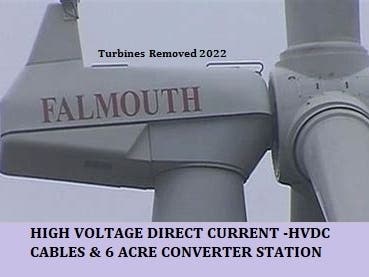
In 2010 and 2012 the town installed two industrial megawatt wind turbines to provide a lasting revenue stream. The installations resulted in eleven lawsuits and associated appeals over regulatory and infra-sound noise. The courts determined the turbines were a noise nuisance and were removed in 2022.
Find out what's happening in Falmouthfor free with the latest updates from Patch.
The wind turbine's health effects and financial loss including legal fees have never been calculated.
A proposal has been made to place HVDC, high voltage direct current buried cables rated at 345,000 volts under a beach and through residential neighborhoods. In addition one of the first in the USA 6 acre HVDC converter station on the sole source Cape Cod aquifer.
Find out what's happening in Falmouthfor free with the latest updates from Patch.
Note # Under Section 1424 (e) of the Safe Drinking Water Act the Administrator of the U.S. Environmental Protection Agency (EPA) has determined that the Cape Cod aquifer is the sole or principal source of drinking water for Cape Cod, Massachusetts, and that the Cape Cod aquifer, if contaminated, would create a significant hazard to public health.
Issues:
On June 8, 2022, a large Select Board Meeting was held over 90 percent were against the project.
The town has been in negotiations with offshore wind since 2019.
2 to 3 years of cable road construction with loss of business revenue, vacation rentals, etc.
FHA and VA loan requirements on residential homes setback from high voltage power lines.
Cable route under land or parks gifted to town for enjoyment of residential use only aka title restrictions.
Environmental Justice Population locations.
Massachusetts Article 97 establishes the right to a clean environment and aesthetic qualities for citizens.
Town Meeting vote for access to public property.
Town Wind Energy System Bylaw: – All equipment, machinery, and structures utilized in connection with the conversion of wind to electricity. This includes but is not limited to, transmission, storage equipment, substations, transformers, service and access roads, and one or more wind turbines.
Wind energy systems bylaw requires a Special Permit, abutter notifications, and hearings.
Town noise levels are set at 6 decibels which is 4 decibels lower than the state regulatory noise level.
Insurance or bonding on a high voltage direct current converter station on the Cape Cod aquifer.
Health, safety and peer-reviewed study of HVDC converter stations USA.
Legal implications of creating a municipal partnership with an offshore wind limited liability corporation.
An HVDC converter station generates radio frequencies and electromagnetic noise causing interference with communication and computer equipment.
The Falmouth town-owned wind turbine's noise was determined to be a nuisance by the courts.
Mitigation strategies;
a. high walls around the HVDC converter station
b. setbacks for radio frequencies.
c. light from converter stations at night.
d, concrete containment walls for equipment leaks, lightning strikes, etc
e. fire department training, and offsite location to shut the converter station.
Concerns for an HVDC converter station installation in the Bronx New York near a children's museum raise a public health threat from strong electromagnetic fields that have been associated with childhood leukemia.
A requirement for a buffer zone is 1/4 mile or 1320 feet.
Massachusetts MEPA and Cape Cod Commission review the Cape Cod Aquifer vs HVDC converter.
The EFSB, energy facility siting board decides the safest and best financial route for the cables aka land or ocean.
Options; Submarine cables to cities where power will be used.
Establish a planned ocean grid transmission system.