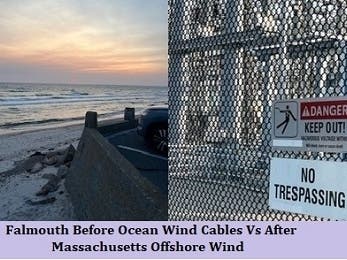
Falmouth is a famous vacation destination including boating and a large retirement community.
The community will be one of the first locations where an offshore wind company uses industrial high voltage direct current HVDC cable technology and a commercial six-acre converter power substation in the United States.
Offshore wind isn't the first time the community gambled on wind turbines. The town-owned wind turbines known as Wind 1 and Wind 2, were installed in 2010 and 2012, respectively, at the wastewater treatment facility on Blacksmith Shop Road to support renewable energy initiatives. Despite good intentions, once the turbines were operational neighbors filed lawsuits to shut them down due to noise and what they claimed were turbine-related health problems such as headaches, anxiety, and problems sleeping. The courts deemed the turbines a nuisance and were removed in 2022.
Find out what's happening in Falmouthfor free with the latest updates from Patch.
Massachusetts, in 2009 set a goal of developing 2,000 Megawatts of land-based wind power capacity by 2020. In order to achieve the 2020 renewable energy agenda the state politicians called for a real all-out war on fossil fuels.
Residents statewide living near the megawatt wind turbines had complained from the beginning about noise and the flicker of light and shadow when the sun is behind the turbine.
Falmouth is ground zero for poorly placed commercial megawatt wind turbines in the United States. The turbines deemed a nuisance by the courts were removed in 2022. Many other towns have curtailed the use of their turbines at night because of noise.
Find out what's happening in Falmouthfor free with the latest updates from Patch.
Massachusetts fourteen years after setting ambitious goals has less than 120 megawatts of wind power. This equates to less than one (1) percent of in-state electric production. The state turned the page on land-based wind turbines and looked towards offshore wind.
Massachusetts in 2016 signed into law an Act Relative to Energy Diversity which required issuing cost-effective bids for offshore wind up to 1600 megawatts by June of 2027. Several wind companies bid on the contracts and Massachusetts electricity distribution companies accepted the cost-saving contracts.
Several offshore wind companies want to back out of their contracts as of 2023.
Interest rates on projects have risen, and purchase prices have increased by double digits.
Maintenance and insurance questions remain on placing larger than 8-megawatt wind turbines in the ocean.
Multiple communities along the East Coast are against having 800-megawatt underground cables placed through residential neighborhoods. The Pilgrim nuclear plant on Cape Cod produced 680 megawatts and those cables did not go through residential locations.
Since 2016 when wind turbine construction started in Rhode Island whale deaths have increased near construction sites along the East Coast. This past week on the East Coast 4 whales died in 4 days including one on Martha's Vineyard.
Industrial wind now looks to be an expensive boondoggle and bunco scheme of enormous consequence. The people who value intellectual honesty should not quietly be fleeced by such mendacity, even from their government officials.
Rebidding Massachusetts offshore contracts are bad for ratepayers and ocean life.