Neighbor News
Falmouth Onshore Wind Cables Maybe Off Table
New Aerial 345,000 Volt Cables and Right of Way Required

Falmouth Cable Project Most Expensive In Massachusetts 500 Million Per Gigawatt
An offshore wind company introduced its plans to Falmouth in October 2019 almost 5 years ago.
The Massachusetts Energy Facility Board and Department of Public Utilities received a request to place the onshore cables, high voltage direct current converter, and a possible 400 or more megawatt battery backup.
The offshore company requested the state agencies to bypass many of Falmouth's safety and health zoning bylaws. Under Massachusetts Constitution Article 97 Falmouth Town Meeting which enacted the zoning regulations would have to approve the request.
Find out what's happening in Falmouthfor free with the latest updates from Patch.
Falmouth is a famous Cape Cod vacation destination with boating, beaches, and a large retirement community. Falmouth Heights Beach has ocean charm, family fun, and memories. The Crown Circle area of Falmouth Heights around 100 homes is in consideration as a historic district.
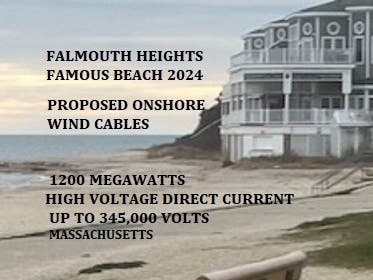
The Falmouth Heights – Maravista Beach and Neighborhood is the primary location for starting the 1200 megawatt up to 345,000-volt buried onshore project under the beach.
Find out what's happening in Falmouthfor free with the latest updates from Patch.
At a June 8, 2022, Select Board meeting attended by 200 residents, 90 percent spoke against the project.
In December 2022 the Select Board turned down a request to explore sites for possible electric cables.
At the April 2023 Town Meeting voters backed the Select Board denying testing access.
In September 2023 researchers studied Falmouth residents' attitudes to the offshore wind by sending multiple surveys by mail. Six months later the results remain unknown its known 90 percent were against the project in June of 2022.
Environmental issues: New "Right-of-Way" on Cape Cod
ISO New England the Grid operator has several studies called the Cape Cod Resource Integration Studies. Study scenarios shown on page 9 of 17 of the PDF reader additional on-shore AC 345 kV circuits would need to be in a separate right-of-way. This raises tree loss and environmental issues with miles of new right of way. The study on that page refers to placing a submarine cable in Boston to avoid adding AC 345 KV circuits.
See link: https://www.iso-ne.com/static-assets/documents/2022/09/a03_second_cape_cod_resource_integration_study_status_update.pdf
Most towns follow the Cape Cod Commission Model Bylaws and Regulations Model Land Clearing, Grading, and Protection of Specimen Trees Bylaw.
The National Renewable Energy Laboratory in March 2024 issued a study map that leaves out the Falmouth onshore cable see page 12 of 230 of the PDF reader and substitutes the submarine cables.
Then appendix E and F on PDF reader pages 184 to 196 shows Falmouth is the most expensive location in Massachusetts to place onshore wind turbine cables and the high voltage N-1 and N -1-1 faults within the Falmouth and Bourne Grid.
Note from the study below PDF reader page 186 Falmouth falls in the high category, representing more than 500 million per gigawatt aka the most expensive in Massachusetts.
"Note: Cost categories represent the $/megawatt cost of upgrading the system to deliver an injection at that node. It is a proxy for interconnection costs. Low represents values below $100 million per gigawatt, medium represents values through $500 million per gigawatt, and high represents values more than $500 million per gigawatt. Injections that are assumed for 2030 have N/A in this column because they are assumed to be built in the optimization."
See the NREL Link: https://www.nrel.gov/docs/fy24osti/88003.pdf
Historic note:
Massachusetts in 2005 had a land-based wind agenda of 2000 megawatts of power by the year 2020 an absolute disaster over two types of noise and shadow flicker with around only 100 megawatts today. The Town of Falmouth bought two individual megawatt turbines that the Massachusetts courts deemed a nuisance and removed in 2022.
The onshore cable project is doing the same thing over and over again and expecting different results.