Neighbor News
Falmouth Onshore Wind Cables Real Estate Study Warranted
Massachusetts Real Estate: Location Location Location

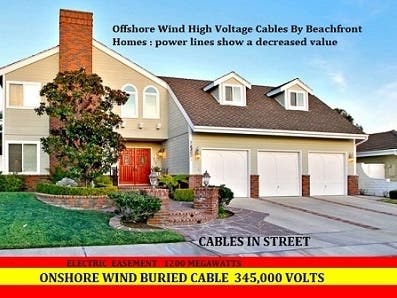
Consideration is being given to allowing placing industrial size onshore wind turbine high voltage direct current buried cables up to 1200 megawatts through residential zoned neighborhoods. The voltage is between 220,000 and 345,000 volts requiring abutter notifications and establishing an electric right of way.
An onshore cable project this large could be cost-prohibitive to business and residential property owners. A real estate study is warranted to prevent what happened to the residents living around the two town-owned wind turbines that were removed in 2022.
To put the cable and electric substation in perspective the Pilgrim nuclear plant's total output was 680 megawatts and this is 1200 megawatts.
Find out what's happening in Falmouthfor free with the latest updates from Patch.
The proposed buried high-voltage power line will create a right-of-way, ROW, in which adjacent homeowners should receive notice of the easements or abutter notifications.
Locations of easements for underground power are similar to overhead power lines in that those easements should be located along residential lot lines. If the property next to the easement is sold the easement remains.
Find out what's happening in Falmouthfor free with the latest updates from Patch.
The question for homeowners who purchased a property in a residential-zoned location is what effect will commercial buried underground power lines around twice the power output of a nuclear plant have on their property values? Will they receive tax abatements and or compensation who is their advocate?
Falmouth is a beach vacation, boating, and retirement destination with a summer population of 100,000. The town with a yearly operating budget of around 150 million has to determine the loss of private business for years of cable construction and devalued tax assessments on business and residential zones.
Environmental issues are much higher with underground cables as the ground is excavated 7 feet deep and 4 feet wide and splicing vaults at around every 3000 feet. The issue of Childhood Leukemia and the proposed high voltage direct current converter to alternating current station is an issue along with noise and radio frequencies. Is there a peer-reviewed health study of this type of onshore wind project in the United States and if not why not?
The HVDC, high voltage direct current converter station with required environmental containment walls is still a gamble on the Cape Cod aquifer which in case of a catastrophic accident could affect the drinking water and all the home values in Falmouth.
Studies show lots near elevated high voltage power lines sell for up to 44 percent less and within 1000 feet sell for less than 17 percent.
Placing buried onshore wind turbine high-voltage direct current cables through well-established residentially zoned neighborhoods with this high of voltage is new in the United States. Generally, high-voltage direct current cables operate through commercial zones, transportation, and electric rights of way or between countries.
The Federal Housing Authority and Veterans Administration have home loan restrictions on properties located near high-voltage lines.
Finally, there are alternatives to bypass the Falmouth cable which is ocean submarine cables to large cities that save both residential homeowners and ocean wind contractors.
----------------------------------------------------------------
NOTES
Massachusetts Residents Urge the Commonwealth to Build an Ocean Grid for Offshore Wind - 2023 https://anbaric.com/massachusetts-residents-urge-the-commonwealth-to-build-an-ocean-grid-for-offshore-wind
Note 1 The Town of Falmouth installed two commercial megawatt wind turbines in 2010 and 2012. The assistant town manager said: “We took on a huge risk and I think we were successful but we’re a large community and I think we can take on that risk. ” The town had been previously been warned by the manufacturer that each turbine generated 110 decibels of noise each a gamble that failed. https://www.wind-watch.org/news/2010/09/11/brewster-officials-take-a-wind-turbine-tour/
Note 2
By 2012 Falmouth wind turbine neighbors and families called on the Board of Health to shut down Falmouth’s wind turbines before any more harm was done.
https://www.wind-watch.org/news/2012/06/06/falmouth-board-of-health-hears-loud-and-clear-from-neighbors-but-holds-off-turning-off-the-wind-turbines/
Note 3
Millions were wasted in Falmouth litigation, engineering studies, and mitigation methods. By 2017 the Massachusetts Superior Court determined the wind turbines a nuisance. The divisive town-owned wind turbines were removed in 2022.
https://www.wind-watch.org/news/2017/11/23/judge-blocks-intervention-in-falmouth-turbine-case/
Note 4
Falmouth is considering allowing onshore wind turbine cables between 220,000 and 345,000 volts through residential zoned areas and a six-acre electric high voltage direct current converter station on the Cape Cod aquifer. Offshore wind construction since 2016 has created controversy over the increase in Whale deaths that have followed wind construction from Rhode Island to New York and New Jersey.
https://www.falmouthma.gov/DocumentCenter/View/12338/Mayflower-Forum---Mayflower-Pres-2-06082022
Note 5
A letter appeared in a Falmouth newspaper on February 16 called: "Some Health Skepticism" with the term: “Don’t Be Fooled Again ”
Public meetings should be held to discuss the project :