Neighbor News
Falmouth Torturous 110 Decibel Wind Turbines Politicians Knew
Court Records, Emails, Maps, Memos, Warning Letters Show Public Officials From State To Town Officials Knew Turbines Generate 110 decibels
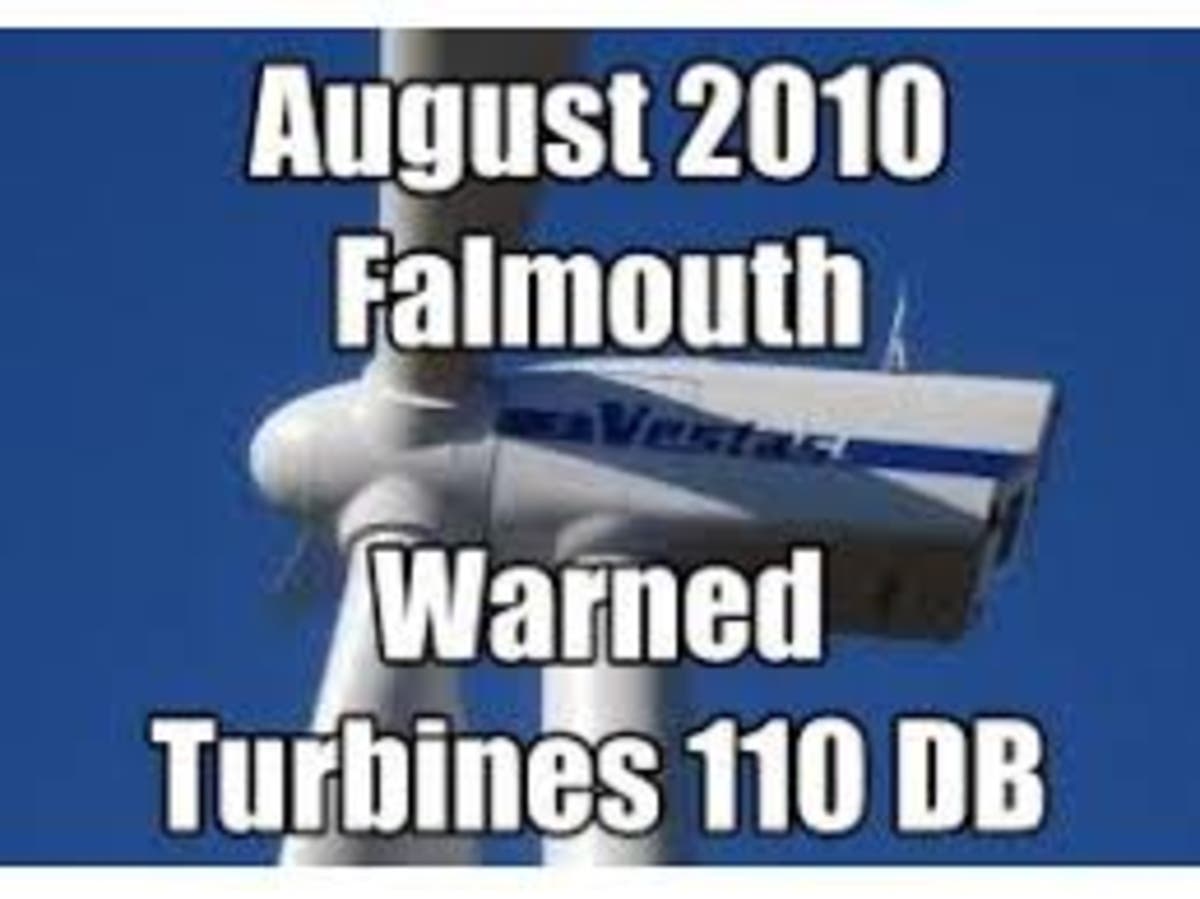
On the Decibel scale a 110 Decibel wind turbine is twice as loud as a 103.5 Decibel wind turbine. The six plus decibels doubles the sound of the turbine to the human ear. Every official involved in the installations of the Falmouth wind turbines knew they were taking the health and property rights of up to 200 residential home owners.
A. The Former Massachusetts Governor Deval Patrick administration in 2012 produced the "Wind Turbine Health Impact Study": "Report of Independent Expert Panel January 2012 Prepared for Massachusetts Department of Environmental Protection Massachusetts Department of Public Health."
The expert panel was: Jeffrey M. Ellenbogen, MD; MMSc- Sheryl Grace, PhD; MS- Wendy J Heiger-Bernays, PhD- James F. Manwell, PhD-Dora Anne Mills, MD, MPH, FAAP- Kimberly A. Sullivan, PhD- Marc G. Weisskopf, ScD Epidemiology; - Susan L. Santos, PhD, The panel used a standard General Electic commercial 1.5-megawatt wind turbine or comparable type turbines that generate 103.5 decibels of noise. The standard for the study was a 103.5-decibel turbine common in the wind industry.
Find out what's happening in Falmouthfor free with the latest updates from Patch.
1. The Massachusetts expert panel study under Noise and Vibration discuss infrasound at 110 decibels of noise. The report states that infrasound can be heard if at a very high level of 110 decibels. The report goes to state that the 110 decibels of noise can be felt ( chest pound) if at a very high level 110 dB
2. The Massachusetts expert panel while writing the wind turbine health impact study did not know the Town of Falmouth was hiding a wind turbine warning letter from the manufacturer Vestas dated August of 2010. The line in the Falmouth warning letter: "The Town has previously been provided with the Octave Band Data / Sound performance for the V82 turbine. This shows that the turbine normally operates at 103.2dB but the manufacturer has also stated that it may produce up to 110 dB under certain circumstances."( The Falmouth wind turbines generate 110 decibels of chest pounding noise)
Find out what's happening in Falmouthfor free with the latest updates from Patch.
3. The expert panel actually drove a nail into both of the Falmouth wind turbines as they both generate a chest pounding 110 decibels of noise
4. The expert panel documentation proves inappropriate levels of infrasound, regardless of the source at 110 decibels, cause adverse health impacts.
5. Some members of the expert panel said wind turbines can cause sleep disturbance
B. In 2005 Massachusetts Renewable Energy Trust's Community Wind Collaborative prepared a wind turbine study for the towns of Mattapoisett, Marion & Rochester. The study was prepared for the public by the Renewable Energy Research Laboratory at the University of Massachusetts. The report was produced at the request of the Massachusetts Technology Collaborative today known as the Massachusetts Clean Energy Center
1. The 2005 report under NOISE stated wind turbine noise take two forms, state regulatory compliance measured in decibels (dB)and nuisance levels at nearby residences.
2. The report goes further to describe the regulatory noise as noise that arises above 10 decibels above levels prior to the wind turbines found in the state regulations 310 CMR 7.10. 3. The second type of noise called the nuisance noise is described further as the Human annoyance. Today the nuisance noise or human annoyance is called low-frequency infrasound.
C. The question today is why did they warn Massachusetts residents about the two types of noise in 2005 but then dropped the warnings for the installations of Falmouth Wind I & II ?
1. The reference to nuisance and human annoyance (low-frequency infrasound )was in the 2005 study for the towns of Mattapoisett, Marion & Rochester because it had been known this since 1987 when Neil Kelley identified a direct link between impulsive infrasound and low-frequency noise, and adverse effects on people. The report was funded by the US Department of Energy & NASA.Boone, North Carolina known since the early 1980s that noise from large wind turbines can adversely affect human health.
In 1981, physicist Neil Kelley and colleagues reported their investigation of complaints from residents living within 1.5 miles of an experimental 2-megawatt wind turbine.
2. The reference to nuisance and human annoyance (low-frequency infrasound ) was dropped from the Falmouth wind studies because of complaints from towns across the state including Mattapoisett residents over the reference to human annoyance and residential setbacks.
Last
The Massachusetts Technology Collaborative today the Massachusetts Clean Energy Center was stuck with two Vestas V-82 type 1.65 megawatt wind turbines each generating a chest pounding 110 decibels of noise. They could sell the turbines at an auction no one bid on them.
The simple solution for the Massachusetts Technology Collaborative today the Massachusetts Clean Energy Center was simple drop the noise warnings for Falmouth and bribe local Falmouth town officials with one million dollars in advance. This ultimately led to the poor installations of commercial wind turbines is as many as twenty-one communities across Massachusetts.
The state at the time had an agenda of 2000 megawatts of wind turbine power by the year 2020. An agenda that has turned into a health and financial fiasco.
In Massachusetts today many suffer from chronic sleep deprivation, suffer sinus pressure, tinnitus, pains in the chest, headaches, nausea, and vertigo.
At a Falmouth Board of Health Department Meeting Minutes for 06-11-2012 shows 63 people/ respondents spoke. Of those 47 people reported health effects from the turbines. 41, or about 85% reported sleep disturbance, 25 reported stress, 21 reported mental health problems, 2 reported suicide attempt or ideation.
The noise is real 2 reported suicide attempt or ideation.
A Florida, Massachusetts resident committed suicide from the wind turbine noise.
His last words to friends; "I can't take it anymore, I don't know what to do, ... something must change".
Jack died alone on a cold winter night at one of his favorite places beneath those damn wind turbines.