Neighbor News
Falmouth Turbines Suffering Financial Losses Daily
Spelling Out Parasitic Power Loss To Dumbfounded Taxpayers
Up to $200,000.00 ( two hundred thousand ) a year ?
If that is not the amount then what is the cost of parasitic power going into the turbines everyday?
---------------------------------
Find out what's happening in Falmouthfor free with the latest updates from Patch.
# Note : The manufacturers of large turbines -- for example, Vestas, GE, and NEG Micon (NEG Micon purchased by Vestas 2004) -- do not include parasitic electricity consumption in the specifications they provide as it depends on the shut down time not the operation time.
----------------------------------
Find out what's happening in Falmouthfor free with the latest updates from Patch.
The Town of Falmouth owns two Vestas V-82 type 1.65 megawatt wind turbines located at the Wastewater Treatment Plant.
The annual revenue from the operation of both wind turbines prior to 2013 is estimated at $975,000.00 or around one million so it's easy to figure parasitic electric power usage loss.
The turbines were installed with no permits in 2010 and 2012. By 2013 the courts ordered the town to operate its wind turbines at the Wastewater Treatment Facility for 12 hours per day six days a week and none on Sundays. The annual revenue by 2013 dropped to around $500,000.00 or half a million.
Wind 1, the first turbine was shut down in September 2015 after the Falmouth Zoning Board of Appeals issued a cease-and-desist order. The annual revenue dropped to $250,000.00 or around one-quarter of a million.
Wind 1 and Wind 2 in June of 2017 were both shut down by the courts as they were deemed a nuisance.The town after paying outside legal firms hundreds of thousands of dollars for seven years defending the 110 decibel turbines got nothing. . Since 2017 there is no annual revenue but the town continues paying a contract engineering firm, a maintenance contract on both turbines, insurance, and a 5 million dollar American Recovery and Reinvestment Act loan on the second turbine. These fees are not included in the parasitic power costs.
These facts you have to agree with show reasons why this approach to the commercial wind in Falmouth was and still is a losing proposition.
The average taxpayer has no idea it's far worse than they have been made aware.
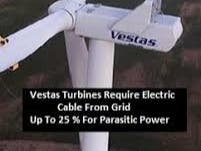
Large commercial megawatt wind turbines when they don't spin need a large amount of electricity from the local power company. The Falmouth wind turbines receive their power from the Wastewater Treatment Plant who in turn gets its power from the local power company. The Wastewater Treatment Plant does not account for the electricity going into the turbines but ultimately the taxpayers are paying the bills.
Both the wind turbines when not spinning can use up to twenty percent of the total output just to maintain themselves as they no longer produce electricity. Originally the turbines had an annual revenue of around a million dollars so its easy to figure the twenty percent parasitic loss in dollars is up to $ 200,000.00 a year.
The turbines are going into their fourth year with the power still pouring into the turbines.
In order to maintain the turbines for future use or sale here are the following parts that need power in the turbine
1, yaw mechanism (to keep the blade assembly perpendicular to the wind
2. lights, controllers, communication, sensors, metering, data collection, etc.
3. heating the blades -- this may require 10%-20% of the turbine's nominal (rated) power
4. heating and dehumidifying the nacelle -- according to Danish manufacturer Vestas, "power consumption for heating and dehumidification of the nacelle must be expected during periods with increased humidity, low temperatures, and low wind speeds"
5. oil heater, pump, cooler, and filtering system in gearbox
6. hydraulic brake (to lock the blades in very high wind)
7. thyristors (to graduate the connection and disconnection between generator and grid) -- 1%-2% of the energy passing through is lost
8. magnetizing the stator -- the induction generators used in most large grid-connected turbines require a "large" amount of continuous electricity from the grid to actively power the magnetic coils around the asynchronous "cage rotor" that encloses the generator shaft. The stator may use power equal to 10% of the turbine's rated capacity.,
9. It could be that at harsh times each turbine consumes more than 50% of its rated capacity in its own operation! The wind industry doesn't publicize any data that proves otherwise; incoming power is apparently not normally recorded. No one knows how much exactly is going into the Falmouth turbines but twenty percent or $200,000.00 a year is close.
Taxpayers only need to ask how much power was going into the Wastewater Treatment Plant in 2009 and after the wind turbine shutdowns how much went in during 2018 and 2019.
To make matters even worse reports show as the Vestas V-82 type 1.65 megawatt wind turbine ages it loses up to 2 percent of its production each year as the blades wear out.
Falmouth Town Meeting in November 2019 voted 2.5 million to take down and store these turbines designed in the 1990s and assembled around 2004.
Both Falmouth wind turbines have their original blades and antique gearbox.
Does Falmouth have a fiscal cliff ?