Neighbor News
Massachusetts 50 Years Of Wind Turbine Failures
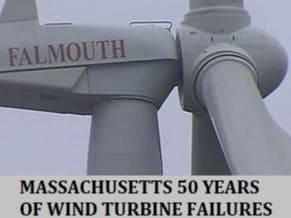
Falmouth Town Owned Wind Turbines Removed in 2022

Massachusetts since the 1970s wanted wind energy to play a significant role in its clean energy future, both offshore and land-based.
In the 1970s Cuttyhunk Island in the town of Gosnold, Massachusetts had one of the world's largest wind turbines. The wind turbine was taken down due to radio interference in line-of-sight communications with the island. It failed.
In the 1980s NASA and the US Department of Energy conducted wind turbine experiments around the country. Research supported by the US Department of Energy in 1987 identified impulsive low-frequency noise. The annoyance was described as an intermittent "thumping" sound accompanied by vibrations in residential homes. They failed.
Find out what's happening in Falmouthfor free with the latest updates from Patch.
In 2005 Massachusetts set a goal of installing 2,000 megawatts of land-based wind energy before 2020 as part of its plan to increase the supply of renewable energy and reduce greenhouse gas emissions. A failure.
The Massachusetts Attorney General 2007 filed suit against a former Massachusetts state representative from East Freetown over the poor installation of residential wind turbines. The suit more or less ended residential wind installations. A failure.
Find out what's happening in Falmouthfor free with the latest updates from Patch.
Falmouth Massachusetts in 2010 and 2012 installed two town-owned commercial megawatt wind turbines. The turbines created noise, and shadow flicker, along with maintenance issues were removed in 2022. The Massachusetts goal of 2000 megawatts of wind power fell far short with today only around 100 megawatts of land-based wind. A failure.
Massachusetts despite the past history of land-based wind turbine failures has a new goal to reach 5,600 megawatts of ocean wind power by 2027 ?????
The Massachusetts Ocean wind goals are already falling far behind. Another failure.
In 2016 Massachusetts started six years of ocean wind legislation and additional legislation for long-term contracts for offshore wind energy pursuant to section 83C. A failure.
Multiple offshore wind companies have backed out of signed contracts in 2022 aligned with the past six years of state legislation. A failure.
There are multiple issues:
NOAA Fisheries in 2016 declared an Unusual Mortality Event for humpback whale strandings along the Atlantic coast. The whale deaths have followed wind turbine construction starting in 2016 at Block Island, Rhode Island, and recently in New Jersey and New York. Whale deaths have now increased in Massachusetts with the start of offshore wind construction. The NOAA event warning is still in effect.
Residential homeowners do not want offshore wind cables with three times the output of the Pilgrim nuclear power plant buried outside the streets in their neighborhoods.
Interest rates have increased the cost of offshore wind construction by as much as 30 percent.
The offshore wind turbines are ten times the size of the land-based wind turbines at almost 1000 feet.
Massachusetts politicians refer to ocean wind turbines as steel in the water because of the base of the turbines. In salt water corrosion starts with steel within a few months.
A major wind construction manufacturer recently stopped building its 8-megawatt ocean wind turbines due to major component failures within two years of construction. The Massachusetts untested wind turbines are over 10 megawatts and 1000 feet tall.
Massachusetts gets both nor'easters and blizzards and rare direct hits from hurricanes which even a brush can be very dangerous. The wind speeds at 1000 feet on the ocean are much greater than on land.
The issue now is who provides insurance for an ocean wind turbine longer than a two-year manufacturer warranty.
Massachusetts is taking a hugely expensive gamble on the offshore wind that could turn electric bills as high as a second mortgage on homes and businesses.
The future alternative shows that small fusion plants can be a very safe and sustainable energy source. A four-acre plant could power Cape Cod.