Neighbor News
Offshore Boston Wind Submarine Cable Avoids Falmouth
Inflation Reduction Act provides 369 billion towards "enhanced planned off-shore transmission grid." (369 that is "B" Billion)

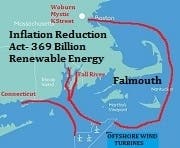
For two years offshore ocean wind contractors proposed onshore cable routes through Falmouth, Massachusetts to get power to Boston via land routes. There are up to seven offshore companies looking at the same route for the easiest and most inexpensive solution to get their power to the Massachusetts market.
The future plan is to send 3600 megawatts or about five times the output of the Pilgrim nuclear plant over a land route to high use energy locations over the bridge north of Cape Cod. Estimates are as high as costing electric ratepayers as much as 1.7 billion dollars to upgrade the existing land power grid.
Some of the power routes require buried cables through residential locations in Falmouth. At a June 8th Falmouth public forum it showed overwhelming opposition to the buried cables.
Find out what's happening in Falmouthfor free with the latest updates from Patch.
The best and easiest solution to advance clean energy in Massachusetts is an ocean wind submarine power cable directly to Boston out around Cape Cod from offshore wind sites.
The offshore wind electric transmission dilemma is two fold. By upgrading and using land routes to get to Boston the Massachusetts electric rate payers finance the project through their electric bills. By providing a submarine cable to Boston offshore wind contractors get a very expensive bill as XLPE submarine cable costs are prohibitive.
Find out what's happening in Falmouthfor free with the latest updates from Patch.
The solution to provide the offshore submarine cable to Boston and additional locations is the Inflation Reduction Act. The IRA could provide an "enhanced planned off-shore transmission grid" that can significantly reduce the necessary onshore upgrades.
The Inflation Reduction Act was signed into law on August 16, 2022, will significantly impact clean energy by providing 369 billion for energy and climate change programs. The Act directs around $369 billion toward energy and climate spending, including wind and clean energy storage.
The act makes it simple to cash in renewable energy credits permitting direct pay for tax exempt groups and allows taxpayers to sell credits to unrelated parties.
Out of 369 billion voted by Congress it makes sense to create a planned off-shore submarine cable grid to advance clean energy for the foreseeable future.
Do it once and do it right.