Neighbor News
Offshore Wind Demands State Bypass Falmouth Safety Bylaws
Host Community Agreement Limits Liability

The Offshore wind company associated with Falmouth has requested in their petition pursuant to G.L. c. 40A, § 3 (“Zoning Petition”), that the Massachusetts Department of Public Utilities and Massachusetts Energy Facility Siting Board grant specific and comprehensive zoning exemptions from the operation of the Zoning Bylaw of the Town of Falmouth.
Falmouth health and safety bylaws have been enacted by Town Meetings and approved by Massachusetts Attorney General. In particular, is wind energy turbine bylaws 240-166.
Offshore wind is also asking the town to partner with them through an HCA, "Host Community Agreement." Generally, the agreement allows the wind company to pay the town for example in other towns 20 million over 20 years with a small stipend every year. In general, the HCA partnership absolves the wind company of any future liability of the project.
Find out what's happening in Falmouthfor free with the latest updates from Patch.
Falmouth has a yearly budget of around 150 million dollars which increases every year up to 2.5 percent.
The money from the wind company HCA is around 1 million a year for 20 years which is less than one percent of the yearly budget.
Find out what's happening in Falmouthfor free with the latest updates from Patch.
The question for Town Meeting and the community is why do you live in Falmouth a residential vacation destination and boating community with many small businesses?
The project consists of placing high-voltage electric cables between 400 to 1200 megawatts under parks, recreation areas, and streets. The construction could take up to three years.
Also of note, there are alternatives to placing the cables through Falmouth and that is to run ocean submarine cables to the large cities. Running the cables through Falmouth is simply economics for offshore wind it's cheaper.
The project also requires a six-acre high-voltage direct current substation. The station requires high volumes of water or some other means of chemical cooling. State and federal politicians will assure you that containment measures will prevent any problems with the electric substation. If you ask an engineer they will tell you everything leaks. Tires leak, hoses leak, roofs leak and power plants leak.
Falmouth can deliver 8 million gallons of water a day when combined with the town's wells to meet the summer demand. This raises the question of the placement of a six-acre HVDC electric substation near water resources.
The Town of Falmouth had been warned prior to the installation of the town wind turbines that both turbines normally operate at 103.2 decibels of noise but the manufacturer had also stated in a letter "undisclosed" to the public that it could reach 110 decibels which noise is equal to a hard rock band 24/7.
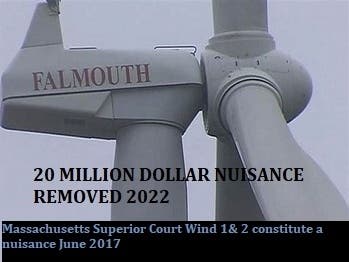
The town gambled and placed the wind turbines which were deemed a nuisance by the courts and removed in 2022. (Loss estimated near 20 million and still paying loans.)
Now with this offshore wind project "Fool me once, shame on you. Fool me twice, shame on me."
Negotiations have been ongoing for three years since March 2020. There has only been one public meeting on June 8th, 2022.