Neighbor News
Planned Offshore Cables Could Bypass Falmouth
Gov Healey 250 Million For Grid Solutions

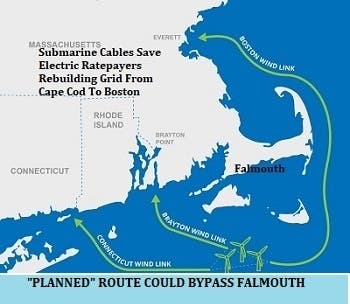
Five New England states as of October 2022 replied to a request for information for a modular offshore wind plan. The plan calls for all high-voltage direct current cables. Two studies by the Brattle Group for Anbaric ( an independent transmission developer) are under consideration for a "planned" offshore grid.
The states of Massachusetts, Maine, Connecticut, and Rhode Island want to work together with the federal government to establish an offshore wind grid. One of the goals is to move construction away from residential communities.
The "planned project" uses several ocean submarine cables directly to the power usage locations like Boston. The submarine cables save wind companies from running twice as much cable through multiple residential communities.
Find out what's happening in Falmouthfor free with the latest updates from Patch.
The submarine cables also save time, resources and in rebuilding the electric grid. For example in the Town of Falmouth, the grid needs to be rebuilt and planned by ISO New England which could take years.
The Town of Portsmouth, Rhode Island residents have been holding rallies against the onshore cables. Portsmouth was the choice after the Falmouth electric grid lacked capacity. Portsmouth is having a workshop on onshore cables on May 25 at 7 PM at the Portsmouth RI high school.
Find out what's happening in Falmouthfor free with the latest updates from Patch.
All along the east coast, many residential communities are in rancorous battles over placing high-voltage cables through their streets with construction taking up to three years. The offshore cables at 800 megawatts each placed in residential streets and neighborhoods are more powerful than the old 680-megawatt Pilgrim nuclear plant.
Currently, each offshore wind developer is running cable Willy-Nilly to the closest grid location on Cape Cod without looking to future projects. The offshore projects are looking a lot like the failed poorly planned land-based wind projects all over Massachusetts. The state land-based agenda was 2000 megawatts and only achieved around 100 megawatts as the turbines were placed too close to residential communities.
Governor Maura Healey has created two new groups to advance offshore wind the Commission on Clean Energy Infrastructure Siting and Permitting (CEISP) and the Interagency Offshore Wind Council (IOWC).
Governor Healey has also applied for 250 million matching funds for federal transmission funding. The funds are made available by the Infrastructure Investment and Jobs Act.
The current signed offshore wind contract approved last year by Mass DPU was the 2016 "An Act Relative to Energy Diversity" which promised clean and reduced-cost electricity. These contracts may well be rebid in June at a higher rate.
If the current offshore wind contracts approved by the Massachusetts Department of Public Utilities in 2022 are allowed to be rebid both residential and commercial electric rates will increase.
Ratepayers will bear the brunt of increases unless there is a planned ocean wind grid.