Politics & Government
Framingham CPA Ballot Question: Pro Vs. Con
Framingham voters will decide in November whether to adopt the Community Preservation Act. Here are the arguments for and against it.


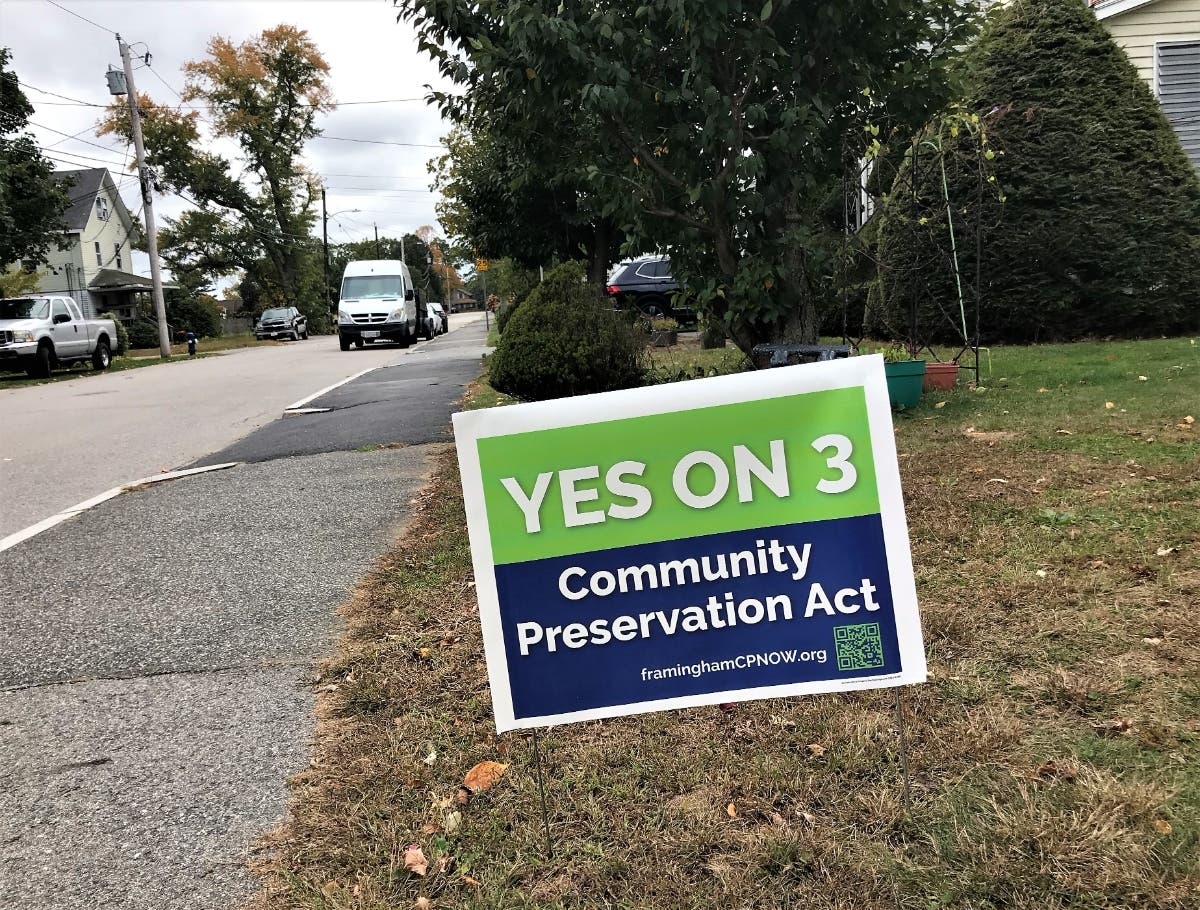
FRAMINGHAM, MA — There's an item on the November ballot that could change the Framingham landscape forever — and it has nothing to do with candidates running for elected office.
Voters will be asked to approve ballot question No. 3, which would allow Framingham to adopt the Community Preservation Act (CPA). The CPA would give Framingham a new revenue source to pay for perennially-underfunded items like buying open space, refurbishing or building affordable housing and historic preservation.
But it comes with a cost. The new revenue stream will largely come from a 1 percent surcharge on property tax bills in Framingham. Adopting the CPA will also allow Framingham to draw on a pot of state money each year. Some communities have seen years when the state matched 100 percent of the CPA surcharge, although local proponents are predicting it could be about 20 percent per year on average.
Find out what's happening in Framinghamfor free with the latest updates from Patch.
Framingham tried to adopt the CPA in 2001, one year after the law passed in the Legislature and was signed by then-governor Paul Cellucci. That measure failed with 70 percent voting against it.
There is opposition to CPA adoption in 2020, but also strong mainstream support.
Find out what's happening in Framinghamfor free with the latest updates from Patch.
The pro-CPA side has the backing of the entire City Council and state Reps. Maria Robinson, Jack Lewis and Carmine Gentile. Pro-CPA signs can be seen on lawns across the city. And after 20 years, CPA has become popular — half of the state's 351 communities have adopted it, including nearby towns like Ashland, Sudbury and Southborough.
Framingham started down the adoption road last October when the City Council set up a CPA study committee. In June, the group presented its recommendation to put the measure on the ballot. The City Council unanimously OK'd the ballot measure in July.
Now the question goes to voters. To explore the CPA issue, we spoke to the pro and con sides, and to a member of Waltham CPA committee to get an idea of how that city has used the funding.
Opposition to Question 3
Bill Lynch — who ran for the District 7 Council seat in 2019 — took on the task of opposing the CPA ballot question this year because no one else was. He hasn't formed a political committee, but he has purchased some opposition yard signs. He mainly reaches people on Facebook.
Lynch mounted the effort after he started seeing pro-CPA advertisements over the summer, and realized no one was asking question about the initiative.
"I found a lot of unknowns in it," he said, noting that he thinks the idea of the CPA is "great."
The surcharge troubles Lynch, in particular that commercial property owners might pass on the cost to tenants. He also doesn't like that we don't know who will sit on the CPA committee, the board that would oversee the CPA funds. Lynch also wants more specifics on projects the surcharge would pay for.
But Lynch's latter two concerns — the CPA committee and the specific projects — wouldn't be cleared up until after the election, anyway.
If the CPA is adopted, the City Council will pass an ordinance to create a CPA oversight committee. There will be one member each from the Conservation Commission, Historical Commission, Planning Board, Parks and Recreation Commission. The CPA law also allows the mayor to pick up to four citizens to join. The public will be able to participate in the ordinance process as usual.
Residents would begin paying the surcharge on July 1, 2021. At that point, the CPA committee would begin taking suggestions from the community for projects. The first projects wouldn't be announced until spring 2022.
The cost of the 1 percent surcharge in Framingham will certainly be higher with valuable properties. But the CPA study committee has estimated that almost 70 percent of residential property owners will pay less than $50 per year. The first $100,000 of assessed value is exempt from the surcharge, and some property owners — seniors, low-income households — may be exempt entirely.
Here's how the charge would look for a Framingham home with a $400,000 assessed value. The owner would subtract $100,000 for a new value of $300,000. With the 2020 residential tax rate of $14.98 per $1,000 of assessed value, the tax bill would be $4,494. One percent of that is $44.94. Because Framingham uses a split tax rate that's higher for commercial and industrial properties, those owners would pay more based on property value.
There's also been questions about whether Framingham would raise the surcharge at some point. The CPA law allows communities to go as high as 3 percent. A hike would need voter approval, and only seven out of 177 CPA communities in 20 years have succeeded in passing a surcharge increase, according to the Community Preservation Coalition.
Lynch says he's talked to several business owners who hadn't heard about the CPA push, which he found troubling.
"I just want people to know the idea behind it is great, but the timing and the process isn't ready to go yet," he said.
Support for Question 3
Steven Weisman's pitch for why voters should adopt the CPA is pretty short: it pays for important projects without taking money from the city.
The CPA is a new revenue stream, and the money is restricted, he says. The City Council can't take from the CPA to plug a hole in the budget. That means projects can be completed even in lean times, like recently with coronavirus.
"It puts a relatively small amount of money in a restricted pool and says these funds can only be used for these purposes, and the city needs to go through a process to decide which are the priorities," Weisman says. "Really, it's the only part of what could be described as our tax bill where we know where the money is going."
The cost is also relatively low for the benefit, he says. The CPA study committee (Weisman was a member) estimates Framingham will collect $1.5 million in the first year. The state chips in varying amounts each year from the Community Preservation Trust Fund. For example, communities shared more than $35 million from the trust fund in 2019-20 compared to $16.2 million in 2018-19. Framingham could get an estimated $300,000 in matching funds in the first year.
Framingham can also borrow against the CPA fund. So the $1.5 million or more per year could be leveraged over a longer period for a bigger project. Some projects that have been suggested: buying the MCI-Framingham property should the state decide to abandon it; building a dog park; and expanding multi-use trails, like the planned Bruce Freeman Rail Trail leg.
Weisman said the group targeted the 2020 November election due to an expected high turnout, which may mean a better chance the ballot question will pass, he said.
"I think this is a really good thing for Framingham," he said. "Frankly, it's about time."
How CPA has worked in Waltham
Waltham, a city with about the same population as Framingham, adopted the CPA in 2005 with a 2 percent surcharge. Justin Barrett has served on the city's Community Preservation Board since then.
Barrett rattles off a list of projects Waltham has completed with CPA funds in about 15 years: replacing windows at a local soup kitchen; renovations at the Robert Treat Paine estate; expanding the Beaver Brook reservation; and making upgrades in public housing units.
There was opposition to adoption in 2005 because of the surcharge (it passed with just over 50 percent in favor). But that concern has largely faded as the CPA has become a part of city government. The biggest pitfall Waltham has found, he said, is the restrictions on how the money can be used.
The city's CPA board acts as a filter for the City Council, he said. Waltham has hired an administrator to oversee the program, but that's the only extra expense the city has seen.
Barrett stopped short of urging Framingham residents to vote for adoption, instead advising voters to see how other communities have used CPA. But the revenue stream has definitely allowed Waltham to do more, he said.
"You're getting a return on your dollar," he said.
Framingham Patch is sponsoring a community discussion on Question 3 on Oct. 21 at 7 p.m. featuring Groton Community Preservation Committee member Bruce Easom. There will be a half-hour presentation followed by a Q&A session.
The meeting is being facilitated by the Framingham Public Library. To RSVP, email CPAinfoframingham@gmail.com.
Get more local news delivered straight to your inbox. Sign up for free Patch newsletters and alerts.