Politics & Government
Framingham: A Tale of Two Cities
Framingham city government is at odds with the city community on finance, infrastructure, education and environment. A new era beckons.

"It was the best of times, it was the worst of times, it was the age of wisdom, it was the age of foolishness, it was the epoch of belief, it was the epoch of incredulity, it was the season of Light, it was the season of Darkness, it was the spring of hope, it was the winter of despair, we had everything before us, we had nothing before us …”
from ‘A Tale of Two Cities’ by Charles Dickens.
Remarkable as it may seem, this quote provides an accurate description of the two cities which Framingham has become.
Find out what's happening in Framinghamfor free with the latest updates from Patch.
We have a city government which constantly fails in vision and action in finance, infrastructure, education, and the environment. It has no strategy, no planning, no meaningful debate. It violates its charter, implements tax breaks which shift wealth to the affluent, deliberately underfunds maintenance on its infrastructure, repeatedly attacks a well-run innovative public school district, and is indifferent to the need for climate change action and the savings that can bring to the city treasury.
We have a community which has been asked four times to support property tax increases for the betterment of Framingham and four times, with an increasingly clear margin, it has voted YES. An operating override for $4.3 million/year in 1991. An operating override for $7.2 million/year in 2002. A debt exclusion in 2018 for $3.3 million/year to fund the new Fuller Middle school, with a resounding 86% YES vote. Adoption of the Community Preservation Act in 2020, with an impressive 65% YES vote in pandemic times.
Find out what's happening in Framinghamfor free with the latest updates from Patch.
This is a community which, Moody’s Investor Service notes, has: ‘Above average resident income and wealth’. This community knows the value of investments to solve problems and save money in the long run. It is a community which manages its finances well, keeps its homes in good repair, knows the importance of a good education to secure its children’s future and is engaged heavily in climate change action, with more than a thousand solar roofs installed on homes, and a growing community-based effort to boost curbside composting to reduce methane emissions. Those climate change efforts also reap very large savings in homeowner utility bills and lower city trash stream costs. The community knows these are win-win efforts for the future of the planet, their financial position and the city’s financial position.
What a contrast to the city government!
That city government performance makes one feel it is the ‘worst of times’. Terrible performance. A threat to us all. A grim future.
The city community is inspiring and makes one feel it is the ‘best of times’. Hope, talent, a rising future.
This contrast must be especially vexing for Senator Karen Spilka and Congress woman Katherine Clark, who have achieved positions of significant power, respectively, as State Senate President and Democratic Whip of the U.S. House of Representatives. They cannot avoid seeing their city bereft of municipal solar installations, strapped financially, roads filling with potholes, school roofs leaking, and the rapidly rising Hispanic/Latino student population so neglected.
Especially, they must be vexed about the lack of climate change action.
Both federal and state governments have over the last decade invested very large amounts of money in incentives to spur climate change action. In the area of solar installations, all of that was ignored by the town government from 2014-2018 and by the city government from 2018-2023, with the exceptions of the McAuliffe library solar roof, the Fuller solar roof and the Brophy and Farley solar canopies. And still Fuller and Farley are not operational!
Framingham has 15 school roofs, 15 school parking lots and multiple other city buildings and parking lots which could be covered in solar panels. We are surrounded by communities who have gone full bore on solar and are reaping utility savings of up to a million dollars/year or more. We had Ameresco, a local Framingham company, who could have helped us. They installed solar roof and canopies in communities all around us. But not us. We did the four installations with Solect, but that has now fizzled. We have Farley Elementary School getting a new roof this summer, with absolutely no plan to add solar panels.
What planet is the City Council living on? It is an appalling disgrace.
The whole city solar installation build out has stalled. Dead in the water.
Further, we have 300 or more local community heroes who are trying to get curbside composting fully launched, but the Mayor remains indifferent. See:
https://patch.com/massachusetts/framingham/framingham-mayor-polite-non-commital-curbside-composting
We also had a bunch of Framingham High School students who launched a tree planting effort to combat climate change with the Tree-Plenish program, but the Mayor and City Council remain indifferent to the fact that a tree planting program could bring environmental justice to the southside and reduce its summer temperature by 10 degrees.
The city is fortunate to have Shawn Luz as its Sustainability Coordinator, but he is like the Lone Ranger trying to bring environmental action and serious savings to Framingham, while an indifferent city government looks on and the community tears its hair out with frustration.
The nightmare in all of this is that the lack of city government engagement with environmental actions is just one of four major failure areas. The fundamental, really big problem the city has centers on finance.
As they say in the movies, follow the money.
When the immigrant, non-English speaking student population in the Town of Framingham began to rise a decade ago, state Chapter 70 education aid started flowing more freely into the town. The financial wizards in town meeting and the Board of Selectmen, in concert with the town CFO, saw this not as opportunity to invest in our students, but as an opportunity to grab some of that money to lower general operating costs of the town and support property tax breaks.
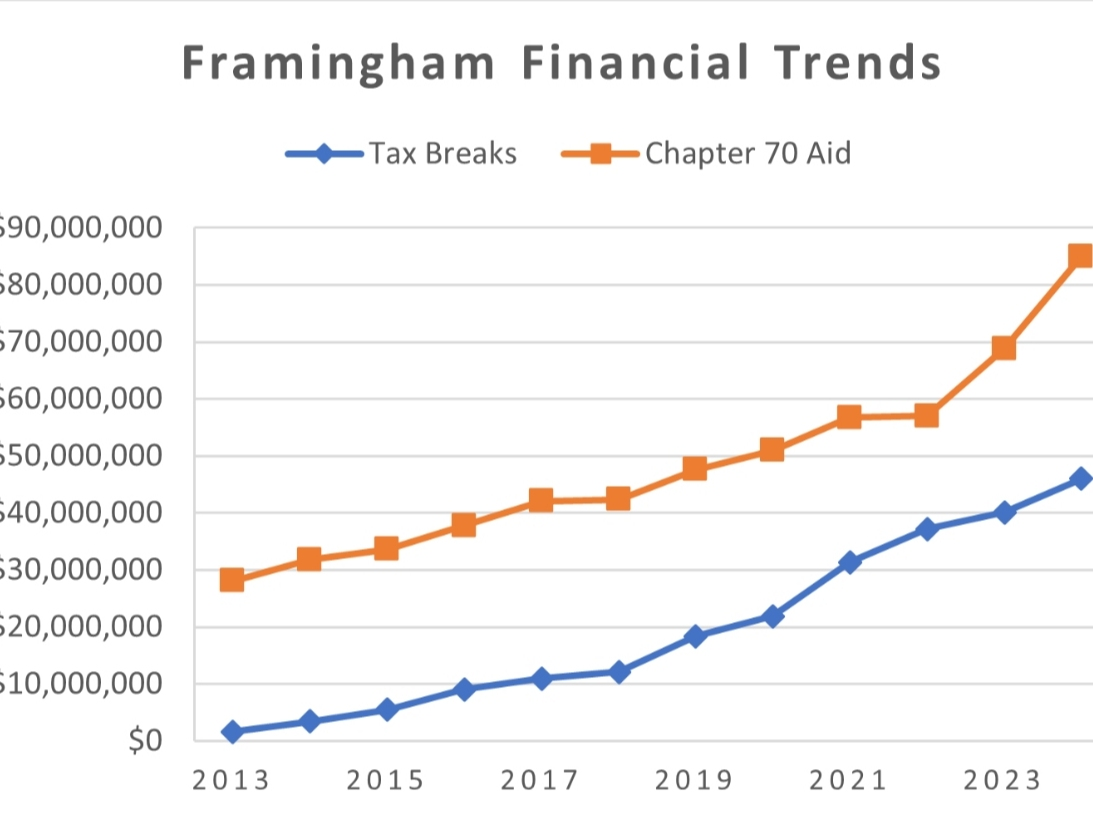
The chart above shows how total annual property tax breaks across Framingham rose as the Chapter 70 money flowed into the town and then city. Note that the tax breaks are lost revenue, so for example, by 2023 the city had lost $40 million/year from its revenue stream due to tax breaks.
Notice that the more Chapter 70 money Framingham got, the bigger the tax breaks became.
George King and others were central to this effort, as their DNA equates rising state revenue (Chapter 70) with automatic lowering of property tax levy increases, i.e., tax breaks. The fly in the ointment for King et al back when Framingham was a town, and they were town meeting members, was that although the Board of Selectmen was brow beaten into lowering the tax levy increases, town meeting had a full complement of parents and grandparents who made sure that the school district budget was properly funded and that all the Chapter 70 incoming aid ended up boosting student performance.
The net result of that was that the full impact of the lowered tax levy increases was delivered to town side operations, squeezing the Department of Public Works (DPW) budget, so vital maintenance for roads, buildings and the water & sewer system was deferred, and DPW staff vacancies began to build.
By the time Framingham switched from a town to a city, the water & sewer system maintenance backlog was north of $200 million, the roads maintenance backlog was around $60 million, and the school roofs replacement backlog was $60 million.
Then things got worse.
With the change to city government, financial decision-making power was wrested from the 212-member town meeting and concentrated in an 11-member City Council, with George King as chair of the Finance Subcommittee, controlling all financial decisions. With parent power destroyed, George et al squeezed the property tax levy increase to 0% for 4 years and throttled back increases in the city contribution to the school district budget.
The new inexperienced Mayor never had a chance to get off the ground, with her financial means to run the city choked off. The School Committee, however, had been revolutionized with the change to district-voted members and 6 new members took charge, with just 3 members of the prior School Committee surviving. The entire Framingham Public School (FPS) finance operation was rebuilt from top to bottom, with a strong collaboration with a remarkably capable Superintendent, Bob Tremblay, and the newly hired, consummate professional, Executive Director of Finance & Operations, Lincoln Lynch. With a remade, zero-based school district budget process and a budget book of more than 200 pages, jam packed with cogent information, the school district wielded enough clout to beat back the attempts by the city to choke off the money supply to the schools. For the first 4 city years, the FPS budget still delivered all of the Chapter 70 state aide for education to its students, navigating the pandemic, with a 100% turn-on-a-dime switch to fully digitally enabled education, and facility environmental upgrades to combat virus spread.
That success in defending the school district budget meant that yet again the cityside operations took the full hit from the tax breaks choking off city revenue
The Mayor struggled to contain water & sewer rate increases, but with much less property tax revenue, the water & sewer Enterprise Fund drained, cash reserves plummeted, and the maintenance backlogs got worse. The roads maintenance backlog reached $100 million. The school roof replacement backlog reached $100 million, and the water & sewer maintenance backlog did not improve, although its exact state seems to be a classified city government secret.
Then things got worse.
With the change of Mayor in 2022, hopes were high. The first year, Mayor Sisitsky, with a new competent CFO, tried to raise the tax levy by 2.5%. George King, Mike Cannon, and John Stefanini combined forces to cut that to 2.0%. More tax breaks. The following year, they combined again to cut the Mayor’s 2% increase down to 1%. The tax cutting machine was back. More tax breaks.
The net result of all of this is that while $200 million in property tax breaks have been delivered to the community, a $400 million infrastructure maintenance backlog has developed. A net loss of $200 million for the community, which will have to be paid for with future tax increases. Deferring maintenance is always a losing proposition.
Then things got even worse.
The infrastructure backlog got so bad and there was so little city property tax revenue to go around, that in order to fix all those leaking school roofs, the city started taking money out of the school district operating budget: $5 million/year in FY23, and now upped to $10 million/year for FY24.
Out the window went the money ($2 million/year) to fix a major shortage of classroom aides for special needs students and non-English speaking students. Out the window went the money ($7 million/year) to pay for an expansion of pre-K to all 4-year-olds in the city, vital now that 60% of the incoming kindergarten is non-English speaking and 40% now have no pre-K experience.
And things will get worse.
King et al now think the school district budget is ‘unsustainable’, King-speak for school district budget cuts are coming as King et al search for more money to fund their incessant tax breaks.
Education in the city is under attack.
Nothing will stop the damage, unless the parents and grandparents who protected the school district when they served on town meeting and all of the other 15,000 or more parents in the city wake up to the fact that we not only have a financial threat, an infrastructure threat, and an environmental threat, but we have in addition a huge educational threat.
If the school system is to survive, the community must remake its current city government.
On July 4th, we celebrated a revolt against King George’s Rule. In Framingham, we have to pursue a revolt against George King’s Rule.
Especially George King, Mike Cannon and John Stefanini deserve strong challenges, but all of the other City Councilors deserve to be challenged too, to make sure we have the right issues being discussed in the election cycle. And the School Committee too, as they have been twisting themselves in knots to please George.
The key issues in the upcoming elections are finances, infrastructure, education, and climate change action, and getting the City Council to start functioning properly to address those issues.
Despite what John Stefanini has said in the past, traffic is not the #1 or #2 issue.
I think all seats should be contested to get the right conversations going, but I do think that about 5 of the current City Councilors could form an effective nucleus of the next City Council.
It is just days until the window of opportunity to run for City Council or School Committee closes. Signatures to get on the ballot must be in by 12:30pm, July 14th to the City Clerk. If you change your mind after signature certification, you have till August 2nd at 5:00pm to withdraw.
Get those signature sheets. Drive around your district and get a signature from anyone you see. You just need 50 for a district race. Get 70, as some will be bogus, and make sure the signatures are legible and the signers are registered to vote in your district.
All PTO members, all School Council members, all members of other boards across the city should self-reflect and see if they can help make Framingham one city again.
Especially, independent thinkers who can do 6th grade arithmetic are welcome.
Future newsletters will address the King/Cannon/Stefanini plan to reorganize the school district administration to fuel more tax breaks and wreak havoc on a fine school system, plus I have loads of advice on how to run a local campaign for City Council or School Committee and win.