Politics & Government
Juneteenth - Time for Framingham to Support Its Immigrant Children
Framingham cut education by $10 million/year to replace school roofs, blocking immigrant children's access to pre-K and classroom support.

Juneteenth - a day to reflect on human rights.
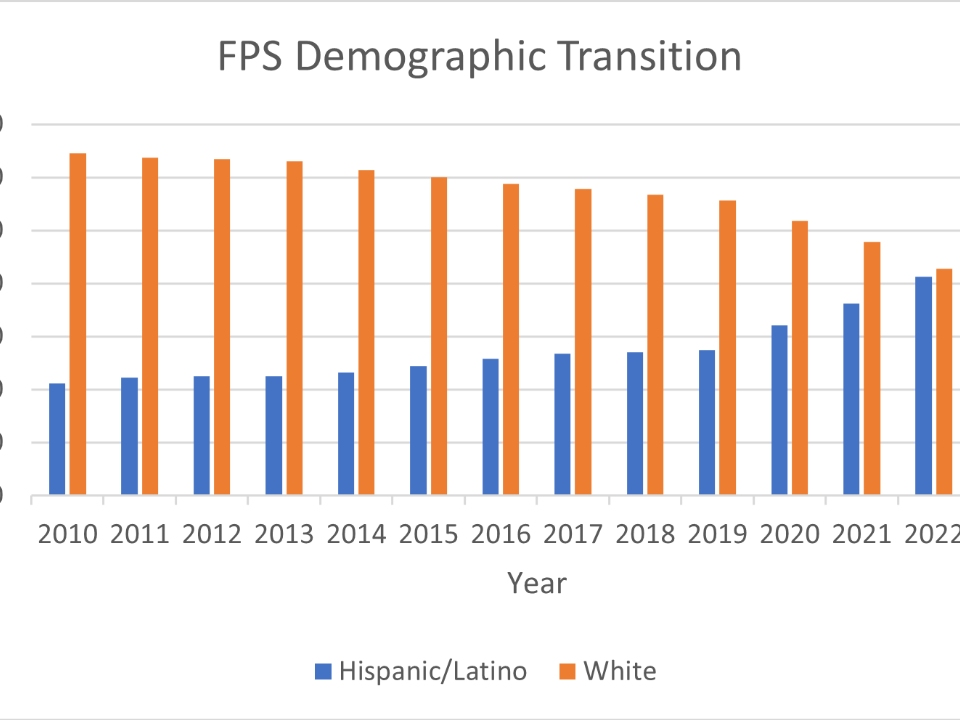
Framingham, as a community, should reflect on the way it is treating its expanding Portuguese speaking population. In the school system, that expansion is rightly drawing boosted Chapter 70 state aid for education, but it is being diverted away from helping non-English speaking immigrant students. See the chart above to get an idea of the demographic transition which is occurring in the Framingham Public Schools (FPS).
$16 million in state Chapter 70 aid was sent to Framingham for the next year’s school district budget, but only $11 million made it to the schools. Last year, $11.8 million was sent by the state, but only $6.8 million made it to the schools. This is recurring support, so the city now is siphoning off $10 million/year from the schools.
Find out what's happening in Framinghamfor free with the latest updates from Patch.
The school district student population is growing by 5% annually, and inflation for the schools comes to about 3%, so the simplest estimate pegs the school district budget growth at about 8%, and that is before accounting for the growing needs for English language educational support at pre-K and subsequent grades.
The approved school district budget increase is 7% for the next school year, so it is already missing 1% in its increase, plus the diversion of the $10 million/year means that pre-K expansion and solving the classroom aide shortage went out the window.
Find out what's happening in Framinghamfor free with the latest updates from Patch.
Low-income immigrant kids cannot get access to pre-K because it costs $7,000/year and the Framingham Public Schools BLOCKS pre-school only has capacity for 300 4-year-olds. We need pre-K capacity for 800-900. Farley will be empty of Baystate Community College students by year end, and we could bring it online as a key pre-K school, solving the capacity problem and making it free, solving the cost problem.
BLOCKS pre-K is currently dominantly White. Kindergarten is dominantly Latino/Hispanic.
It is a glaring injustice.
The spirit of Juneteenth says that making pre-K free and expanding its capacity to handle all 4-year-olds in Framingham is a dire human rights emergency.
The city has dropped its funding of the Framingham Public Schools by $10 million/year over the past two years, diverting the money to replace leaking school roofs. That’s why that increased Chapter 70 money never reached the school district.
That money should have gone to staff the pre-K expansion which will cost $7 million/year and to raise classroom aide pay to solve the current shortage of more than 100 aides who support students whose native language is not English, and special needs students. That would likely cost another $2 million/year.
$400,000/year should also go to increase school bus driver pay from $29/hour to $34/hour, so largely southside, low-income children don't get educationally damaged each day, as they get to school late. No one seems to have noticed that the school district budget will have to absorb that cost, with no additional funding from the Mayor and the City Council, who are too focused on generating more property tax breaks to notice the damage being done to the school district finances and its students.
When George King asserts that the school district budget increase of 7% is unsustainable, he is ignoring the 5% increase in students’ numbers as a key driver and the rising percentage of Hispanic/Latino students in the Framingham Public Schools. All of George's financial rules apply to municipalities like Weston, Wellesley, Wayland, and Newton, where budgets rise at 2.5%-4.5% each year, with largely static student numbers and few immigrant children.
In Lawrence, city and school budgets rise 10%/year as the population of immigrants rises. 95% of the Lawrence school district budget is paid for by Chapter 70 state aid. All of that Chapter 70 state aid reaches Lawrence children.
Framingham is in a comparable period of rapid demographic transition, which elected officials refuse to recognize, and those elected officials are directly responsible for failing to provide non-English speaking students the educational support which will determine their life trajectory.
When George King says that the 7% increase in the school district budget is unsustainable, he is inadvertently saying that the rapidly rising Hispanic/Latino student population is unsustainable, and he also leaves no room for the further budget increase which would cover expanding pre-K and fixing the classroom aide shortage. The fact that $10 million/year is going to fix school roofs, not educating children is not even on his radar, nor on that of his cohorts Mike Cannon and John Stefanini, who continue to view the school district budget as a piggy bank to raid for tax cuts and cityside infrastructure projects.
Nor is the failure to properly educate immigrant children the #1 central problem on the radar of the City Council and the School Committee. These children are invisible to elected officials.
This is the Juneteenth moment for Framingham.
Will the community trade human rights and the future of our immigrant youngsters, and indeed the entire school district, for a continuing stream of property tax break dollars, of which 95% go to property owners who don’t have an affordability problem.
Only one City Council slot out of 11 is likely contested in the November election. No School Committee slots are contested yet. The deadline for filing signatures to run is in mid-July.
Will no one enter the political fray and help bring the changes which are needed to make this a city we can be proud of for its human rights record? Will no one enter the fray even to ensure that the major problems in finance, education and infrastructure facing the city are discussed?
When I first ran for School Committee in 2005 in Newton, I was defeated by a two-year incumbent, with almost the entire Newton School Committee and Board of Aldermen lined up against me. However, a genuine conversation was started on how education could be improved. In 2007, I ran again, and won, as did multiple other new candidates. That brought real change to Newton.
The same can happen in Framingham. All it takes is for a small number of concerned residents to jump into the political arena and help bring the conversation to life here, and to light the fuse of change.