Community Corner
Travel Back in Time: Memorial Building, Village Hall, Danforth Building
Travel Back in Time with the Wednesday Patch Passport, to discover the history and roots of Framingham.


Editor's Note: Unless otherwise noted, all facts and historical references in this article are from Stephen Herring's book, "Framingham: An American Town," which was sponsored by the Framingham Historical Society and the Framingham Tercentennial Commission.
Incorporated in 1700, the town of Framingham was the site of Native American villages, Colonial settlers, and eventually — lots of buildings. Shedding light on the town's rich history is the story of three of these buildings, Village Hall (1834), Town Hall, and Danforth (1907).
A Brief History
Find out what's happening in Framinghamfor free with the latest updates from Patch.
Before these buildings, the Nipmuc Indians lived in Framingham until the early 1600s when they were diminished by tribal wars and disease. In 1616 there was an epidemic of "malignant distemper" followed by a 1636 outbreak of smallpox.
A few Nipmuc remained when the English colonist John Stone moved to the area on 1697. Stone built a house and a mill in an area called Saxonville. As more European's moved to the area, it was called Danforth Farms, after Thomas Danforth, a Bay Colony Official. Danforth was from Framlingham, England, after which the town was named without the "L."
Find out what's happening in Framinghamfor free with the latest updates from Patch.
Eighteenth-century Framingham was a place of farming. When the Worcester Turnpike opened in 1810, daily stagecoach traffic to town surged to up to 17 a day. According Herring in his book, "They took Framingham from a rustic farming town and made it into a vital community with a central village that was a showplace for civic, religious, and educational institutions, as well as a thriving commercial center."
The Buildings
In 1834, the year the Village Hall was built, the first trains came to town, bringing more people and more commercial opportunities.
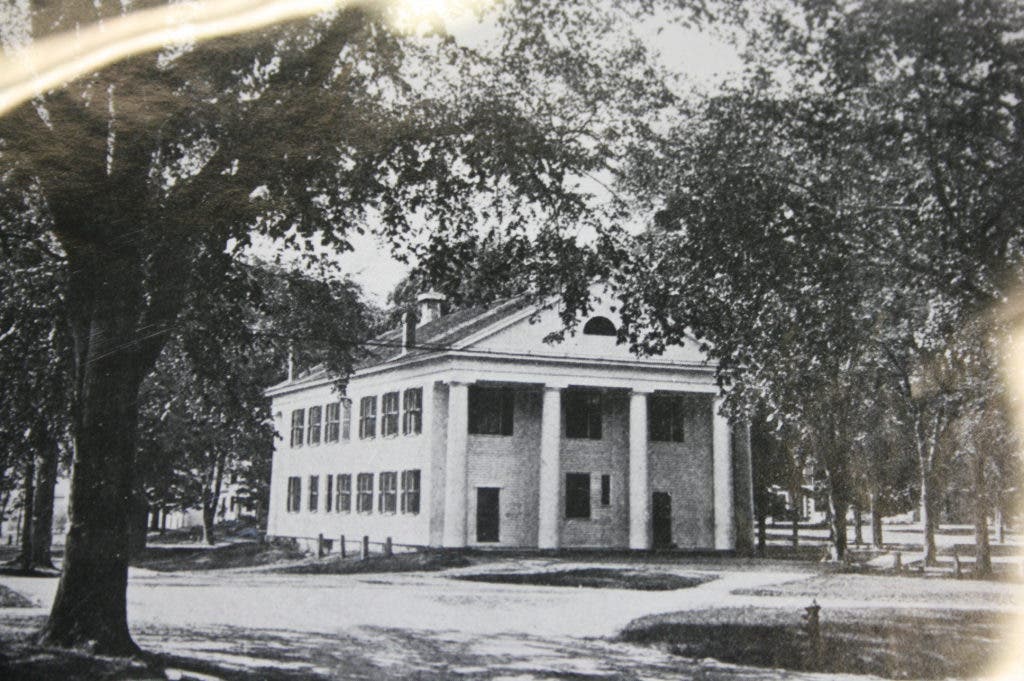
Village Hall (2 Oak St.)
In 1834, the Village Hall was built at a cost of $5,400. This double-ended Greek revival style structure replaced the Town House. At the time, a committee member stated, "... the growing population of the town will justify erection of a new Town Hall."
- Around the time when the Town Hall was built, the Framingham population was 2,313 (1932).
- Designed by Solomon Willard (who designed the Bunker Hill Monument) and Dexter Hemenway, Dexter Esty built the Greek-style structure that reflected the interest at the time of the "classical roots of American democracy."
- Stone and brick were considered for the wooden building, but were found to be too expensive.
- The building, which was called "The New Town Hall" was used for town hall meetings until 1891, when these gatherings were moved to the Elmwood Opera House. An anonymous poet wrote about this change, "There (is) stands by the wayside, deserted by all, Our forefather's sanctum, the old village hall..."
- A north portico was added in 1907. A decorative retaining wall was added in 1914.
- The Village Hall is now owned by the Framingham History Center.
By 1920, there were two car dealerships in town: Vialle Motor Company and the Framingham Motor Company. The Town Hall was built between 1926 and 1928 at a cost of $750,000.
Town Hall (150 Concord St.)
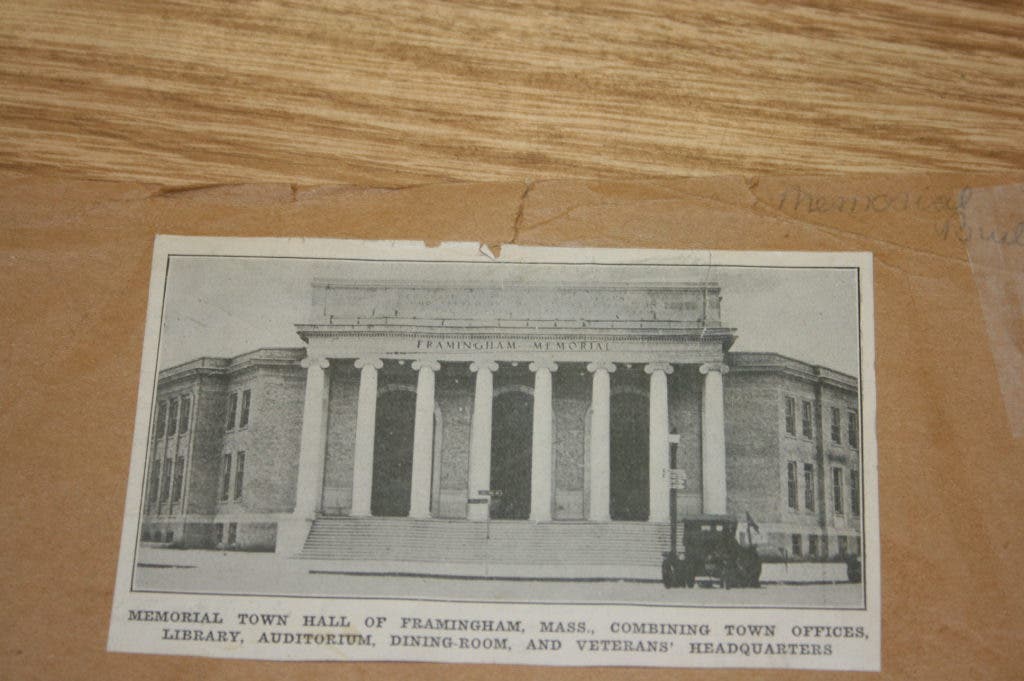
Framingham's Town Hall, known as the , was designed to be a memorial to veterans. Its rotunda contained bronze plaques with the names of 2,300 men and woman lost in wars as of 1928. The committee responsible for the building proposed, "... a memorial to soldiers, sailors, marines and nurses, of the town."
- The Town Hall was designed by architect John Aston, and built by John J. Prindiville, a native of Palmer who built many other structures in Framingham.
- At the Feb. 22, 1928, dedication, six survivors of the Civil War were present, As they marched into the rotunda, the Civic League Orchestra played "Marching Through Georgia."
- In 1923, 3,000 people attended a five-night town meeting held at the Town Hall. This was the largest Town Hall meeting held in the U.S at that time according to a report by Carl Dodds, then president, Chamber of Commerce. (Framingham Library archives)
- The Town Hall had offices for town officials, a library, large auditorium, fireproof vault, and a dining room in its basement that seated 1,000 people.
Danforth (123 Union Ave.)
Named for Thomas Danforth, the Danforth opened in 1907 as the Framingham High School. It replaced a wooden building used for the school.
- In the 1930s, wings were added on Pearl and Lexington Street (Images of Framingham by Laurie Evans-Daly and David Gordon, Framingham Historical Society, 1997).
- Bids were made in 1949 for a new gym and cafeteria, but construction was delayed due to a wartime shortage of steel.
- In 1958, the Danforth was enlarged to house the Framingham Junior High School. It became the Lincoln Junior High in 1964, and was the Farley Middle School from 1970 - 1974.
- In 1975, the building re-opened as the , Keefe Vocational High School provided low-cost renovations that made this transformation possible.
- The building is also home to the of MetroWest.