Politics & Government
The History and Mission of the Downtown Initiative Steering Committee
Town Manager Norman Khumalo shares the history of the DISC as well as the process the town has gone through to develop their revitalization plans.


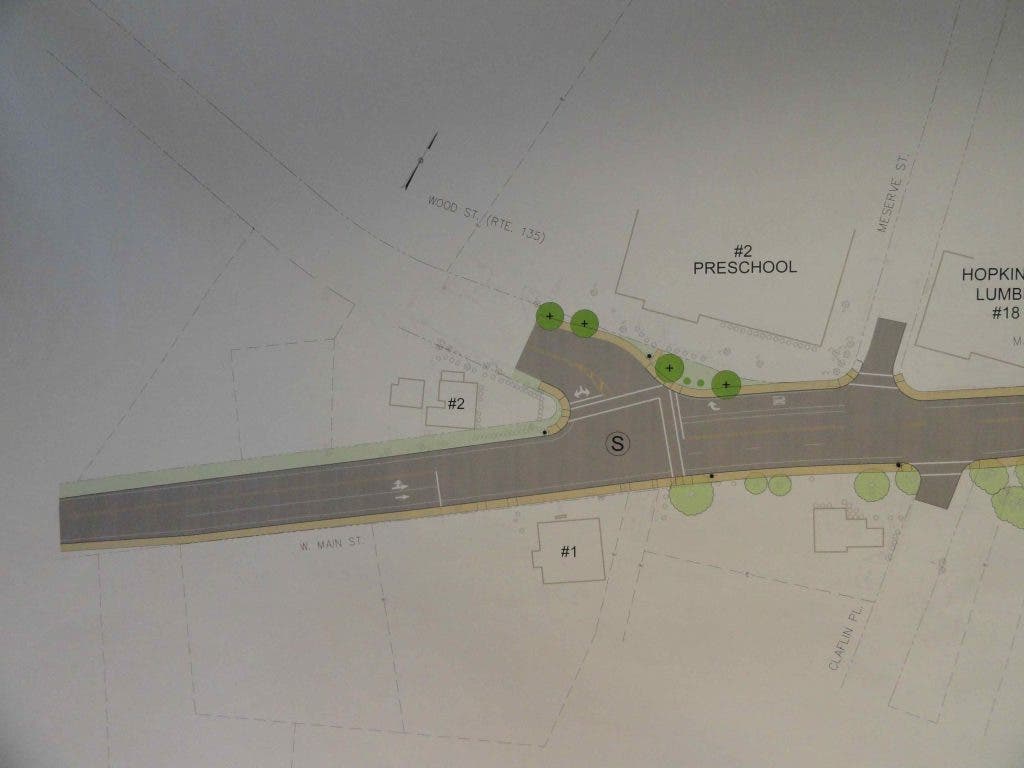
From Norman Khumalo,
In May 2010, Town Meeting voted to spend $400,000 for engineering to develop a plan to improve streetscape and infrastructure in our downtown. In April 2010 MassDOT’s Project Review Committee determined the project was eligible for federal funding through Boston Metropolitan Planning Organization’s (MPO) Annual Transportation Improvement Program (TIP) at an estimated cost of $4 million. MassDOT’s determination was not a commitment of state or federal funding only that the project could be included as an eligible project in the TIP. Final commitment for funding requires approval of the project through the MPO which is the federally designated entity charged with developing transportation plans and programs. MPO is comprised of members including MassDOT, Metropolitan Area Planning Council (MAPC), MBTA, MBTA Advisory Board, MassPort, the City of Boston and six other municipalities. Under the TIP, funds are designated for the construction of roadway improvements but require the community to fund and administer the design with MassDOT-Highway Division review and approval.
The Town subsequently retained BETA Group (BETA), to including the roadway improvements that would be covered by any TIP funding. The Town additionally established the Downtown Initiative Steering Committee (DISC) whose primary function is to participate as advisors to the Town Manager in the planning and implementation of the Downtown Initiative project.
Find out what's happening in Holliston-Hopkintonfor free with the latest updates from Patch.
DISC was originally comprised of six members selected by the town manager to represent residents and downtown business and property owners. The group scheduled and posted regular public meetings with BETA to evaluate a broad range of potential improvements to traffic flow, pedestrian safety, parking, drainage, and visual enhancements to the downtown.
BETA and the Town evaluated numerous options and the effects of these options in an effort to make the first submission to MassDOT for review at the 25% design level. Because of the interaction and interdependences among issues, the most appropriate solutions are not often clear-cut. For example, improving traffic flow may decrease available parking, and the presence or absence of a bike lane may affect the willingness of the state DOT to rank the project higher or lower in the funding queue. DISC, town staff, and BETA, with input from businesses and townspeople, have been working together to address these complex trade-offs.
Find out what's happening in Holliston-Hopkintonfor free with the latest updates from Patch.
DISC now is in the process of finalizing its recommendations with regard to the downtown streetscape and infrastructure. DISC also has the task of providing information to the town, so that townspeople can continue to evaluate options. Public input is sought and can be provided to the town engineer. The town engineer is also planning on providing time for residents to review the plans. More information is available on the DISC space on the Town of Hopkinton’s website.
By the mid 2000s, the state had recognized Downtown Hopkinton as an area with a traffic problem, and understanding that traffic would only get worse, expressed an interest in improving conditions. At the same time, a charrette (Voices of Vision) comprised of 108 Hopkinton residents, met and identified revitalization of the downtown as a key goal. The Downtown Revitalization Committee (DRC) was established to help address this concern.
In 2009, shared funding provided by the business community and the town was used to hire a team of students to evaluate the potential for revitalization of Hopkinton’s downtown. The students were from the Conway School of Landscape Design, a graduate school in Conway, MA, that requires its graduate students to conduct a substantial design project during a semester. These students met with the DRC and held multiple meetings to elicit input from the town before producing a public presentation of their findings and a report. That report, entitled Visions of Hopkinton: Steps towards Downtown Revitalization, was completed in early 2010 and is available on the DRC’s space on the town website.
The Conway Report
The Conway report opens by noting that “Hopkinton is a town with a strong community, a rich history, and an appealing character.” It then identifies opportunities and challenges, with roadway issues including:
“Frequent traffic accidents, especially at intersections, and anecdotal evidence point to problems in Hopkinton’s town center for both pedestrians and drivers. The perceived danger to pedestrians from cars when they cross Main Street is so great that it seriously deters people from walking in the downtown. Cars move fast along Main Street. Due to I-495, Routes 135 and 85, and several other major roads that intersect Main Street, downtown traffic is heavy throughout the day and dominates the downtown experience. There are no separate travel lanes for bicyclists. The pedestrian experience also leaves much to be desired, with long waits to cross the street, street crossings that are too long and not visible enough, deteriorating sidewalks, walkways completely exposed to the sights and sounds of traffic, and parking often inconvenient for downtown destinations”
The report concludes:
“In other communities where revitalization efforts have been limited to streetscape changes, results have also been limited. A downtown thrives through the diverse combination of factors that this report explores, and Hopkinton should give attention to each factor. The town can begin to implement some measures immediately at little cost. A multifaceted approach to revitalization that considers physical, social, and economic aspects of the downtown over time and in relation to the region will lay the groundwork for a vibrant town center.”
In May 2010, the town voted to fund the design of a roadway improvement project as a significant physical step in the downtown revitalization process and established the Downtown Initiative Steering Committee (DISC) to help facilitate this design process, keeping in mind the principles of the Conway Report. As noted in the Conway Report, this physical improvement will only be successful in combination with consideration of social and economic aspects of the downtown in a multi-faceted approach. For this reason, on the project from businesses and residents, as this input is critical to fully developing a successful project.
Get more local news delivered straight to your inbox. Sign up for free Patch newsletters and alerts.