
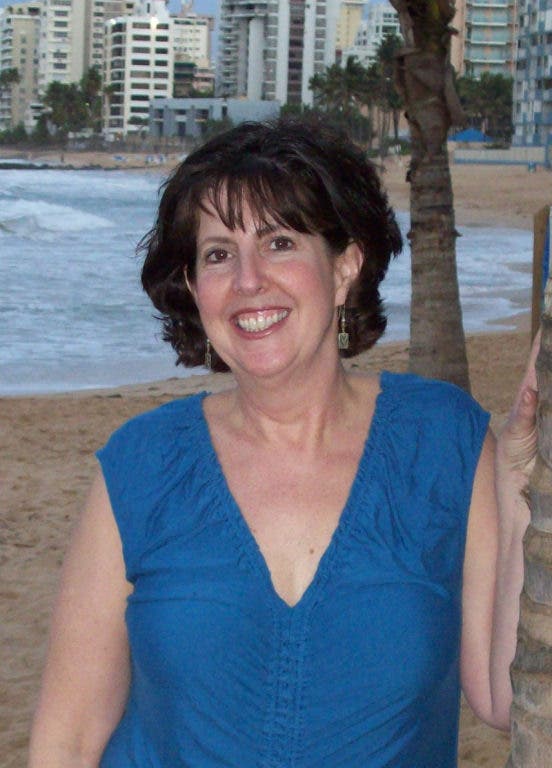

This week I have my birthday,
As fast as you can drive
Is how much I am celebrating
Find out what's happening in Holliston-Hopkintonfor free with the latest updates from Patch.
The years I’ve been alive.
My husband was a classmate,
Find out what's happening in Holliston-Hopkintonfor free with the latest updates from Patch.
We both grew up in town.
Our children are adults now,
I love when they’re around.
Who Am I? I am Sue Shannahan.
HOLLISTON NATIVE STARS IN FISHY COMMERCIAL
I don’t think it's necessary to watch an hour-long television show every week to know that America’s Got Talent. For people of my generation who grew up watching The Ed Sullivan Show with his classic spinning plate and juggling acts, not to mention the breakthrough performances of Elvis Presley and Tiny Tim, the notion of America having talent is as obvious as the nose on the Old Man of the Mountain’s face.
However last week, as I was entrenched in the cyber-world, performing critical research for a future Patch story, my wife disturbed me while watching the aforementioned show. “I think that’s Toni DiBuono,” she emphatically stated, and as I swiveled to catch a fading glimpse of a commercial for Snickers Peanut Butter Squared, I told her I thought she was right.
Antionette DiBuono was a former classmate (at least through middle school, she graduated from Marian High in 1974) who eventually graduated from the Boston Conservatory and pursued a theatre career. My wife and I saw her star in Forbidden Broadway in Boston in the late 80s and since then, she has accumulated an impressive list of movie, television and commercial credits.
Toni grew up on Washington Street and was the daughter of former Framingham District Court Judge Anthony DiBuono.
WILLIAMS' CONTRIBUTIONS HAD LASTING IMPACT ON REGION
It was August 13, 1968. It was a day I will never forget.
I was with my parents at the Somerset Hotel in Boston, where I, along with 14 other young men were being presented to the press as the winners of the first “Week at Ted Williams Baseball Camp” contest sponsored by the BoSox Club. The winners had submitted essays as to why they would like to win a week’s stay at the Lakeville-based camp, and our submissions had been deemed the most worthy of the approximate 1200 entries.
I had learned of my selection just a week before when a letter arrived notifying me of my selection, written and signed by former Red Sox great Dom DiMaggio, who was then serving as the club’s president. The letter included an invitation to attend the August BoSox Club luncheon, where “Members of the Red Sox, including Dick Williams, will be present.”
At the luncheon, as the winners were announced, we walked to the head table where we shook hands with Williams, then the Red Sox manager, and he gave us each a gold Red Sox tie clip. I treasure it to this day.
I’m reminded of this with word that Williams passed away last Thursday at the age of 82. Williams is a member of The Baseball Hall of Fame, largely due to his success in piloting the Oakland A’s of the early 1970’s to two World Series crowns. But in this region, Williams' iron-fisted rule as the rookie manager of the 1967 Red Sox is what he’s best remembered for.
Williams took the reigns of a team that had finished ninth in the 10-team American League in 1966, and overcoming 100-1 odds, won the American League pennant on the last day of “The Impossible Dream” season. The Red Sox lost the World Series to a powerful St. Louis Cardinal’s squad in seven games, but in those simple days before talk of any curse existed, their performance galvanized all New England.
Williams, and the emergence of Carl Yastrzemski as one of the game’s great stars, is the primary reason for the team’s metamorphosis, and the love affair between the “town and the team” has endured. Prior to Williams’ arrival as manager, the Red Sox were accused of maintaining a country club atmosphere where team owner Tom Yawkey rewarded mediocrity.
Williams changed everything, stripping Yastrzemski of his captaincy, and placing himself squarely as the “boss.” It was a technique that Williams employed in all his managerial stops, generally achieving early success, before tensions and hard feelings would force his inevitable firing.
I had twice before met Williams. In 1964, Tulsa was a new gas station on East Main Street in Milford. Three members of the Red Sox came out one night to sign autographs: Dave Morehead, Frank Malzone and Williams. Williams was in the final year of his 13-year playing career, and gladly signed his photo for me and the relatively few others attending.
In 1965, Tulsa held a similar sparsely-attended event. But 1967 was entirely different. The Red Sox were winning, the fans were excited, and Tulsa invited six members of the team to a signing. Skylights streaked across the sky and a multitude of fans stretched far off into the night. Williams, as the team manager, was there again.
The site of the Tulsa station sits idle and ugly these days, while the Red Sox continue to bask in the undying devotion of their fans. They have done so since 1967, the year that Dick Williams and his team came to Milford, and lit up the sky.