Arts & Entertainment
Gerry Wright Channels Frederick Law Olmsted in One-Man Play
Olmsted says about the parks, "Let it be not for present use and delight alone, but let it be of such a work that our descendants will thank us for it."
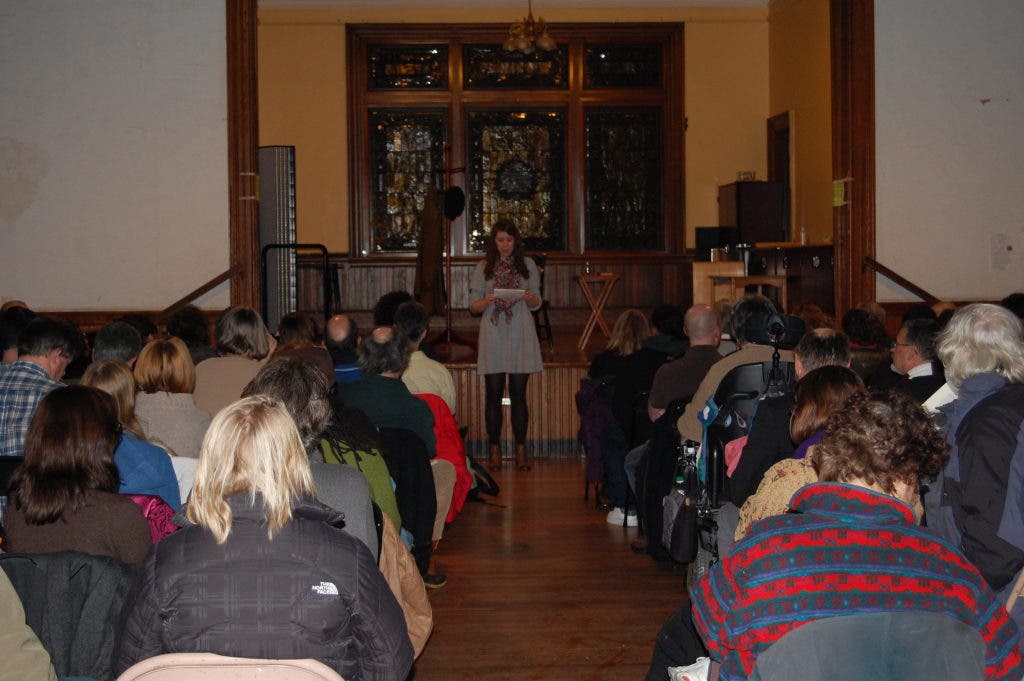


Frederick Law Olmsted, the father of landscape architecture and creator of Boston's Emerald Necklace and Jamaica Plain's treasured and , 'rode his horse in, through the snow' on Friday night to talk with community members about his life, his passions and his legacy. Olmsted, as played by Gerry Wright, hit on themes of social justice, conservation and public health, asking the audience to see the similarities in problems in the past and today.
The theatrical event, "Unhealthy People, Unequal Communities and Unwell Environment: Examining Olmsted's Practicality to Improve Society's Woes," was co-sponsored by the JP Forum and Community Caring Institute. welcomed in buttoned up travelers to watch the one-man play researched, written and performed by Gerry Wright, a long time Jamaica Plain resident, naturalist, and activist. Nearly 100 people gathered to watch Wright's performance, and after, they joined in asking questions to the '188-year-old landscape architect.'
Elizabeth Wambui, of the JP Forum, spoke to the audience about the Forum and its purpose. She then spoke of the many new, exciting events that are coming up in the next month, with topics ranging from food security to a visit from Senator Bernie Sanders. Wambui then introduced Alison Yoos, a member of the Community Caring Institute, to introduce Gerry Wright.
Find out what's happening in Jamaica Plainfor free with the latest updates from Patch.
"Seven years ago, Gerry Wright began his theatrical experience as Frederick Law Olmsted. As a human services pioneer and naturalist for over fifty years and to this day, the Olmsted play offers an artistic release of values of which Wright firmly believes, especially everyone’s right to equity, nature, and health," said Yoos.
Olmsted came out the door swinging, walked through the audience and up to the stage. He exclaimed about the beauty of his ride over, emphasizing the exquisite beauty of nature in the snow, and the need to preserve such beauty.
Find out what's happening in Jamaica Plainfor free with the latest updates from Patch.
He then started into the beginning days of his life, detailing his relationships with his family. His father and brother would continue to be prominent figures throughout his life.
Olmsted's career path was not linear, and he describes his jumping from one job to the next. He talks about his time as a farmer, his time as a writer and publisher, and his time as a traveler. Each one of these escapades ends with a similar sentiment.
"Damn! Another failure!" screams Olmsted, and then turns to the next idea.
"Dear father," writes Olmsted, asking his dad to help fund his next great idea and luckily, his father obliges.
Then, Olmsted's luck turns around. Hearing of a position opening for the superintendent of Central Park, Olmsted immediately throws his hat in the ring. Luckily, he wins the position by one vote.
"Do you know who that vote was? Washington Irving! A literary man! They said a literary man couldn't do it, but that's what won me the job!"
Olmsted is then commissioned for several other parks, and also becomes known for his writings on slavery, noting the importance of education for improving anyone's condition in society. He also serves on the Sanitary Commission during the Civil War, constantly noting the link between the soldiers' environment and disease.
The end of the play ends with Olmsted's eventual mental collapse, and he enters McLean Asylum, going over and over how he could do more... how he needed to do more.
Olmsted finally passes away, and Wright ends on a positive note, quoting Olmsted, "Let it be not for present use and delight alone, but let it be of such a work that our descendants will thank us for it."
Questions followed the end of the performance. People asked about more details on the design of his parks, and if he had designed the Boston Common. "No! The Boston Common is the oldest park in the country. It was there before I was born!"
Other questions focused on the themes of social justice and conservation. One person asked about philanthropy and the parks, and Olmsted praised those who fought and continue to fight to preserve the parks. A young member of the audience raised her hand.
"What was the easiest park to design?"
"Why, Jamaica Pond! It was easy because I didn't have to do anything! Nature already did it!" responded Olmsted.
Questions then arose around recent news, broken by the JP Gazette, that the hill across from the boathouse was up for sale. Olmsted thoroughly disagreed with its development, noting that the trees were essential to the ecosystem of the park and the beauty of such a pristine forest would be ruined. Wright himself is a staunch opponent of the development.
Community Caring Institute had more information for the public in the back about the sale and the possible consequences of housing development at Hellenic Hill.
The next forum, about food security in Jamaica Plain and New England, will take place on Feb. 3 at 7 p.m. at First Church Unitarian Universalist.
[Editor's note: Alison Yoos works for Community Service Care and is part of the Community Caring Institute.]