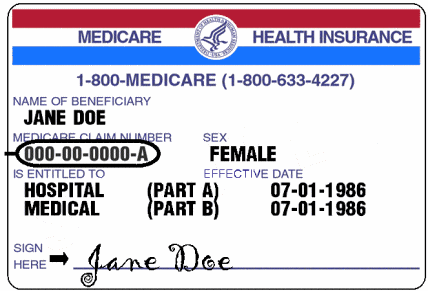
As the Medicare system begins to morph moving from its Rooseveltian roots taking on a more madoffian model there are some important factors that current Medicare subscribers should be aware of and future golden-agers should contemplate.
First, Medicare is your money. As you work throughout your lifetime your friendly federal government, or as I like to call those un-landed gentry in Washington, the not-so-wise guys, will “dip their beak”. In doing so they will skim off a little from every paycheck for your Uncle Sam. That is the tax portion. Then there is the Federal Insurance Contributions Act (FICA) tax. This is your money and your employer's money taken to fund Social Security and Medicare. This is not a government perk; this is not a government handout. This was money taken from you and your employer that was supposed to be set aside for Medicare/ Social Security for you! In 1968 however, President Johnson, taking time out from escalating the Viet Nam War, made changes so that the transactions to the Medicare Trust Fund were included in what is known as the "unified budget." This means that every function of the federal government is included in a single budget; allowing for some prestidigitation that would make the Amazing Randy's head spin . From that point on you, the workers have been loaning the government money at zero interest and apparently zero payback. I say this obviously since Washington keeps saying that Medicare / Social Security are on the verge of bankruptcy. How can that be if funds have been flowing in continually since 1936?
There are many theories as to why Medicare is in the condition that it is in. But basic finance will demonstrate even to the least educated among us, but obviously not to most politicians, that when you spend more than you take in eventually you will exhaust your supplies. How this is happening is the politicians' albatross. Are they spending your money on people that never even paid into the system? Yes. Do they have a right to do that? That’s a fair question for society to wrestle with. Or, is it just a problem with all “Ponzi schemes” in general? As most socialist governments in Europe are being reminded today, as less people are working and paying in than there are people sitting back and receiving; eventually the system runs out of money. Seems pretty straight forward, doesn't it? But the legitimacy and the faults of this system are fodder for another blog.
Find out what's happening in Jamaica Plainfor free with the latest updates from Patch.
Now to the crux of the matter. Today’s seniors are suffering through wide sweeping changes in the Medicare labyrinth. Besides the other issues we have mentioned above now the government has instituted the Affordable Health Care Act (AHCA) . This law does in all fairness have many good things to offer. But , as the saying goes ,"if you're going to make an omelet, you gotta break some eggs." The great things are that there is included guaranteed coverage regardless of preexisting conditions, no limiting cap to payments in catastrophic diseases. The law mandates free choice of physicians, disallowing arbitrary discrimination against Chiropractors, and other licensed alternative care providers, and inclusion of children up until they are 26 years of age. This seems all so benevolent, but if those ganifs (fr. - pl: (gӑnїf) ,"politician") would get it together and work on the economy instead of spend their time and our money fighting over who can marry who, and who may have a baby and when, maybe these 26 year old college graduates would have a job and be able to afford their own medical insurance. Anyway, the AHCA is being funded by a chunk of future Medicare funds that were shifted to fund the AHCA. This has caused cut backs in Medicare that for political reasons are being called readjustments.
A particularly reprehensible "adjustment” is in hospital coverage. It is very important for seniors to read this carefully. Medicare has changed the way it views hospital admissions. There are admissions, and there are "hospitals stays for observation" . Medicare will review the admission records of hospital patients. If Medicare believes the admission was not medically necessary by their standards, they will ask the hospital to repay Medicare the money with interest. The hospital may not correct the billing and resubmit it. The hospital now has lost this money, but not really lost it. Because they are going to bill the patient for it. What 's more Medicare can audit the hospitals and denying payment for unnecessary admission even one year after the patient has left the hospital! So hospitals with the fear of Medicare reneging on payment for an admitted patients are very careful not to "admit" a patient that might fall into this category. These patients are kept overnight in the emergency room, or even moved up to a hospital beds next to an admitted patient, not understanding that the bed and all the care that goes with it is now on the patient's dime, until they get home and receive the $10,000.00 bill. The hospital Quality Control Officer states that all patients receive an orientation concerning their status. But with all fairness, at a time when one is ill, or one's spouse or family member is ill, usually in an emergency situation I do not believe that the entire message is getting through to the patient and their families. Especially if we are discussing an elderly patient and their spouse.
Find out what's happening in Jamaica Plainfor free with the latest updates from Patch.
So, what to do? It is best at times of extreme anxiety to bring along a designated thinker. Someone who is not freaking out and has the level head to handle the questions that need to be asked. Upon heading to the hospital one needs to remember to ASK the status of the patient in extended stay in the emergency Room. If there is an extended stay, ask 1) is it necessary. If the answer is yes, ask 2) Why the patient cannot be admitted? 3) If you are told it does not qualify for admission, ask if it will be covered by Medicare? If the treatment is not covered for admissions it probably is not covered in the emergency room either. Now at least you know what you are dealing with. If the patient is brought up to the hospital room ask, 1) is the patient being admitted? If the answer is no, be alert. Call your Primary Care Physician, perhaps he can help with modifying the diagnosis by giving supplemental information to the hospital doctors so that the patient can be admitted. If all else fails I suggest you contact an elder care attorney to deal with Medicare. Is that fair? As President Clinton once said," that depends on you definition of "is".