Business & Tech
Q&A: Red Sun Press' Matt Osborn on Printing for Peace, Justice and a Sustainable World
The union shop lives its values: Decision-making is shared, profits are shared, and the workload is shared. There is no one single owner.
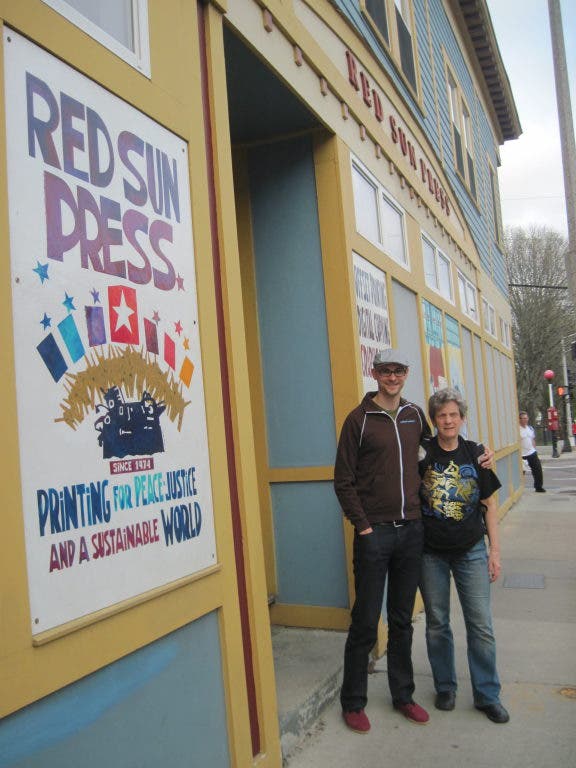
The colorful wall murals catch the attention of passersby as they walk down Green Street. The union print shop on the corner of Lamartine and Green is an anomaly against the backdrop of the explosion of e-readers and online media (present company included), adapting to the changing market while staying true to the mission it was founded on in 1974: printing for peace, justice, and a sustainable world. On a recent day, as the late day light streamed in the ’ second-floor windows and the sounds of foot traffic picked up outside as evening commuters made their way home, sales and customer service representative Matt Osborn sat down to talk about the press. Red Sun Press began with $350 and a small press in a Somerville basement as an outgrowth of the social movements of the ‘60s and ‘70s. After a move to Cambridge, it landed in JP in the mid- 1980s, and has been calling it home ever since. Despite a changing print landscape, it has continued to produce brochures, annual reports, calendars, and newsletters with the same vigor, all in the name of social change.
The idea of social justice seems layered for Red Sun Press: the way you do business, the way you work as an organization, and your attention to health and the environment in how you print things. Can you talk about that?
Find out what's happening in Jamaica Plainfor free with the latest updates from Patch.
Red Sun Press was founded in 1974 to serve and support movements for social and racial and economic justice. Since then we’ve printed for a lot of grassroots organizations, local groups, coalitions, campaigns, unions, schools, a lot of different organizations working for social change—organizations that have a social mission, an environmental focus—so it’s always been part of what we do. We give donations to groups that don’t have a lot of money or resources to support their work.
We're structured as a cooperative organization. Decision-making is shared, profits are shared, and the workload is shared. There is no one single owner. The organization owns all the assets. So, it’s kind of a counterpoint to some of the more traditional, hierarchical organizational structures. We’re also a union, so we’re part of the UAW (United Auto Workers) because we believe in the labor movement. We believe in workers’ rights. We believe in solidarity and support the organizing that’s happening.
Find out what's happening in Jamaica Plainfor free with the latest updates from Patch.
For a long time, we’ve had an environmental focus. We were one of the first printers in the area to use recycled papers. A lot of people who work here came out of the environmental movement. We use recycled paper, we recycle all the paper that goes through the shop, we recycle our plates, we use alcohol-free press chemistry. We print for a lot of environmental and conservation organizations and also make donations to support their work.
Do you decide what clients to bring on based on the messaging and mission of a company or organization, to make sure it aligns with your values?
I think it’s more like the other way around. We don’t have a lot of NRA people or conservative, right-wing politicians seeking our services.
What’s it like operating in JP, an area known for being socially conscious?
I think we kind of fit into the fabric of JP fairly well. We have a social change mission. Our tagline is: printing for peace, justice, and a sustainable world. I think there are a lot of people in JP who believe in that and want to support that. So it’s a good place for us to be. It’s a good community.
As “green” has become a buzzword these days, so has “social change.” But you’ve espoused it all along. What does it mean to be a company that's had these words as part of its mission from the get-go but now they’re kind of tossed around in other ways?
Social change is definitely a very vague, very broad term. I think it’s a really good question. And a question we’re always trying to navigate. We’re always trying to decide how much in donations can we give, how much can we support local groups and what do we see as real social change work? And who gets to decide? Obviously people have different opinions, even within Red Sun Press, about what that is, what that looks like. Social change, I think, is when people in the community organize, when people who are more directly impacted by social problems and injustices come together and really try to build a base and build community power to achieve structural change, systemic change. There are a lot of different organizations that are doing that and we’ve worked with them for many years. Community Labor United is a good example, as is ACE (Alternatives for Community and Enviroment).
With the internet not only as a mode of communication, but also as host to a lot of DIY sites, how has that affected you?
That’s also affected us because you can get 5,000 postcards online for a fraction of what it would cost here. These places have this highly automated system where they have enormous presses and they can just put tons of postcards on a single press sheet and just blast them out. So there are definitely some ways that it’s hard for us to stay in business. But our strength is that we’ve developed good relationships and give good service to a lot of organizations.
Nancy Nichols, Red Sun’s business manager who’s been with the company for 27 years, arrived at the end of the interview and shed some light on a few historical points.
Where did the name Red Sun Press come from?
Well, there’s a debate about that. I don’t think there’s one answer to that. Just sort of that it was positive. They [the founders] were pretty left-leaning at the time… It was created as a way to do quality printing for the left. It was partly that, partly sort of the positive image.
I noticed lot of red sun artwork around here.
Well, we find things around. A lot of it has been found… Someone here loves to go to yard sales and comes back with all this artwork with red suns on it.