Kids & Family
Seventy Summers Ago, Residents Eyed A Town Beach
In this look back at long-ago Lynnfield, a 1942 newspaper noted that a fence at proposed beach would "solve the problem of the present night petting parties which are so frequent."


In this latest installment in a series looking back at how Lynnfielders celebrated their holidays back in the early 1940s, we find that July 4th festivities were muted due to a lack of fireworks materials and air raid precautions that banned bonfires or illuminating fireworks.
On June 11, 1942, the former Lynnfield Village Press weekly reported that the town was "due for a quiet fourth" because of the previously mentioned limits. "No planned entertainment is anticipated for the holidays," read the newspaper account. "In past years, gala celebrations were held in both parts of the town for the residents."
However, a week later, town officials apparently had a change of heart. "The plans are underway for a gala time and although no bonfire or fireworks will be permitted, other events to celebrate the night before will be held," said the June 18, 1942 Village Press. Said activities included dancing in the street the night before the 4th up until midnight, and a horribles parade on the morning of the 4th. There was also "the usual program of sports for adults and children with free tonic and ice cream."
Find out what's happening in Lynnfieldfor free with the latest updates from Patch.
Perhaps the most interesting event was an annual baseball game where a team of married men played against a team of single men. There's probably enough jokes in that detail to fill an entirely new column.
An editorial reminded town residents to write to men serving in the military overseas, telling any veteran readers to look back to their own service in World War I to remember the thrill of receiving a letter from almost anyone. "It's a swell idea. Will you do your part?" asked the paper.
Find out what's happening in Lynnfieldfor free with the latest updates from Patch.
One of the wackiest characters in Lynnfield history seems to be the guy who wrote the "Man About Town" column for the Village Press, which included random, lighthearted nuggets about town residents. "The Maddisons own the only cannon in town that we know of," said one entry. "Ernie Goobie, water superintendent, now has Brownie's Jitterbug on the road. With no lights, he is all set for blackouts," said another. Another cryptic one was "Bob Peabody gets excused. A heavy date over the blackout." The blackout of course being a civil defense drill.
50 Cents For Golf, And Saving Gas
An advertisement by the former Colonial Golf and Country Club suggested "Why not enjoy yourself in Lynnfield this summer?" Nine holes of golf cost 50 cents, and one could the course all day long for just $1.
Another ad told readers, "Save gas by dining at the Ship's Haven." In retrospect, this may be an early ancestor of the old "Eat Here, Get Gas" gag. But that said, the early days of World War II were characterized very much by rationing of everything from tires to gasoline and much more. Residents were required to be conscientious about their gas consumption because they could only get so much of it at a time. In fact, a later newspaper report told the story of a Lynnfield man caught by the fire department hoarding a couple of hundred gallons of gas in his basement in town.
Police And Fire Personnel Active For Holiday
After the fourth, the paper noted that auxiliary police had put in 340 hours of work that holiday weekend to ensure that the wartime era rules were observed. One accident gave the town a chance to try out the new ambulance it received as a gift that summer from Mr. and Mrs. Stanley Heath of Chestnut Street. The ambulance was "equipped with the most modern stretcher cot available." There was also one arrest for drunkenness that weekend.
Police Chief Everett Webster had the entire force on duty that Fourth of July weekend, and a published warning from him and Fire Chief W.W. Moxham reminded residents of "strict penalties" for having a bonfire or for having illuminating fireworks displays. Men were also reportedly stationed at every single fire alarm box in town to prevent false alarms. "The fire department must be kept free of false alarms to insure them of giving protection in case of an emergency," said the paper.
The Lynnfield Beach That Never Was
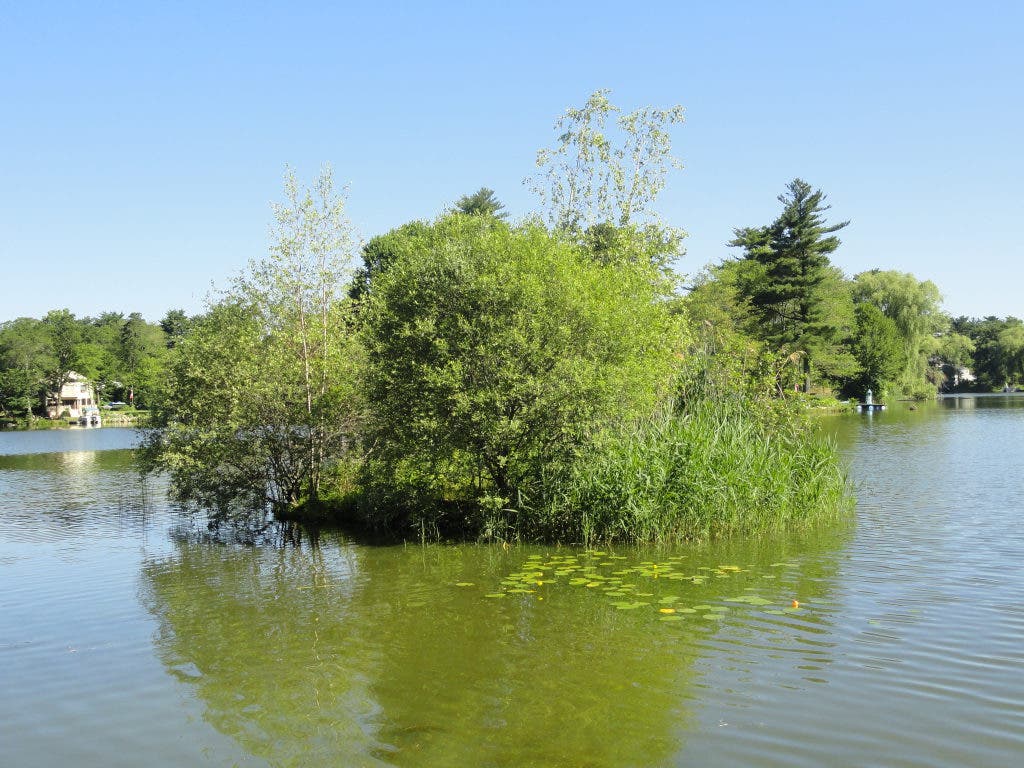
As Lynnfielders had to make do with limited mobility brought on by gas rationing, the situation gave rise to calls for a beach to be created at Pillings Pond of all places. In its June 18, 1942 edition, the Village Press ran the headline "Residents Seek Local Beach Facilities," noting that the combination of warmer weather and gas rationing was leading more people to swim in Pillings Pond (Personally, I'd rather be eaten by a shark than swim among so many reeds). "The pond however, being shallow and overgrown with weeds, is not satisfactory at present to those wishing to bathe there," said the paper, going on to editorialize that "whatever expenditure would be necessary to acquire a public beach in town would be small compared to the benefits which would be derived by the townspeople."
One proposal for the Lynnfield beach was for the town to acquire land at the south end of Pillings Pond where the former Shoreside Inn had once stood. By dredging the area, the weeds would be removed and sufficient depth for swimming would be established. From there, sand would have been deposited.
"Possibly a fence could be erected around the property also they believe, and this would solve the problem of the present night petting parties which are so frequent," stated the paper. It's hard to picture people using the term "petting" in conversation without chuckling for some reason.
I presume that after the war ended and gas rationing ended, the drive for a Lynnfield beach ended and residents went back to Sunday drives and a bit later, the interstate highways and more far-flung road trips.
Other Details From The Summer Of '42
- For locals who wanted to catch a movie at this time in history, options at the nearby Wakefield Theatre included "Ghost of Frankenstein" with Bela Lugosi and Lon Chaney Jr., "One Night In The Tropics" with Abbott and Costello, and "Roxie Hart" with Ginger Rogers (I'm more of a Rita Hayworth guy myself). Upcoming movies included Bob Hope in "My Favorite Blonde," Rex Harrison in "Night Train," and Gene Autry in "Cowboy Serenade."
- Police Chief Everett Webster warned that he would prosecute illegal dumpers because the lack of a town trash dump had people discarding their trash somewhere on Summer Street and behind the Lynnfield Motors garage.
- Mrs. Harry Doyle hosted a strawberry festival event sponsored by the Thrifty Wheel of the .
- Speaking of the Congregational Church, the July 2, 1942 issue of the Village Press reported that its pastor, the Reverend Ward Fellows, had resigned to accept a commission as an Army chaplain.
- In the June 25, 1942 issue, selectmen reportedly voted to purchase two air horns for town in the event of an air raid. A list of town residents permitted to buy new tires for their cars also ran in one of the issues around that time.
- Speaking of rationing, people had to make due with milk deliveries every other day instead of daily. Information from the board of health offered tips on the safe storage of milk.
- John P. Shaughnessy was the new commander of American Legion Post 131 in Lynnfield, while Augustus S. True was the new vice commander.
- Lawrence Mitchell of Medford was running for Congress that year, and he implied that unlike many other candidates, he had been opposed to isolationism long before the Pearl Harbor attack."I am a business man, not a politician. The politicians have too long been in power," he wrote. Something tells me that Mr. Mitchell would be spinning in his grave today if he took a look at any paper that covers Washington politics.
- Richard Hay of Main Street was promoted to lieutenant commander in the Navy.
- Something called "The Little Folks School" held its graduation.
A Drowning Tragedy In Town That Year
In the July 2, 1942 issue, a page six report noted that seven year old Robert Denton slipped on a sluice pipe at Suntaug Lake while picking blueberries with his two sisters, and drowned. Dr. Potash unsuccessfully tried to revive the boy, and a rescue squad from Lynn was on the scene with an inhalator. One would think a drowning would be page one news, but there were probably different mores in place back then. To this day, I have a pretty hard time myself doing stories when things like that happen.
Two weeks later, the Village Press reported that citizens at a selectmen's meeting had raised some $400 to purchase a new resuscitator for the town, which was said to be a more modernized upgrade over the inhalator. That story made absolutely no mention of a boy drowning in town only two weeks before.
Editorial Reflected The Era Well
In conclusion to this piece, I would like to run an editorial excerpt from the paper that ran on July 2, 1942.
"In 1942, we are engaged in the greatest, hardest struggle to maintain our independence that we have ever had. We are in a true 'World War' geographically and politically... This Saturday we are not merely indulging in a traditional celebration, we are observing solemnly the laying of the cornerstone of these United States."
Get more local news delivered straight to your inbox. Sign up for free Patch newsletters and alerts.