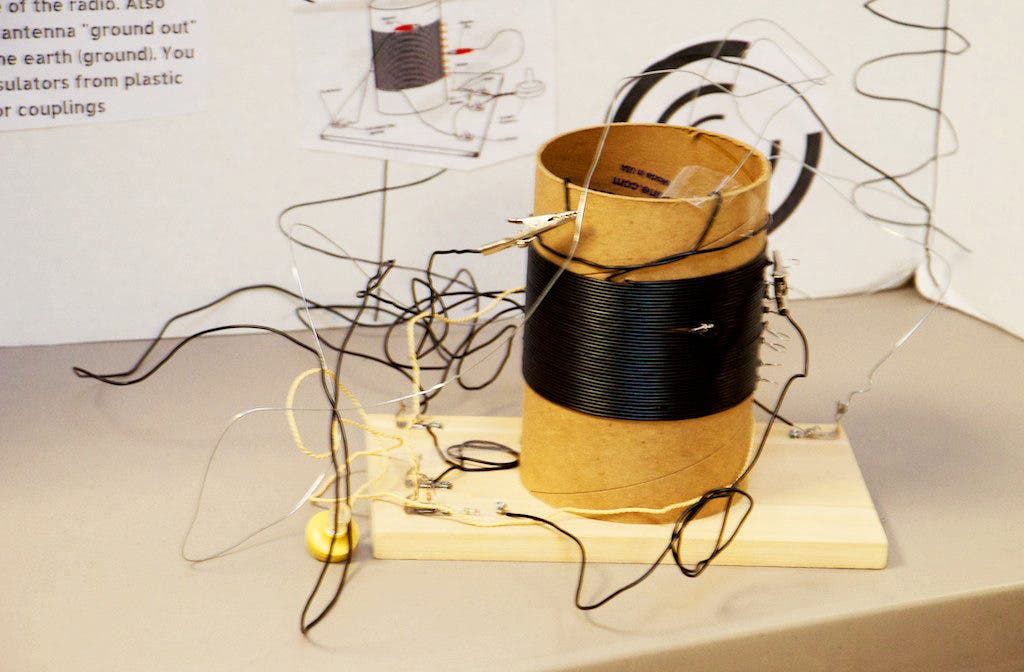
I smiled when I saw it: nobody recognized the Quaker, because his face wasn’t on the can.
It was Al-Noor Academy’s annual science fair, a very big deal for our kids. They research a hypothesis, devise an experiment to prove, or disprove, it, and conduct the experiment, collecting data. Then judges from the very real world of science judge their work, which is defended in oral presentation.
Because I’m a ham radio operator, I knew what the kluge of wires and clips was: an AM receiver. They used to call them Quaker Oats radios in my youth, because they call for a fat tube to wind a wire on, and those old Quaker Oats cans were perfect. Only this one was brown cardboard. No matter. It was good to know the ancien technology, built by many a boy, lived still.
Find out what's happening in Mansfieldfor free with the latest updates from Patch.
That was my favorite, for sentimental reasons, but it didn’t win a prize. There were self-filling balloons full of carbon dioxide, plant and soil experiments, many takes on the laws of physics, and considerable sophisticated math, especially statistics.
Each student was required to make a tri-fold display, over which they fussed endlessly, up to the moment when they gulped as the judges stepped up to view—and ask probing questions. Woe betide the student found wanting.
Find out what's happening in Mansfieldfor free with the latest updates from Patch.
And these were not just any judges. No, two staff medical doctors in charge of research wings in hospitals, and a heavy hitter from MIT. Where did they get these people? I didn’t know because I teach on the other side of the aisle, in Humanities.
They got them from the Islamic community, is where. Education is highly prized in Islam, and there is no shortage of exalted professionals in mathematics and the sciences, including medicine.
And not a few more coming up, I reflected while applauding as the prizes were awarded, during our weekly assembly in the masjid (or mosque) on the top floor.