Health & Fitness
A Thing or Two About Vineyard Aquaculture
The growing aquaculture business on Martha's Vineyard and thoughts about the global industry as well.
Not only is the Island a place where I live, it's the place I work from, writing about the global aquaculture industry. And some of my reporting, luckily happens just down the road or a ferry ride away.
The beautiful thing about living in New England is that the burgeoning aquaculture sector, like the fishing and whaling industries before it, has tapped into the same Yankee gusto and work ethic that made previous historical marine commerce world renown.
On the Island, you don't have to go further than the next town over to find young fishermen testing out aquaculture as a new means to continue their lively-hoods on the ocean.
Find out what's happening in Martha's Vineyardfor free with the latest updates from Patch.
In Menemsha, for instance, fishermen Al Gale and Tim Broderick have taken on an experimental submerged mussel farm that went into the water in Vineyard Sound September 2010. Using Gale's vessel, the Jane Lee, they dropped a 500-foot cable 30 feet underwater and then hung lines off the cable that were loaded with juvenile blue mussels, held to the line by biodegradable socks.
Since then Gale and Broderick have had two successful harvests of blue mussels they raised as part of the pilot project, part of a wider effort in the region with pilot farms also in Narragansett Bay and the waters off Newport, RI and Block Island. Some of the earlier cost was underwritten through a $214,000 National Oceanic and Atmospheric Administration (NOAA) grant as well as some local financial support from the Menemsha Fisheries Fund. The Martha's Vineyard Shellfish Group (MVSG) administered the project along with Woods Hole-based Marine Biology Labs (MBL).
Find out what's happening in Martha's Vineyardfor free with the latest updates from Patch.
Gale and Broderick are currently drawing up a business plan and searching out investors to turn the project into a commercial entity. As part of leasing water locations from the state, MBL and MVSG locked in acres of island waters to support more shell-fishermen and fishermen interested in following Gale and Broderick's example.
Fish hatchery
It's not only shellfish farming that makes up the aquaculture activities here on the Island.
After a year of field studies collecting data from two ponds on the Island, University of New Hampshire (UNH) aquaculture specialists and biologists are moving into the next phase of their winter flounder restoration effort--refurbishing a tribal hatchery.
The Aquinnah Wampanoag Tribal council agreed to lease the hatchery to the Dukes County/Martha’s Vineyard Fishermen’s Association (DCFA) for $100, allowing the association and UNH to use the shellfish hatchery for the winter flounder project, the tribe announced in October.
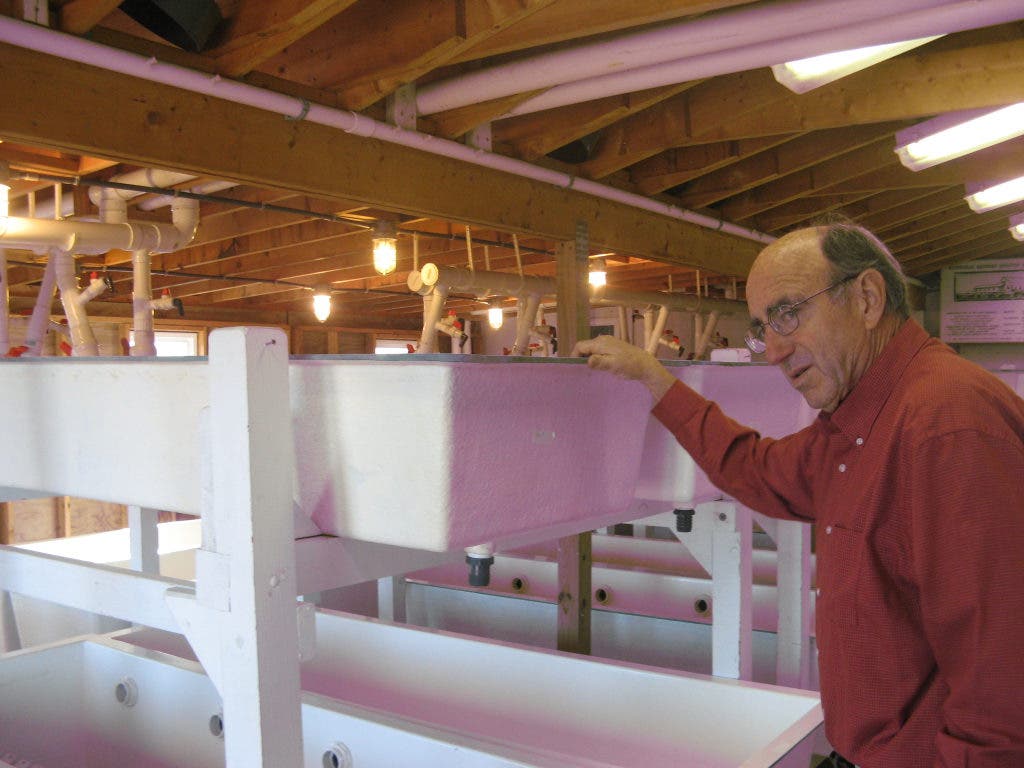
Before fertilized fish eggs can be brought into the facility, it has to be refurbished as a finfish operation. Currently the work is being done to rewire the electrical system and bring in the appropriate pumps and tanks for the winter flounder.
The building hasn’t run as a hatchery since before 2006. Two saltwater pumps at the facility were destroyed when the building was hit by lightning that year. However, it has already been used for the raising of quahogs, bay scallops and oysters.
The partnership is part of a federally funded two-year $308,000 National Sea Grant project to find ways to restore one of the most troubled fish resources in Southern New England. The grant provides for enough funds to retrofit the facility so that it can raise fish instead of shellfish. As much as $20,000 from the grant will be used to replace the pumps and get the place working again.
You can read more about both local aquaculture operations over the last several years for the Canadian published Aquaculture North America and Hatchery International.