Health & Fitness
Dispatch From Upper Falls - Propped up For 200 Years
Propping up an old house with whatever happens to be lying around.
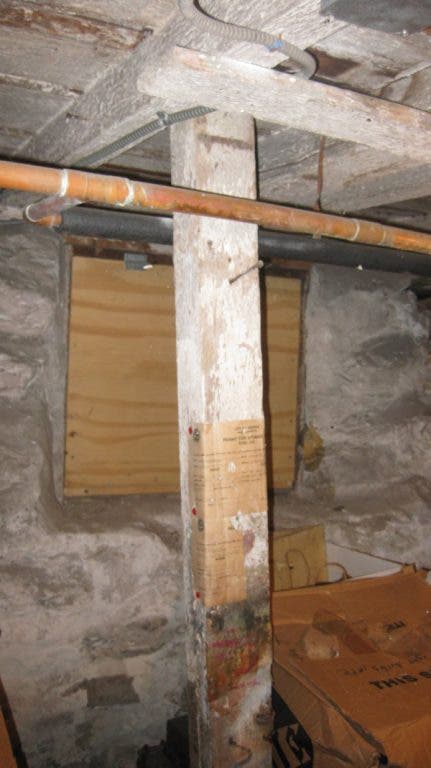


I just went down the basement for an extnsion cord and was reminded of a revelation we had four years ago when we bought this house. The house we live in as nearly 200 years old. Depending on who you ask, it was built in 1820 or 1830. This whole neighborhood in Upper Falls was built as a mill village, to house the workers in the water powered factories that were built at the Upper Falls on the Charles River in the 1800's. Most of the houses here date back to that era.
When we turned up at the Open House for this property we immediately fell in love with the house ... until we went to the basement. The realtor mentioned that there had been some previous structural issues with a major support beam. In the basement, there were two contraptions propping up a major rotted beam that seemed to be supporting the whole house.
Now I don't know a damn thing about house construction, but that sure didn't look like something I should be getting involved with. Much as we otherwise loved the house, we told our realtor that we weren't interested. Once she heard our concerns, she urged us to not be too hasty. She told us if we otherwise loved the house, than do some homework, bring in an expert, find out what we'd be up against if we proceeded.
Find out what's happening in Newtonfor free with the latest updates from Patch.
First I called a local contractor, described the propped up rotted beam and asked how would you repair that correctly. He said, "yes, the beam could be replaced. It's a big job, you jack up the house, pull it out and replace it." Next, I called Barry, a friend down in Virginia who has owned two houses of the same vintage. I described the situation and he said "now why would you do this?". I said "well we really love the house". "No, no", he said, "why would you pull out and replace the main beam in a two hundred year old house? Is the house sagging? Are there cracks in the plaster or some other sign of the sagging?". I told him "not as far as I can see." He said "that house has been standing long before you were born. Even if you do nothing, chances are it will be standing long after you're dead and gone. Unless you see clear evidence of a real problem (sagging etc), I'd leave it alone" He said "the only thing I can guarantee you, is that anytime you go looking for a problem in a house that old, you're sure to find one, and it's sure to be much bigger, more complicated and expensive than you can imagine to bring it up to current standards."
Next I called Brendan, another old friend, who does lots of restoration work on antique houses. I asked if he could come and do a detailed inspection. Brendan came by and checked out the whole house. A major chunk of what appeared to be rot in the beam had been caused by an earlier infestation of something called "powder post beetles". Like termites, they get into the wood and eat it up,. There was no signs of current beetle infestation, and the deterioration has been stopped.
Find out what's happening in Newtonfor free with the latest updates from Patch.
Next he showed me the beetle damage to the beam. A chunk of the beam had been turned to sawdust. He said, "At first glance, this looks really bad. In the spot with the worse damage, a sizable cross section of the beam is eaten away. What's might not so obvious though is that the beam is HUGE! The same beam in a house you'd build today would be a fraction of this size, so even with the damage, there's still more wood left in that beam than in the beam of a brand new house today.
As I eyed the contraption propping up the beam, I said, "well I saw that thing and it looked like it was the only thing keeping the house from falling down. What's that all about?" He said " that's a 'lally column' and yes, they put it under the weak spot in the beam to hold it up - definitely a good idea. I think you're missing the bigger picture though. What about the rest of them?. I counted nine or ten".
I had no idea what he was talking about, so he led me on a tour. "Those two lally columns were installed a few years ago because of the beetles. Over here, we've got a 4x4 propping up this beam. That looks like it may be 30 or years old. Over here, we've got the best one - a piece of steel railroad track propping this one up. I'd guess that's from the early 1900's. Now look in the crawl spaces. That one looks relatively recent, maybe in the last 50 years, it's milled lumber. Those logs there though are probably from the 1800's. That's the deal with a lot of these old houses. Every 40 or 50 years, something goes wrong, something starts to sag, you prop it up, and you're good to go for another 30 years till something else happens. Houses from this era though are a lot more forgiving of this sort of thing. By today's standards they were completely "overbuilt" - the size of wood, the spacing of the supporting joists, nearly everything gives them more of a margin of error.
In the end, we went ahead and bought the house. We gave up on the idea of replacing the damaged beam and we've got used to the idea that our house is being supported in part by 150 year old logs resting on dirt and a piece of old railroad track. Anytime I go to the basement though and see all those supports in unlikely places, I can't help thinking that we're living in a very pleasant, 200 year old house of cards.