Business & Tech
The Future Of Newton's Washington Street Corridor?
What would your vision of Newton's Washington Street include? Two mayoral candidates Ruthanne Fuller and Scott Lennon weigh in.


NEWTON, MA — For years, West Newton residents have talked about the problems along the stretch of businesses along the four-lane road that is the Washington Street Corridor: Too many speeding cars trying to make left turns, unattractive surface parking lots, unsafe sidewalks and not enough green space. This summer the city council finally gave a thumbs up to building Washington Place, which would be a multi-story project running along a portion of Washington Street in Newtonville.
But some say there is an opportunity to do more along the corridor.
The Newton Needham Chamber of Commerce asked recognized planner Jeff Speck and a team of transportation design experts to come to Newton recently to speak about walkable cities. Speck had recently been commissioned by Mark Development, the firm behind the team that's redeveloping the corner of Washington and Walnut streets in the corridor already, to create a vision of what’s possible.
Find out what's happening in Newtonfor free with the latest updates from Patch.
"It really illustrates how making a road narrower makes the road faster. How accommodating bikes can make a difference. It's just a vision for how you can apply this smart growth to Newton - a conceptional illustration of what's possible," said the chamber's president Greg Reibman.
(For more information on this and other neighborhood stories, subscribe to Newton Patch to receive daily newsletters and breaking news alerts.)
Find out what's happening in Newtonfor free with the latest updates from Patch.
Speck's vision
What Speck and his team came up with was a vision spanning the Washington Street Corridor from West Newton Square to Crafts Street. It would include improvements to safety, reducing traffic, help address housing and office needs, while attracting new businesses and promoting bicycle lanes.
“Newton’s continued success depends on compact, mixed-use development and increased walking, biking, and transit riding,” Speck says in a short film presentation. “With a road ‘diet’ and future urban renewal, Washington Street can become a truly transit-oriented corridor accommodating Newton’s housing and office needs while reducing traffic and building upon the city’s long history of high-quality, walkable villages.”
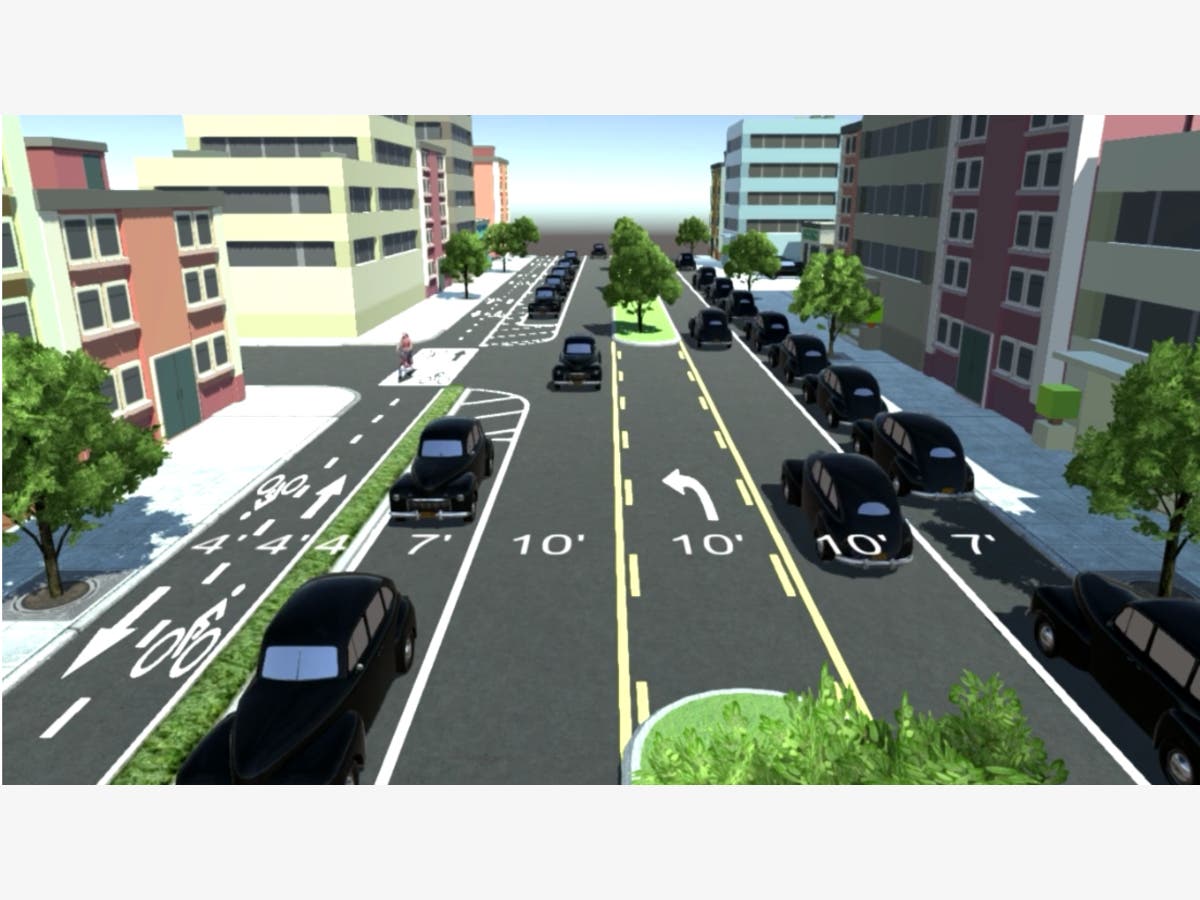
Speck proposes reducing Washington Street's four-lane "highway" to a single lane in each direction with a third lane in the middle to use as a turning lane when there are turns, or a median with trees when it's not needed. He proposes protected bike lanes and mixed-use buildings along the route, taller than the existing buildings as a way to protect the rest of the neighborhood from the noise of the highway that parallels the street. He cited studies in other communities from Oakland, Calif. to Reno, Nevada that showed that following a road diet, those communities found safer conditions for drivers and pedestrians.
Three lanes would reduce speeding and confusion, but would not reduce road capacity, Speck said, adding in many cases it had increased capacity through efficiency.
The vision also calls for zoning changes.
“New mixed-use multi-story buildings can front generous sidewalks with glassy store-fronts to encourage window shopping. Retail footprints can be larger to attract a good variety of tenants, parking can be located off rear alleys, below grade, or in nearby central parking lots, reducing the number of driveways and making the sidewalks safer,” he said.
What's already been done?
During the Fall 2011, a class of MIT graduate students from the Department of Urban Studies and Planning are studied West Newton Village and the Washington Street corridor. Students addressed the area from the intersection of Brookside Street at the east to the end of the commercial area on Washington Street before it crosses over the Massachusetts Turnpike at the west and came up with a thick booklet with recommendations.
On the heals of that, after almost a year of back and forth the City Council gave the thumbs up to a developer to go ahead with a project at Washington Place. It is slated to encompass the area known as the Orr block, three buildings on the north side of Washington Street, running from Walnut Street to Washington Terrace toward Lowell Avenue. The project will be multiple stories, up to 160 apartments and 40,000 square feet of commercial space. And approximately 25 percent of the units will be rent restricted for middle to low income residents.
About two years ago Mayor Warren's office announced a renovation was coming for the Washington Street Corridor.
"I announced we'd be updating and renovating Newton Corner through West Newton. In last year's capital improvement plan we set forth a vision for the next 5 years to address an upgrade this major artery in the city. We know the corridor is outdated and needs to accommodate pedestrians in a safe way, bikes in a safe way, and people who drive," he said.
So the city started a process to upgrade the corridor within the next five years. By 2018 the West Newton upgrades are slated to start, and then it will be Walnut Street in Newtonville's turn as the city addresses the corridor in segments.
What's the pricing look like?
"Generally design is roughly 10 percent of construction project," said Barney Heath of Newton's Planning department. "We're looking at a construction value of $4 million, roughly. "
Each segment would be slightly different in cost.
The city predicts that involving the community, and making sure all stake holders are involved in the decision and direction will be the biggest challenge to moving forward. It takes time to reach out and make sure people know about conversations.
"We're in the process of doing this with Newtonville," said Heath "We're trying to have a conversation with the businesses and the residents and the bike folks - police, fire, everybody has to be at the table when you're redesigning roadways."
The mayor's right hand woman Dori Zaleznik said it was a bit of a balancing act.
"But it's also a real opportunity to redesign a major corridor in a way that's more fitting for 21st century life," she said.
"It's a relatively wide street right now, said Heath, so there are opportunities when you're looking to redesign and accommodate without restricting the capacity.
"What we see and what we've heard is that if there's clear markings for where cars and bikes belong it tends to be a lot safer. Certainly the efficiency can be improved," he said. In West Newton Square, there are six traffic signals in a stretch that's less than a mile long, and they're not coordinated right now. "We're actually eliminating a signal and that will help."
Boston has been experimenting with dedicating lanes to bus travel and Heath said that's not out of the question for Newton. The opportunity to update commuter rail access is something they're eyeing, too, he said.
"Stay tuned and stay involved in the conversation," said Zaleznik, "I think the video that was presented is a wonderful long-range look but that has led some people to think things are further ahead than they are or the city is not doing anything at all. Neither is true. We are moving things along."
Mayoral candidates where do they stand on this?
Ruthanne Fuller
"Jeff Speck's vision of a walkable city ... making sure our roads and sidewalks are safe and usable for drivers and cyclists and pedestrians and linking to mass transit and the concept of having mixed use development where people can live and work and shop all in one place without going too far is terrific," said Ruthanne Fuller, who is running for mayor.
She also said called the idea of improving the commuter rail station compelling.
"My concerns are that this is a developers vision for Washington Street and I think it's important for the City of Newton and our residents to create our master plan for the corridor with our vision of what works well for the City," she said.
Another concern she said is getting the scale of the project correct - and in a way that doesn't lead to other problems, such as too little school space.
She said she liked the concepts, but she said: "I think we have important work to do to include our residents and business in developing a vision and fleshing it out."
Scott Lennon:
Mayoral candidate Scott Lennon said he, too, liked many of the concepts from the mixed use buildings, making the roadway safe for pedestrians and bikes and improved commuter rail access.
But, he said there were important stakeholders who needed to be consulted.
"I believe that the mixed use process up and down that corridor will be helpful, but you have to makes sure you're doing it collectively. I want to make sure we have a very robust conversation with everyone involved," he said.
Including existing businesses. The proposal showed a vision of mixed use buildings, but there are existing businesses in this area, he said. "And if they're not selling, how do we work with them on that?," he said adding the city should take a proactive approach to working with the community.
And then, he said, Speck's vision ended too quickly. "I think we should proactively plan along the whole corridor," he said. "There's a lot of opportunity here."
Check out the video here:
Photo screen shot from the video.
Get more local news delivered straight to your inbox. Sign up for free Patch newsletters and alerts.