
By Cara Cipullo
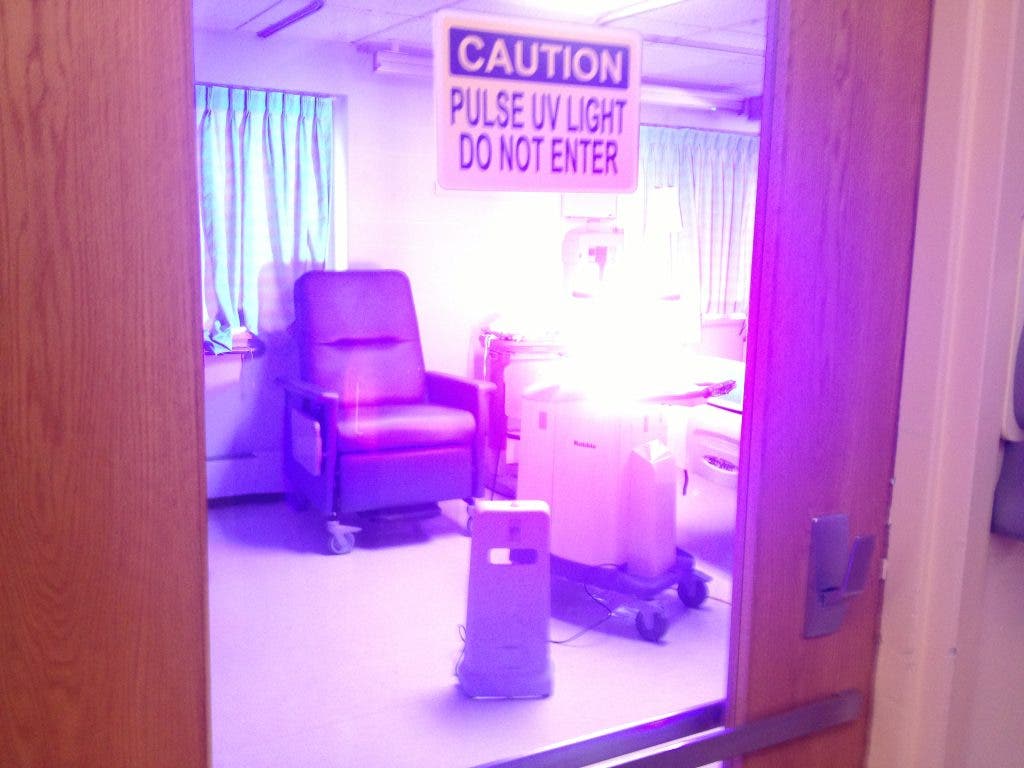
It might look like a mix of Star Wars R2-D2 and the extended neck of E.T., but it’s no alien or robot from a far-off galaxy. It’s a round metal machine that emits pulsating ultraviolet flashes to kill microbiological contaminants. It’s a Xenex system, also referred to as “Robbie.”
The Xenex machine, acquired in September 2012, is the new leading disinfectant at Signature Healthcare Brockton Hospital. It is one of four hospitals in Massachusetts to be equipped with this device, and the only south of Boston.
Find out what's happening in Nortonfor free with the latest updates from Patch.
The Xenex device, which gets its name from xenon lamps/pulse xenox UV, is designed to be a portable and highly - effective machine. The machine is known to get rid of some of the harshest bacteria such as CRE, Clostridium difficile (C. diff) and methicillin-resistant Staphylococcus aureus (MRSA), which are known as superbugs.
Ashley Hunter, account manager for Xenex Healthcare Services, explains that the machine on a cellular level works by emitting ultraviolet C light (UVC). UVC is filtered out by the earth’s ozone layer, unlike UVA and UVB. Bacteria, spores and viruses have never been exposed to this type of radiation, so when it gets soaked up into their DNA it destroys them and they cannot replicate or infect patients.
Find out what's happening in Nortonfor free with the latest updates from Patch.
The device not only destroys all bacteria, but also leaves the room with a fresh smell – it has the ability to eliminate some of the strongest odors.
According to Melinda Hart, Media Representative for Xenex, the device can kill the flu virus and norovirus in approximately 2 minutes. It takes the device about 4 minutes to kill C. diff spores, which can linger in a hospital for up to six months.
Hart also mentions that the device’s flash is 20 times stronger than the sun, and 20 times more effective than standard chemical cleaning practices – according to studies/customer results.
When turned on the Xenex acts like a camera – flashing and clicking, emitting a pretty purple light. Its “Smart Lamp” system has the ability to focus in on areas with “high-touch” surfaces, such as bedrails and remote controls. The machine then collects the information onto a database log for tracking and analysis by the hospital’s Environmental Services supervisor and Xenex.
The Xenex system also has a variety of safety features, such as a motion detection system that will shut down if it senses any motion in the room. Also, the UVC light cannot penetrate through doors, glass or plastic – and can be watched while waiting outside the room.
Anthony Quintiliani, Environmental Services Operations Manager for the hospital, says that Signature Healthcare is currently in phase 1 with the machine, a transitional period. It will take a while for the hospital to be completely free from the use of using disinfecting chemicals.
“It’s a basic device that does complex things to protect against hundreds of diseases that are out there we can’t see, it’s rewarding once you actually use it,” said Anthony Quintiliani.
The first of employees trained to use “Robbie” was Quintiliani, along with other supervisors.
Now, with the help of training by Xenex’s Ashley Hunter and James Grebinski, the hospital will slowly have staff on the floors use the device on their own as a part of their daily cleaning protocol.
Hunter reveals the hospital is using the machine as a second layer of cleaning at the moment, saying “Brockton is a really good candidate for graduating to the more effective protocols, such as eliminating bleach cleans. We (Xenex) are more effective at eliminating deadly microorganisms than bleach – and because of our studies, a lot of our hospitals are slowly getting rid of bleach all together. It saves on chemical cost, time and damage.”
When the device is first implemented at any hospital, it is used as a supplement to the normal protocols. Grebinski suggests that some hospitals will start by using it in rooms with discharges only, and then over time roll it out hospital wide.
This is exactly what Signature Healthcare is doing, currently using this machine as another layer of disinfectant in precaution rooms and nightly in the Operating Room.
Both Hunter and Grebinski point out that the device is also used as an “infection control tool”; another way of tracking infections, and identifying problem areas. The device is extremely data-driven.
“Different hospitals have different worry areas. So when we go in to implement a device we create a custom protocol so they can see results efficiently and effectively,” said Hunter.
Anthony Quintiliani reminds the public that the extra protection they’re getting at Signature Healthcare is better than any other local hospital.
“We are going the extra mile, and protecting patients, family members and staff.”