Politics & Government
Main Street: The Latest Update
City planners and project consultants provided the latest update on the Main Street Corridor project on Monday night.




All that remains is for the next week and hopefully a grant award from the state by the end of October – the Main Street Corridor redesign can then finally move toward fruition.
City planners and consultants from Green International shared the final plans to date on the project with the small crowd of residents, business interests, city councilors and other election candidates gathered in the Torigian Center on Monday night. The reception to the plan was much warmer than the last month, although not as many residents showed up this time.
“This is great work we’re doing,” said mayoral candidate Sean Fitzgerald at the close of the meeting. “This is exciting…a must do for us.”
Find out what's happening in Peabodyfor free with the latest updates from Patch.
Fitzgerald added that he hopes the city is or will be conferring with the Metropolitan Area Planning Council on regional transit issues while moving forward on Main Street.
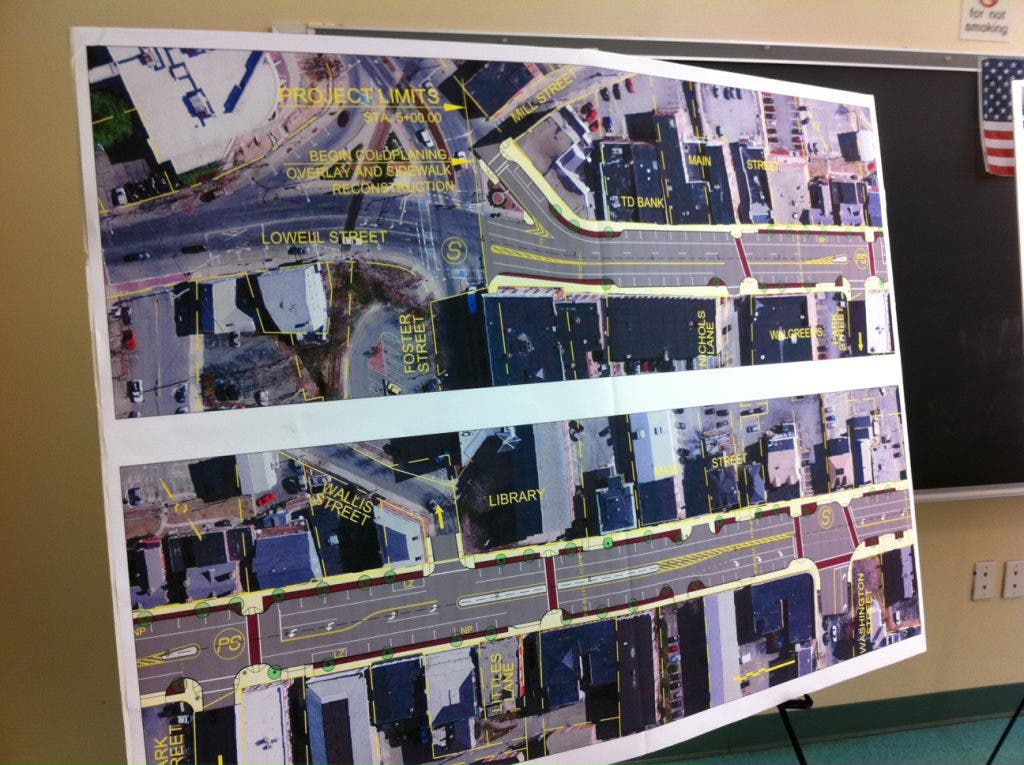
This final design, barring any further tweaks, still reduces Main Street to two lanes in most sections, incorporates dedicated turning lanes, a center turning lane in one stretch, more crosswalks, handicap compliant sidewalks, roomier parking spaces, designated loading zones, better lighting, more trees, Littles Lane won’t be touched and there’s no marked bicycle lane.
Find out what's happening in Peabodyfor free with the latest updates from Patch.
“No one in their right mind wants to cross four lanes of traffic in their downtown,” said Eric Atkins of Green International.
By reducing the number of lanes, the width of everything from the sidewalk to the remaining two traveling lanes can be increased. In terms of the roadway, plans call for a middle third lane to provide turning lanes at certain intersections and a longer center turning lane from Washington Street to Howley Street.
Atkins said his firm is coordinating closely with the city on its plans for flood work in Peabody Square, particularly in regard to the timing on traffic signals. Atkins said reconfiguring the square after the new underground culverts are installed will certainly affect traffic flow – the goal for Main Street is to plan for those changes.
Atkins said this plan will not adversely affect traffic on Lowell Street or Central and Foster streets for that matter.
The tentative timeline for the project, if the state approves the $1.5 million in grant funds, is going out to bid in January and commencing construction between April and early summer to have the project completed by the fall.
The plan itself is a 10-year plan, following a projection of about a half percent increase in traffic growth each year. Consultants noted that currently, overall traffic numbers are on the decline, although they admitted that might be due more to the economy than other factors.
Under the new plan, all the traffic signals along Main Street would be coordinated to allow for smooth flow as much as possible.
According to a traffic simulation by Green International, the new projected flow will be a marked improvement on current conditions on Main Street, in addition to making it a safer road to traverse. The simulation depicted traffic patterns at their heaviest: in the afternoon hours.
Consultants said that by making more effective use of existing lanes at key intersections, congestion is reduced.
Identifying the Washington Street intersection as one of the main problem areas, the plan would convert two lanes into dedicated turning lanes and allow one lane in either direction for through traffic. There would be both right turn only and left turn only lanes onto Washington Street, and a driveway across the street would also be added to the new signal configuration.
And further down the road, there would also be dedicated turning lanes in either direction from Main Street onto Howley Street. A left turn only lane would also be added for the driveway across the street off Main Street.
The center turning lane from Holten Street to Howley Street should provide safer passage into and out of high-volume businesses in that stretch, such as and CVS, according to the consultants.
The firm compared a study by Vanasse Hangen Brustlin from 2006 with one of its own and then added actual current conditions to the simulation.
“We want to make sure the model matches up with conditions we see in the real world today and not [end up] with some pie in the sky model,” Atkins said. He reiterated that the model does in fact show improvement.
Ward 2 Councilor Arthur Athas, who wasn’t entirely convinced the Washington Street intersection would be greatly improved with the changes, said he didn’t see much work slated for the half of Main Street headed toward Salem.
“I see very [few] positive things happening here,” Athas said, noting that stretch has more potential for commercial development than the other half of Main Street.
“You get people safely through the first half, then it’s open [country],” he said – prime opportunity for motorists to hit the gas.
Atkins said future consideration could be made for more crosswalks in that area, while noting engineers generally avoid placing them where there isn’t an intersecting road.
A major concern from residents skeptical of the new design has been traffic spilling over onto residential side streets due to congestion. That argument, however, wasn’t raised again on Monday.
City Council President Anne Manning-Martin, all in favor of the project, said her colleagues and other city leaders have some work to do on educating the public. She said it’s incumbent upon them to bring all the pieces of work downtown – flooding mitigation, development issues, Main Street, etc – under one umbrella so that residents can better understand the master vision and how it all complements each other.
“Without community support, we won’t get anything done,” she said.
All those present on Monday agreed.
“We need to get the word out,” said Tom Gould, who’s running for an at-large seat on the council, asking if more can be done to share the plans with residents via Peabody Access.
Michael Zellen, chairman of the downtown advisory committee, said Mayor Michael Bonfanti has instructed the group to dust off the city’s master plan for the downtown once this project is on its way to completion.
The master plan was updated several years ago, but according to Zellen, many of the ideas in the document were never acted upon as flood work, rezoning and Main Street dominated public discussions.
“We have a chance now to move forward with the downtown, which I think is unacceptable [in its current state],” Zellen said.
Fitzgerald asked about a parking garage after discussion turned to future plans to redo existing lots in the downtown similar to the Central Street parking lot. He sees this as a “perfect time” to try and dovetail that into completion on Main Street and major flood mitigation downtown.
Community Development Director Karen Sawyer, not denying a parking garage would be an asset, said the city’s focus on acquiring state funding has been primarily for the flooding work and Main Street. Zellen interjected that the issue was raised with U.S. Rep. John Tierney.
Zellen said Tierney told them federal funding was being reserved for transportation hubs that would include bus or rail transportation and the like.
Fitzgerald responded that he has a plan and that the city should be looking at funding under the state transportation bond bill.
Atkins said the same presentation on the updated plan would be made to the City Council on Sept. 22. He said the city was preparing to submit the state grant application later this week.
Atkins said the firm would of course continue to address any significant concerns in the design as the project moves along. He did, however, point out to City Council candidate Russ Donovan, who noted traffic backs up in the morning due to drivers turning left onto Caller Street, that the traffic plan couldn’t hope to solve every single issue on Main Street.
Additional features of the redesign:
- The two loading zones have been placed at Santoro’s and Wallis Street.
- The parking scheme for the street has been refined to now include 77 spaces – 16 fewer than exist now, but the new design will allow for wider, longer spots, much easier and safer to park in. City planners also said they are talking with business owners to consider sharing parking to accommodate downtown shoppers.
- No dedicated bike lane, but the wider shoulder of the road could safely accommodate bicyclists.
- 57 new trees along the length of the street and saving 17 existing ones.
- New wider concrete sidewalks and new curbing – all American with Disabilities Act compliant and with plenty of room for tree roots to spread.
Get more local news delivered straight to your inbox. Sign up for free Patch newsletters and alerts.