Schools
Peabody Teachers Get Training In Gene Editing
Jesse Byrne and Sarah Coleman were among 25 teachers who received training in cutting-edge technologies.

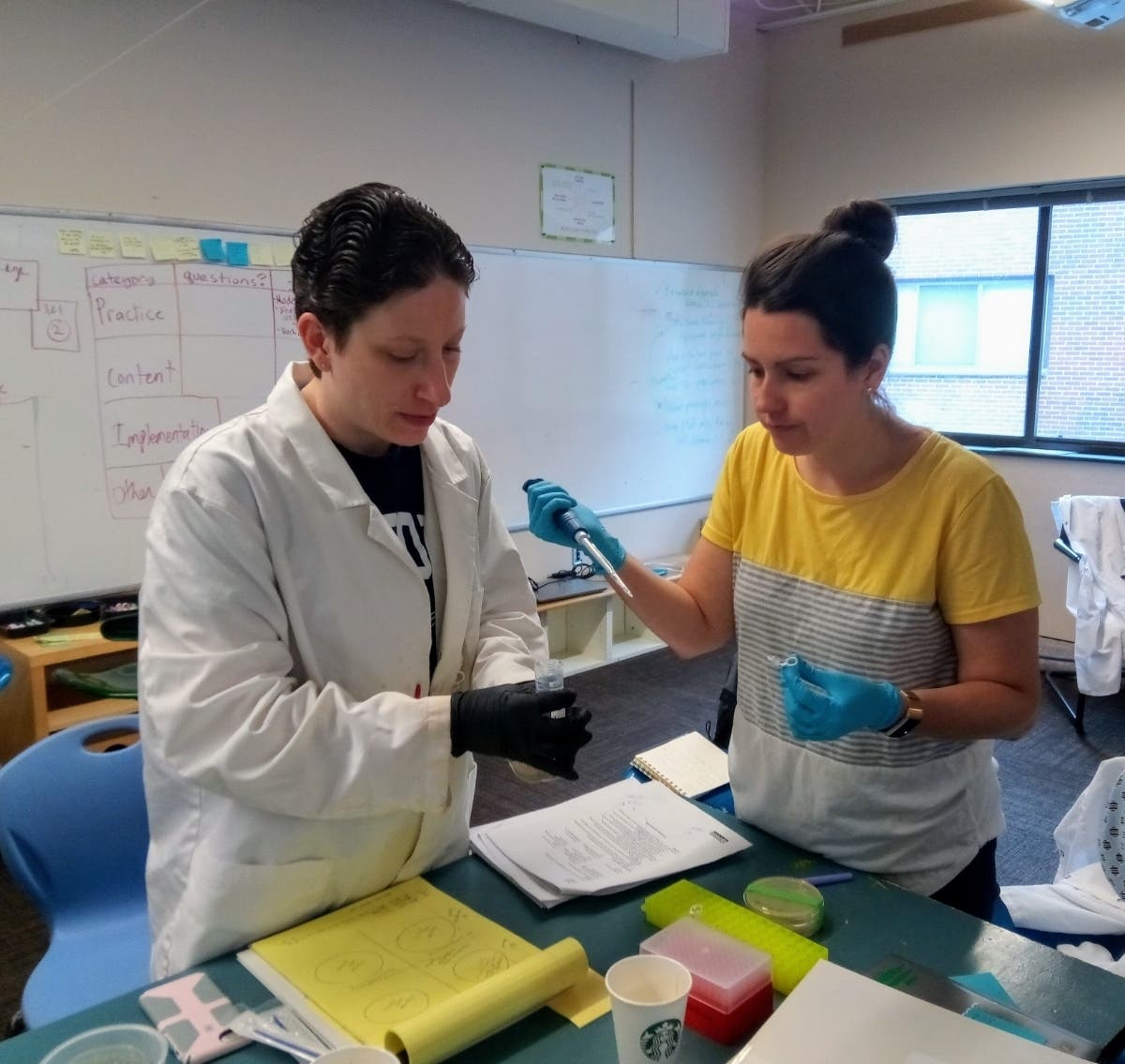
From Acera Schools: School may have just ended, but the learning continues for local high school science teachers. About 25 teachers – including two from Peabody Veterans Memorial High School – learned how to edit genes using CRISPR during a series of free professional development workshops by Acera Education Innovation (AceraEI). The goal is for participants to bring this curriculum to their own classrooms.
Short for “clustered regularly interspaced short palindromic repeats” CRISPR is a family of DNA sequences found within the genomes of organisms such as bacteria. The technique is considered to be at the leading edge of scientific research.
Peabody science teachers Jesse Byrne and Sarah Coleman participated in the training. They went through a three-day intensive workshop with AceraEI’s Life Sciences Lab Manager Michael Hirsch. Hirsch’s curriculum included conducting hands-on experiments using a CRISPR-based molecular biology assay and detecting bacterial transformation.
Find out what's happening in Peabodyfor free with the latest updates from Patch.
The workshops are funded through recent $50,000 grants from both the Amgen Foundation and Bristol-Myers Squibb. In addition to the training, teachers have access to ongoing support to assist schools in creating science labs that teach 21st century skills, engaging students in cutting-edge biology and fostering the next generation of innovators and scientists.
"Our students will be excited to engage in this hands-on CRISPR lab," said Coleman. "I learned so much, and it really got me thinking about different activities that I can engage my students in for next year."
Find out what's happening in Peabodyfor free with the latest updates from Patch.
AceraEI trained its first group of high school biology teachers in gene editing earlier this year, and participating teachers began applying the curriculum in their own classrooms with students. As a result of this training, more than 1,000 public school students will soon apply CRISPR to edit a gene in their high school science classrooms.
“All students should be able to link classroom learning to real-world innovations; the CRISPR toolkit is the first step in our plan to collaborate with schools to reinvent high school biology,” said Courtney Dickinson, founder and director of Acera. “Working with breakthrough technology that is in the news, and engaging in deep discussions to understand these innovations, including how they work and why they matter, makes science labs meaningful and enable students to see a pathway for themselves as future scientists and innovators.”