Arts & Entertainment
From Slavery to Freedom: Black History Walking Tour
Plymouth Antiquarian Society hosts a walking tour of the early history of Plymouth's African-American residences.




To honor Black History Month, two of Plymouth’s most respected historians are hosting a walking tour of Downtown Plymouth Saturday where the histories of Plymouth and slavery merge.
Donna Curtin of the Plymouth Antiquarian Society, and Karin Goldstein of Plimoth Plantation are hosting the tour, which will begin at Shirley Square at 1 p.m. Saturday.
For Curtin, this tour focuses on the many layers of the history of North Street; one of the most well-to-do streets for much of the town’s history.
Find out what's happening in Plymouthfor free with the latest updates from Patch.
“One of challenges, when you’re thinking of Black history, is that a lot of the research your working with may not yet have been done,” Curtin said.
Much of the research, which Goldstein wrote about in her , is limited by the sources.
Find out what's happening in Plymouthfor free with the latest updates from Patch.
“There is a copious amount of research and scholarship on the Colonial period here, but we don’t have a lot on the history of Africans and African-Americans in Plymouth,” Curtin said. “People are uncovering interesting materials in the records. We need to develop later history of Plymouth. At this point, it’s still piecemeal. We’re trying to use our resources.”
Curtin noted that while many New Englanders were well-known abolitionists, including many well-known families in Plymouth in the 1800s, in the 17th and 18th centuries, many of those same families owned slaves, albeit not in the quantities of the Southern plantations. Here, African slaves were more likely to work in the house than in the fields.
“Many New England communities try to forget that there was slavery in New England until the 18th century. They only think of the abolitionist movement,” Curtin said.
The story, as Curtin and Goldstein see it, begins in the 17th century. The tour will follow North Street, stopping at various houses and shops where slaves, slave-owners and abolitionists once resided.
In the 19th century, slavery was one of the most controversial topics in the country. Everyone, it seemed, had an opinion – even bricklayers.
One of the most interesting physical artifacts of the debate was found at the Blue Blinds Bakery, when the 12 Tribes community was renovating the old house as a modern bakery.
“While they were putting in the modern kitchen, they had to remove the old chimney stack and brick hearth,” Curtin said.
As workers carefully dismantled the hearth to preserve the bricks, they found one particular brick with an unusual inscription.
Most likely inscribed while the clay was wet, someone had written the words “If you free all the Negroes, you build us a prison as large as the Roman Coliseum.”
The brick was a shocking find, but it proves that despite the appearance that the North was anti-slavery, it wasn’t so clean-cut.
“It’s amazing that they carved this on a brick and put it here in a home on North Street where so many abolitionists lived,” Curtin said. “It touches on a thought that many people shared: If you free the slaves, what happens next, there was nothing in place and there were many ideas. Many people, white and black, thought to send the freed slaves back to Africa and that’s why Liberia was actually founded. But it shows that there was still this separation.”
Another amazing artifact is found down the street. An old, one-room shack in the back of one of the homes, which has been used as a tool shed for decades, is no believed to have originally been a slave dwelling.
“It’s extraordinarily rare, not only for Plymouth, but for New England,” Curtin said. “Slave dwellings tended to be small, little buildings, and they usually haven’t survived. That this one has been used as a tool shed probably helped it survive.”
Other artifacts were found in the written record, and even in literature, such as the story of Kwashi Kwandi, an African slave taken from his home and brought to Plymouth. The story was written by Jane Goodwin Austin, an American writer from Worcester.
According to Austin, Kwashi Kwandi refused to be given a slave name – his owner, a man named Dr. LeBaron, wanted to name him Julius Caesar – much like Kunta Kinte in Alex Haley’s book Roots. Kwashi Kwandi was beaten, abused, and starved, but he refused to respond to his slave name, and finally, having no choice, his masters acquiesced.
While the story may be fiction, it appears to have roots in Plymouth history, Curtin said.
Eighteenth century records show a slave named Kwashi Kwandi owned by the LeBaron family on North Street.
Finally, in the mid-19th century, come the stories of the abolitionists. North Street residents worked tirelessly for the cause, and encouraged popular speakers to come to Plymouth, but the stories of former slaves were the most powerful.
“There were many speakers involved who were incredibly moving, but it was a whole other story when Frederick Douglass came to town.”
With the backdrop of Plymouth Rock, a powerful symbol of freedoms that the Pilgrims probably never would have accepted, these speakers moved crowds of thousands.
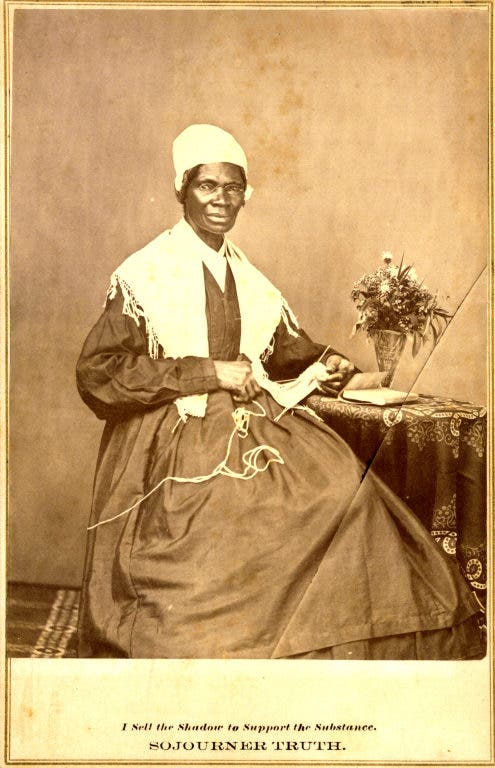
While its not known if Frederick Douglass came to Plymouth, ex-slave Sojourner Truth was one who definitely spoke in Plymouth.
“She was one of the most powerful voices of the abolitionist movement and women’s suffrage. I’m not sure if she spoke at the Rock, but she gave a speech where she discusses the Rock as this symbol and lambasted Daniel Webster, who gave an earlier speech at the Rock supporting the end of the slave trade but avoiding the subject of ending slavery,” Curtin said.
“But I like to imagine her at Plymouth Rock, using it as her symbol.
Black History Walking Tour
Join local historians Donna Curtin and Karin Goldstein for a slavery-to-freedom walking tour on the early history of African-Americans in Plymouth. Learn about black members of the Winslow household, including colonial America’s first published African-American author, Briton Hammon, once a family slave. Investigate what may be one of New England’s only surviving wooden slave dwellings, located on North Street, and follow in the footsteps of Plymouth’s fugitive slave residents, who journeyed north to freedom.
The tour is co-sponsored by Plimoth Plantation and the Plymouth Antiquarian Society and is free and open to the public. No reservations required. Meet at Shirley Square at the head of North Street at 1 p.m. For more information email pasm@verizon.net or call 508-746-0012.
Get more local news delivered straight to your inbox. Sign up for free Patch newsletters and alerts.