Community Corner
MEMA Issues Ice Safety Warning
We may be dealing with pretty cold temperatures, but officials warn ice on local ponds and lakes may not be frozen through.


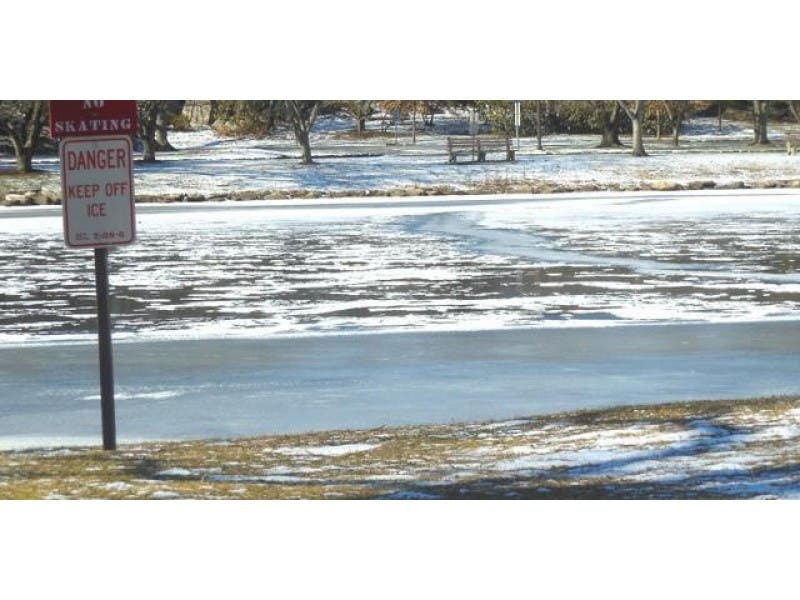
In spite of the recent cold spell, the ice conditions of many bodies of water across the state remain uncertain, as demonstrated by the recent ice rescues of a number of individuals and pets. Therefore, the Massachusetts Emergency Management Agency has issued information regarding safety precautions to be taken on our frozen lakes, rivers and ponds.
“Before we experience a tragedy that is unfortunately too common this time of year, it is important that we remind everyone, particularly children, of the dangers of unsafe ice,” said MEMA Director Kurt Schwartz. “People may be a bit impatient and venture out on the ice for skating, hockey, ice fishing and other winter sports before understanding the conditions. We highly recommend the use of recreational skating areas provided by the Commonwealth and your local communities. It is very important to exercise precaution and common sense.”
Find out what's happening in Plymouthfor free with the latest updates from Patch.
Always check with your local police, fire or park department to ensure that safe ice conditions exist. However, due to the uncertainty and constant changing of ice conditions and the dangers presented, many departments will not endorse the safety of lakes, ponds, streams or rivers. The strength and thickness of ice should be known before any activity takes place.
MEMA officials say by following safety procedures, you can be safe and enjoy the many winter activities offered by the great outdoors.
Find out what's happening in Plymouthfor free with the latest updates from Patch.
Here are some tips to stay safe:
- Never go onto the ice alone. A friend may be able to rescue you or go for help if you fall through the ice.
- Always keep your pets on a leash. If a pet falls through the ice do not attempt to rescue your pet, call 9-1-1 or go for help.
- New ice is usually stronger than old ice. As ice ages, the bond between the crystals decays, making it weaker, even if melting has not occurred.
- Beware of ice covered with snow. Snow can insulate ice and keep it strong, but can also insulate it to keep it from freezing. Snow can also hide cracks, weak and open ice.
- Slush is a danger sign, indicating that ice is no longer freezing from the bottom and can be weak or deteriorating.
- Ice formed over flowing water (rivers and lakes containing a large number of springs) is generally 15 percent weaker.
- Ice seldom freezes or thaws at a uniform rate. It can be one foot thick in one spot and be only a few inches thick 10 feet away.
- Reach-Throw-Go. If a companion falls through the ice and you are unable to reach that person from shore, throw them something (a rope, jumper cables, tree branch, etc.). If this does not work, go for help or call 9-1-1, before you also become a victim. Get medical assistance for the victim immediately.
- If you fall in, try not to panic. Turn toward the direction from which you came. Place your hands and arms on the unbroken surface, working forward by kicking your feet. Once out, remain lying on the ice (do not stand) and roll away from the hole. Crawl back to your tracks, keeping your weight distributed until you return to solid ice.
Get more local news delivered straight to your inbox. Sign up for free Patch newsletters and alerts.