Arts & Entertainment
Remembering the Training Green on Memorial Day
Every morning when I walk my dog in the Town Training Green, I think about how nice it is that Plymouth has such a lovely, historic park. Several days a year, however, like Memorial Day and Veterans' Day, I'm reminded of its earlier use.


The tradition of maintaining a “trained band” of citizens for defense came with the Pilgrims from England. Men between the ages of 16 and 60 were required to meet, or “muster,” for training four to six times annually. Muster time was also an occasion to check the condition of weapons.
As Plymouth grew in the early 18th century, the town began selling commonly owned land to private individuals. In 1716, three areas were designated not to be sold: the Training Green (laid out in 1711), Coles Hill, and the “Great Gutter” at the base of Burial Hill (now the site of the 1820 Courthouse).
Common land like the Training Green was used for a variety of purposes. In the 19th century, the green was one of the few places cattle could still graze. (Others included Burial Hill (!), Stephen’s Lane, and the area behind Market Street that became Market Street Extension.) People used the green for public gatherings and lectures. Of course, the green was also used for training soldiers--as recently as WWI.
Find out what's happening in Plymouthfor free with the latest updates from Patch.
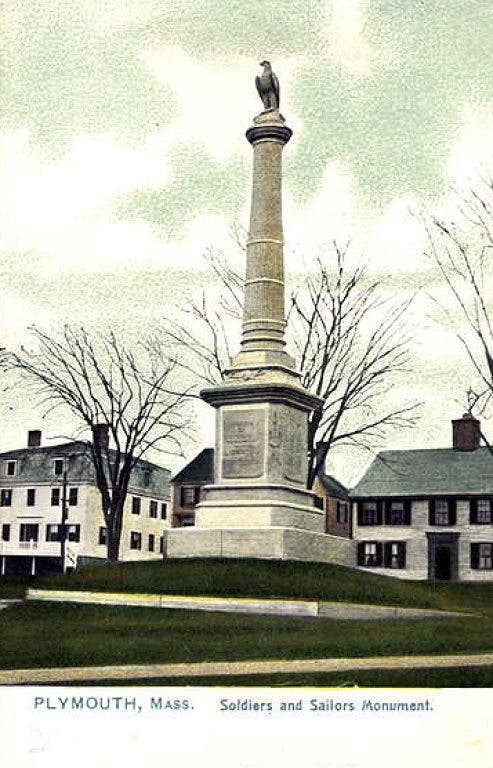
The Soldiers and Sailors' Monument on the Training Green, inscribed with the names of troops killed in the Civil War, was dedicated August 9th, 1869. Twenty years later, the town contracted the landscaping firm of F. L. Olmsted and Company to improve the park, by adding land from the adjoining streets and laying out walkways.
This Monday we commemorate Memorial Day, when we honor all of those who have died in the service of their country. Originally known as Decoration Day, in 1868 the holiday was set for May 30, “for the purpose of strewing with flowers or otherwise decorating the graves of comrades who died in defense of their country during the late rebellion.”* At Arlington National Cemetery in Virginia, the graves of Civil War veterans are still decorated.
Find out what's happening in Plymouthfor free with the latest updates from Patch.
By 1890, the holiday was observed by all of the northern states. It wasn’t until after World War I that the South observed Memorial Day as well.
In 1971, Congress moved the holiday to last Monday of May as a time to remember all of those who died in military service. Over the years, Memorial Day was extended to include visiting the graves of all deceased relatives. Today most of us observe Memorial Day as the start of summer, with a long weekend, cookouts, shopping, etc.
Whatever we do this Memorial Day, let’s not forget those who have died for our country. Let’s also not forget the meaning of Plymouth’s Training Green and other war memorials. “Let no wanton foot tread rudely on such hallowed grounds. Let pleasant paths invite the coming and going of reverent visitors and fond mourners. Let no vandalism of avarice or neglect, no ravages of time testify to the present or to the coming generations that we have forgotten as a people the cost of a free and undivided republic.”
*General Orders No.11, May 5, 1868 [designating May 30 as Decoration Day], by General John Logan, national commander of the Grand Army of the Republic