Arts & Entertainment
Two Halves Make a Whole
The urban renewal projects of the 1960s leveled most of the houses on the eastern end of Summer Street, but one house survived.
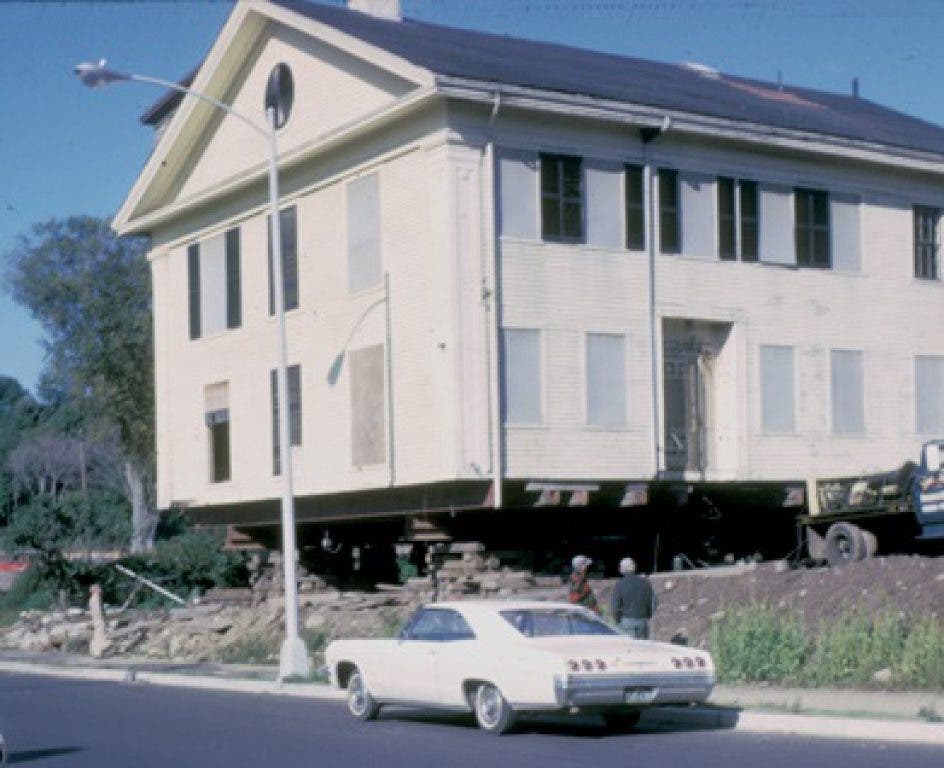


If Plymoutheans from 150 years ago walked through town today, they would be confused by what they saw. Not only have two entire areas been torn down and rebuilt (the waterfront and the Summer/High Street neighborhood), but several houses have been moved from their original locations.
Moving buildings was not uncommon in the 19th and early 20th centuries. Streets were widened and owners moved their structures back from the road. In other cases, when property was sold for a new use, people often purchased the buildings on the lot and moved them to a new location. Perhaps the best-known relocated building is the Hedge Antiquarian House, now on Water Street. It used to stand on Court Street, but was moved a block over when the lot it stood upon was purchased as the site for Memorial Hall in 1919.
The First Parish Church Parish Center, located on Church Street by Burial Hill, is another relocated building, with an interesting history. The handsome Greek Revival structure started as a family home at 67/69 Summer Street, a block or so west of what’s now the John Carver Inn. The Finney family acquired the property in 1840, and the house was built soon after. In 1857, Ezra Finney sold the east half of house out of the family.
Find out what's happening in Plymouthfor free with the latest updates from Patch.
Houses owned by two families were not unusual. Portions of a single-family home were often divided among heirs, and sometimes one would sell his or her part out of the family. The two owners did not always decorate or care for their halves in the same way. That’s what happened to the Finney house.
Let’s fast forward almost a hundred years, to when architect Charles Strickland wrote a report on the neighborhood, which contained many historic houses. Strickland quipped that “it would still have the appearance of a single house, in good condition, if the present owners would come to some understanding as regards what they both would consider to be a good year to paint the exterior.”
Find out what's happening in Plymouthfor free with the latest updates from Patch.
In the early 1960s, the first three blocks on the north side of Summer Street were slated for urban renewal. The town acquired the properties, including 67/69 Summer Street., which still had two distinct halves to its façade. According to a 1960 report on the neighborhood, “a cloud on [the] title prevents correction of needed repairs.” Like others in the neighborhood, the house was scheduled to be demolished.
The Plymouth Redevelopment Authority, which managed the renewal project, offered any of the houses to be cleared for sale. While most fell to the wrecking ball, the Finney house did find a new home. The First Parish Church purchased the building and moved it to Church Street, to be joined with an old chapel building that had formerly stood just off Town Square for use as a parish center.
Today the old Finney house sits just above First Church, united again under a single owner and a single coat of paint.