Neighbor News
Wind turbines blow down property value, says expert
Case Study Data: The most reliable method for determining property value Mason County, Michigan.
Wind turbines blow down property value, says expert
Article from Wind Turbine Syndrome ---Sep 24, 2012
“Direct Evidence of Value Impact:
An Appraiser’s Perspective on Living with Wind Turbines”—Michael S. McCann, CRA, McCann Appraisal, LLC (Chicago, Illinois, USA)I can understand why some people have no clue as to what constitutes “direct evidence of value loss” when they have zero training or education as a professional appraiser.
Find out what's happening in Plymouthfor free with the latest updates from Patch.
Further, when self-interest is placed above objective analysis by anyone, wildly different opinions are the result.However, different does not mean equal. Being duly licensed, and with over 30 years experience in professionally evaluating the impacts of one land use on the value of another, please permit me to clarify.There is a hierarchy of evidentiary value, or how reliable certain information is construed, vis-à-vis other forms of potential evidence.
Case Study Data: The most reliable method for determining property value
Find out what's happening in Plymouthfor free with the latest updates from Patch.
The most reliable evidence is represented by Case Studies, or individual examples of value loss, directly linked to the cause of value loss. This can be true for a contaminated property, a loss of parking from a shopping center, or indeed from a wind energy project of one or numerous turbines.
A good example of a Case Study is represented by a recent appraisal assignment in Michigan.
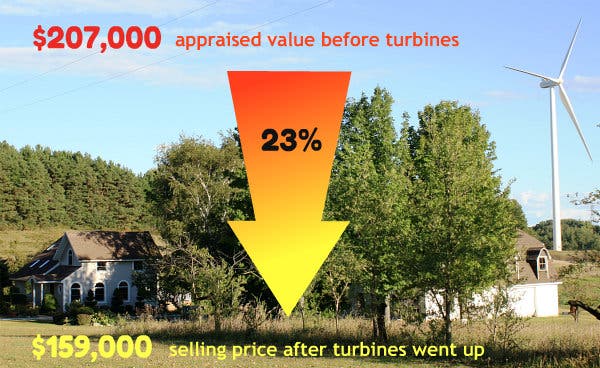
I appraised this home (see above) prior to the approval or construction of the Consumers Energy Lake Winds project in Mason County, Michigan. All pre-turbine comparable sales considered, this property was worth $190,000. Nice home on a small acreage lot, remodeled and updated, great view of apple orchards and a rural countryside.
I appraised this property in June 2011, and the market increased about 9% since then, indicating it should have increased in value to about $207,000. With a typical Sale:List price ratio of 95%, under pre-project conditions, this adjusted value should have resulted in a recommended list price of $217,900, to allow for the negotiation to bring the selling price to the $207,000, June 2012 “market value.
”However, since then the wind turbine project was constructed and industrial-scale turbines have been built within about 1/4 mile of this residence (and many others). This family decided to move away from the turbines (which, incidentally, establishes the direct link) and local realtors told them that being located in the turbine project, they would not list the property based upon the appraised value, and would not list it unless it was discounted to a $169,000 asking price.
Thus, the realtor community acknowleged the loss of marketability, and enforced a beginning discount that was contrary to the pre-turbine project market value, much less the increase since then. With the nearest turbine quite obvious and present, the final sale price was $159,000, or 23% lower than market value (as adjusted for market appreciation during the intervening year).In this Case Study example, the nearest turbine had been only “tested,” and there was no direct experience for the seller in their own home with any noise, audible or LFN, or flicker, although clearly within range of both noise and visual impacts.
One of the owners did spend one night in a residence similarly situated near a turbine in the same turbine project that was running that night, and reportedly was disturbed to the point of being convinced he would not be able to endure living under such conditions.
This case study illustrates a 23% value reduction, clearly, and with no in appropriate considerations, from an appraisal perspective.Absurdly, the wind energy industry has attempted, with some success, to cast this direct type of evidence as being “merely anecdotal,” and in their (non-expert) judgment, unreliable.
On balance, the Appraisal Institute is a far more reliable and authoritative source on valuation matters, methodology and techniques. It is, as well, the leading education provider for appraisers in the USA, and is the oldest appraisal association. Their published text on valuation of detrimental conditions clearly states that “Case Studies” are the most reliable data upon which to base a professional valuation conclusion in situations of detrimental conditions—like this one.In addition, courts of law will typically consider a very recent sale of a property to be the “best” evidence of its value—not merely “anecdotal.”
The Uniform Standards of Professional Appraisal Practice (USPAP), which is a regulation applicable to the entire community of licensed appraisers, has a specific regulation (SR 1-5) which mandates an appraiser “must consider and analyze any sale of a subject property within the prior 3-year period.”With regard to Case Study data, what the wind industry calls anecdotal or unreliable is exactly the type of information that the appraisal profession and the courts typically rely upon as being the best evidence.
Bottom line: Case Study data is factual and empirical, and is therefore the most reliable.
[truncated due to possible copy right] click the url to read the entire story :
Source: http://www.windturbinesyndrome.com/2012/wind-turbines-blow-down-property-value-says-expert/