Seasonal & Holidays
Barry's Berman's Memorial Day Address
Through the story of Reading's Ernest Leach, Select Board Chair asks residents to serve their town and country.


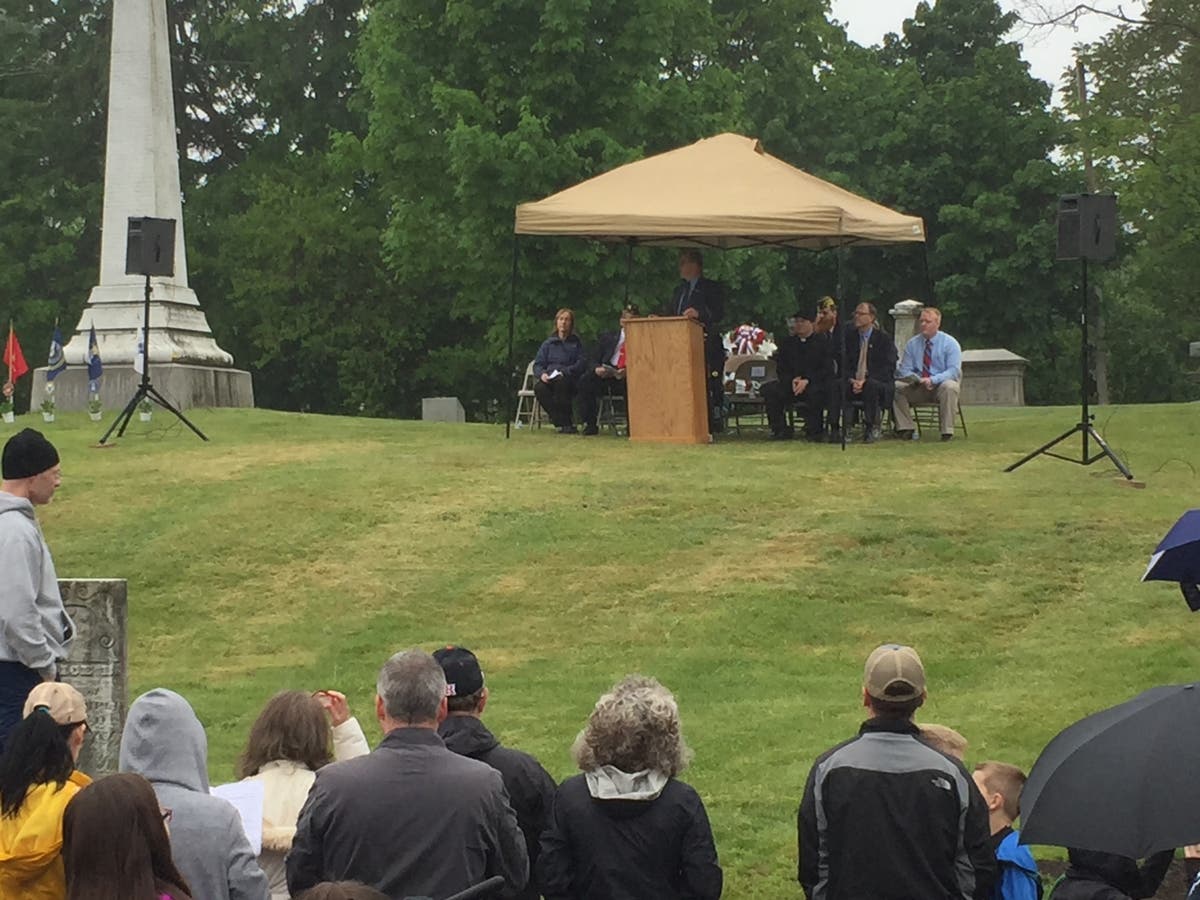
Reading Select Board chair Barry Berman's Memorial Day address:
Good Morning Distinguished Guests, Friends and Neighbors.
In Flanders fields the poppies blow
Between the crosses, row on row,
That mark our place, and in the sky,
The larks, still bravely singing, fly,
Scarce heard amid the guns below.
Find out what's happening in Readingfor free with the latest updates from Patch.
Thus opens the first stanza of Canadian poet and Army Doctor John McCrae’s seminal poem about the killing fields of Belgium during the Great War. We are approaching the 100 th anniversary of the end of that bloody conflict, the war that was supposed to end all wars. Reading contributed its fair share of men and women to that great cause. With then a population of just under 7000, over 400 men and women served overseas, and fourteen gave their lives. The town erected a memorial in 1939 to honor them. You passed it on the way in.
Today I want to tell you about one of these remarkable men of Reading, Ernest Leach. Most of what I am going to tell you was taken from snippets from the Reading Chronicle. It was provided to me by town historian Virginia Adams, whom we all owe a debt of gratitude. In those days the Chronicle regularly published letters home from soldiers, redacting location. It gave us an inside look at the war, and the impact it had on the soldiers and nurses. Ernest Leach graduated HS in Reading and then worked as a teller at the First National Bank in Reading.
Find out what's happening in Readingfor free with the latest updates from Patch.
Although Mr. Leach had scarcely reached his majority when Germany continued its ruthless submarine
warfare, he sensed that the time had come for America to do her part. For months he had been desirous of crossing the seas to fight the Germans. Declining to wait for America actually to formerly enter the war, he left his position at the bank and went abroad, joining an American ambulance unit serving in the French Army. He was the first Reading resident to go overseas. This conjures up images of the heroic and dashing character Frederic Henry from Hemingway’s novel “A Farewell to Arms.”
While the fictional Lt. Henry drove ambulances in Italy, our true life hero was assigned to Verdun, in France. Those high school students here who have studied WW1 might know that Verdun was one of the bloodiest battles in the annals of recorded human history. In the few short months, there were nearly 750,000 casualties. He spent most of the six months he was in the ambulance service in Verdun.
Once, as he was returning to a hospital with a wounded soldier, a piece of German shell passed through the ambulance, putting it out of commission. Despite the fire, he saw that the wounded man reached a relief station safely. In a letter he sent home shortly after this experience, he said that war was worse than he had believed it could possibly be, but he added in true American spirit that the men in his unit were ready for anything, whatever that anything might be, “if the United States only comes and keeps on coming” until Germany is crushed “and a secure, lasting world peace is assured.”
Miraculously, he survived Verdun. When his tour of duty was over, he had the option of returning home. By this time America had formerly entered the war, and was in desperate need of pilots. Instead of returning to America to recuperate, he answered the call and entered the American army’s aviation instruction detachment. “It took all my will power to pick aviation as my service branch, after I had seen a number of planes brought down in air fights and had seen the results at close range,” he said in a letter to a friend. “But I figured that if anything was going to happen it would happen just the same in one service or another. At least, one can feel here as though he was doing his full part.
He completed flight training in half the allotted time and was commissioned as Lieutenant. On January 23, 1918 while training another pilot, the pair encountered 20 German planes at high altitude. They encircled and got beneath him. Notwithstanding these disheartening odds, Leach’s nerve did not fail. He had no gun or weapon of defense. His plane did not possess the speed to leave the pursuers behind. His life depended on his ability to out maneuver the enemy planes. And this he did. With a skill probably never before possessed by an aviator with so brief a training, he got safely through the network of German planes. However with no safe place to land, the wheels of the plane came down on mud and skidded. He was thrown from the plane against a stone wall and was killed instantly. Ernest Leach was 22 years old. He was the first Reading casualty of the war.
Efforts by his family to bring his remains home here to Laurel Hill were not successful. He is buried at an American military cemetery at Lorraine province in France. How did Reading choose to honor Lt. Leach
upon his death? Article 17, of the March 24, 1919 Town Meeting “ it was voted to change the name of Mayall Park to Ernest Leach Park in honor of Ernest H. Leach, the first boy from Reading to make the supreme sacrifice in the German War. Those of you who live on the West side pass Leach Park every day. It is the park at the corner of Hopkins St. and Summer Ave, not far from where Ernest grew up. I am sure this beautiful park will take on more significance as you learn about the hero for whom it is named.
How do we, a grateful town, 100 years later, honor Ernest Leach and the thousands who came after him, and the current cadre of brave men and women serving today in fields afar?
First, we remember, and we tell their stories. Second, and no less important, we act. In one of his last letters home, he fully realized the seriousness of his undertaking, yet he said “if I don’t come back, please remember that I do this willingly and gladly. I feel that the cause is worthy of me.” That cause was freedom and democracy.
All too often, we are content to leave key decisions to others. We don’t participate to the full extent of our abilities. We become complacent. In our recent town election we were ecstatic that turn out exceeded 40%. But what it also meant is that over half of us stayed home.
Today, as 100 years ago, worldwide and national events impact our peaceful little village. This will also be the case 100 years from now. As idyllic as we hope our town life to be, we are not an island. But these events also shape and hone us and spur us to action. It did for Ernest Leach, and it does now for our current sons and daughters in uniform.
For those of us too young or old to wear the uniform, or whose talents and interests lay elsewhere, how do we answer the call to duty? I believe we must put ourselves where we are needed, right here in town. Run for town meeting; join a board or commission. Currently we are recruiting for dozens of openings on town boards. Be a coach. Mentor a child. Visit with a shut in. Write a check. Donate time. Do what you can to strengthen the institutions and the fabric of our democracy. Advocate for your beliefs. Disagree without being disagreeable. Pitch in. Engage. Show up. Ernest Leach left us a wonderful legacy of service over self. Let’s all of us try our best to honor that legacy with our own service to the town and country we call home.
Photo of ceremony at Laurel Hill by Bob Holmes
Get more local news delivered straight to your inbox. Sign up for free Patch newsletters and alerts.