Neighbor News
I'm For a Passing Override
Question: What amount would YOU place on a ballot question, to be assured that voters would approve that amount?

A yes/no override ballot question is an all-or-nothing, yes-or-no proposition.
In October 2016, Reading voters turned down a proposed tax override amount of $7.5 million (~$1,000 tax increase on a $600,000 household). Those for and against the $7.5M override were separated by about 20 percentage points at the polls, with 40.6% (2,795) voting to approve that amount, and 59.4% (4,097) voting it down.
For those who may not be familiar: “Proposition 2½" (also called “Prop 2.5”) is a Massachusetts law that sets 2.5% as the maximum amount by which a town may increase its total tax levy in a single year. An “override,” therefore, enables the municipality to override Prop. 2.5—in order to increase the town’s tax levy by an amount greater than 2.5% in a single year—provided that the increase is approved by the majority of voters.
Reading voters will most likely have another opportunity to vote an override ballot question on April 3rd, but first the 5-member Board of Selectmen must determine what amount to put forth for consideration. That meeting (open to the public) will occur next week on January 30th. I hope all residents will consider coming and sharing their perspectives during Public Comment.
Find out what's happening in Readingfor free with the latest updates from Patch.
If the Board’s override ask amount is perceived as a moderate household impact, it will have a higher likelihood of passing. In that instance, Reading benefits by receiving funding for areas of priority.
If the Board’s override ask amount is perceived as a high household impact, it will have a higher likelihood of failing. In that scenario, Reading gets no funding for any needs.
Find out what's happening in Readingfor free with the latest updates from Patch.
How much is acceptable ?
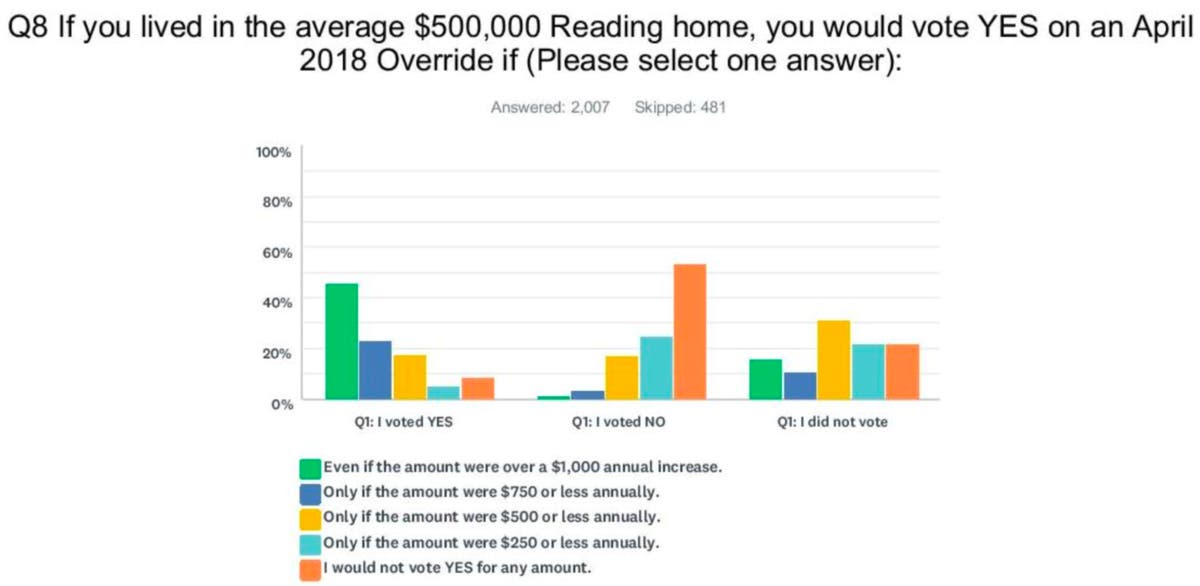
The thousands of responses to the 2017 Selectmen’s Survey on this topic illuminated how Reading voters felt regarding a forthcoming ballot question on an April 2018 override. The data showed:
- Voters who voted YES in October 2016 to the $7.5M override were generally strongly motivated to vote yes again on another override, and,
- Some voters who voted NO previously would consider changing to to a "yes" vote if the override increase for the average home were reduced to:
a) less than $250 (~$1.875M total ask), or,
b) less than $500 (~$3.75M total ask)
Note: the FY18 single family home average assessed value in Reading is $559,803, FY18 tax rate is $13.87 per thousand, making the "average" FY18 tax bill (or, tax bill for a ~$560,000 value home in Reading) work out to be $7,764.
Here's a snapshot of the relevant survey data gauging tolerance to varying override levels:
In addition to the above, the many comments collected by the survey demonstrated that residents did not trust that elected officials were spending their tax dollars wisely. Though no survey exhaustively captures all opinions, and opinions can also change over time or with new information, the Board of Selectmen’s process since receiving this feedback reflects a healthy respect for this "Trust Gap."
Over the course of several meetings open to the public, Reading’s Town-side and its Schools have each demonstrated substantial needs not currently afforded by the tax levy.
Some key questions elected officials and voters must consider, in any discussion about an override, are:
- How can Reading best balance respect for its residents’ reactions to proposed tax increase levels, against the town’s present substandard public safety accommodations and programmatic gaps in the education of our youth?
- How much are we collectively willing to risk in an April override ballot question ask?
How did Reading get to this point?
Some costs shared between the town and school (common costs are called “Accommodated Costs” in the budget) are funded first, by law and/or mutual agreement. These include spending for medical insurance, special edutcation, and employee benefits. Some of these accommodated costs have grown faster than our town revenues have (and, moreover, these costs are usually outside of the town’s control). Over several years, the gap between costs and revenue grows to unsupportable levels.
For the past 14 years (time since the last override Reading voters passed), the Town Manager and Board of Selectmen have compensated for increases in Accommodated Costs by shrinking other Town and School costs:
- We've shared (“regionalized”) common functions with other towns to reduce staffing costs.
- We shared some responsibilities between town and schools.
- We delayed hiring in public safety.
- We asked some salaried staff to cover nighttime hours to reduce hourly staff.
- We have reduced hours in the Senior Center and Library.
The Board of Selectmen have likewise increased revenues from non-property tax sources such as ambulance transport, building permit fees, and depot parking fees.
Why is an override needed now?
Despite the Board of Selectmen’s efforts to reduce expenses and grow revenues, Accommodated Cost growth has now crowded out funding for basic services like public safety and full-day programs at our schools.
Did you know that...
- Reading’s police force is the exact same size today (41 officers) as it was in 1967, when Reading’s population was about 7,000 fewer? In addition to ~7,000 more residents to protect, our officers are charged with a very different set of issues today than existed in the 1960s (including the advent of technologies and the internet; high density housing complexes; the opioid epidemic; more than daily calls related to the use, sale, and theft of drugs (and drug-related violence); and of course ‘ordinary’ emergencies).
![]()
- Reading’s Fire Department crews are likewise at or near minimum manning. An injured firefighter means the task of fighting fires or rescuing citizens falls on a team with one less person sharing the load. What suffers, with reduced Fire and Police staff, is their ability to respond to you in a timely fashion, when you need them most.
- Reading Schools require restoration of multiple teaching positions, in particular middle school foreign language positions, to prevent interruption or elimination of existing classes. The Reading School Committee budget pages provide a full review of their lengthy meeting discussions.

It’s how we’re built
Because about 72% of Reading’s total tax levy (our budget) comes from property taxes, and 92% of those property taxes are paid by residential properties, homeowners are under significant financial pressure in this town. (Note: of the remaining 8% of property taxes that come from the Reading's Commercial-Industrial segment, just 6 parcels account for 40% of that share, due to their size (think Home Depot, Staples, and Jordan’s Furniture). Reading’s 189 smaller commercial parcels comprise the rest.)
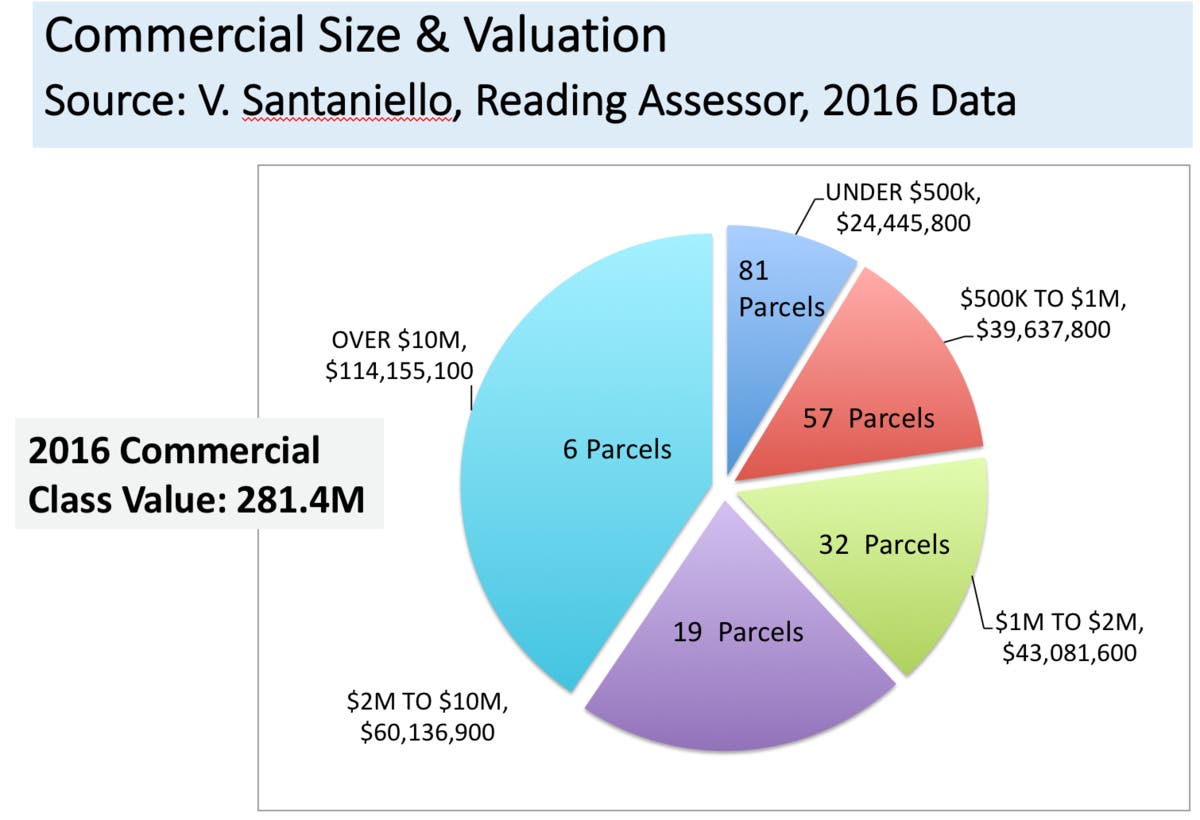
If Reading can grow revenues from an area other than residential property taxes (like attracting new businesses/more commercial tax income to town), that financial load on the everyday taxpayer will be lessened. That is why the Board of Selectmen have taken earlier steps to grow economic development in this town. Hopefully we’ll see the fruits of that labor coming over the next several years.
It’s clear to me, however, through years of reviewing our town budget and spending, that Reading’s current makeup (heavy dependence on residential property taxes coupled with high student headcounts) forces the town to entertain an override question periodically.
That time is now.
What should be done?
Given the gaps in services described above, I personally believe that Reading needs to pass an override this year in order to replenish its town and school services.
I am not for just putting forth a ballot question. I want to see the ballot question pass.
At the Board of Selectmen’s meeting on January 30th, I pledge to do everything in my power to present the voters with an ask amount that will pass. A failed override benefits no one, and in fact will jeopardize and harm many. I am unwilling to risk another year of barebones public safety and patchwork budgets that leave our Municipal and School organizations with inadequate resources.
It’s an all-or-nothing, yes-or-no, win-lose proposition, and much is at stake in this decision.
What amount would you place on a ballot question, to be assured that voters would approve that amount?
###
N.B. The views expressed in this article are my own, and do not represent the position(s) of the Board of Selectmen. Find this post, and more like it, at: www.JohnArenaforSelectman.com/blog