Community Corner
Martin's Pond Group Hosts Eurasian Milfoil Meeting on March 11
Martin's Pond is facing a crisis - the introduction of Eurasian Milfoil. Eurasian Milfoil can quickly overtake a pond.
For those unfamiliar with this invasive, Eurasian Milfoil is a “highly aggressive” invasive plant that forms heavy underwater and surface mats that can quickly crowd out native aquatic plants which provide necessary oxygen for underwater wildlife. Thick growth can impair recreational uses such as boating, swimming, kayaking and fishing. Heavy growth of Eurasian Milfoil can quickly degrade the habitat of native fish and all other wildlife who reside in or near the pond. Martin’s Pond is enjoyed by wildlife ranging from the Great Blue Heron, Osprey, Mergansers, Bald Eagles and various other birds and waterfowl, not to mention its rich and diverse fish population.
Eurasian Milfoil is easily spread by plant fragments, which are abundant in infested waterways. A little one inch piece of plant fragment can start a whole new plant colony. These fragments can be carried downstream by water currents or inadvertently picked up by boaters and this leads to rapid spreading. Once Eurasian Milfoil is introduced in any body of water it spreads very quickly and full eradication is never possible. Martin’s Pond is a perfect candidate for rapid Milfoil growth because of its shallow depths and warm water.
In the summer of 2013 a new plant was noted along the edge of the pond. In 2014, Dr. Jonathan Lyon of Merrimack College performed a study and identified the Eurasian Milfoil in 70% of samples taken in the shoreline areas up to a depth of 6 feet. Massachusetts Division of Lakes and Ponds confirmed the identification. Dr. Lyon’s report is available at www.martinspond.org under Environment/ Studies and Reports. Those who have been on the Pond this past year have noticed that the Milfoil matting is the heaviest from shore to 50 feet out in some areas and it is working its way toward the middle.
Find out what's happening in Readingfor free with the latest updates from Patch.
The Martin’s Pond Reclamation Study Committee has been attending conferences on this subject, talking to the State about the Milfoil and has been speaking to other lake and pond associations who are dealing with this issue. “Early Detection and Rapid Response” has been the only successful factor when dealing with Milfoil. Martin’s Pond also feeds the Ipswich River Watershed and the downstream effects of the Milfoil are a concern.
The good news is the Eurasian Milfoil in Martin’s Pond is still at a stage where it can be “controlled” if those who care about the pond take immediate action to save this resource.
Find out what's happening in Readingfor free with the latest updates from Patch.
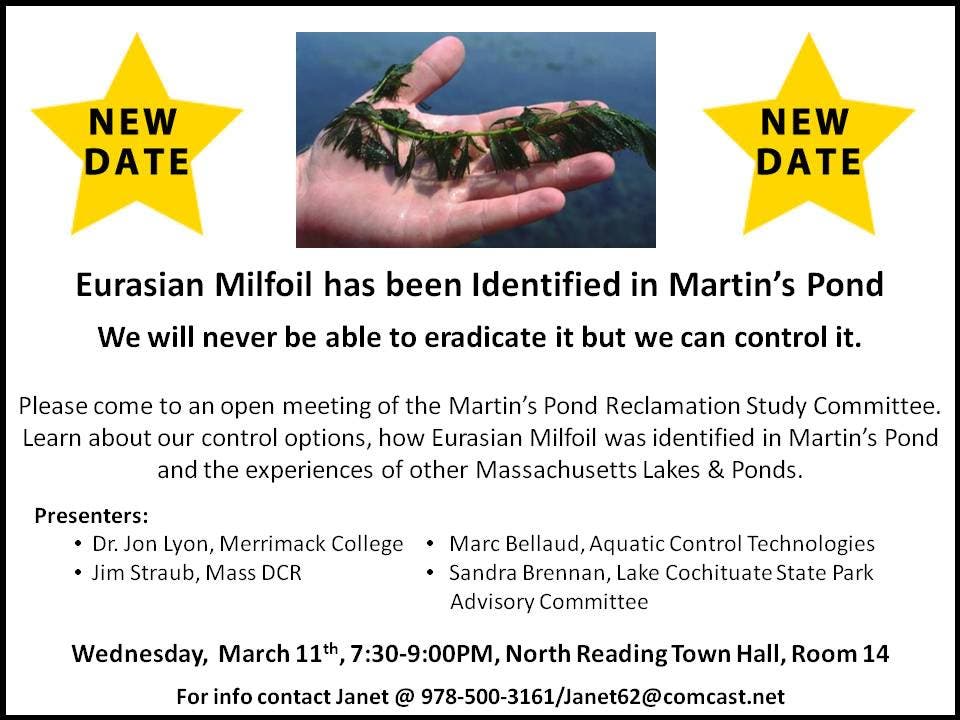
To learn more about this issue and control/treatment options please come to a public meeting of the Martin’s Pond Reclamation Study Committee at Town Hall on Wednesday March 11th 7:30-9:00PM in Room 14. Dr. Lyon will present his findings, Jim Straub of Mass DCR will share his experience with hundreds of lakes and ponds in Massachusetts, Marc Bellaud, an aquatic biologist from Aquatic Control Technologies, will discuss treatment options and costs, and Sandra Brennan, Lake Cochituate State Park Advisory Committee will tell us about her experience and success in controlling Eurasion Milfoil in Lake Cochituate. Town officials will also be on hand, as will committee members to answer questions and discuss our options. All town officials and boards are urged to attend. For more information please contact Janet Nicosia at janet62@comast.net or 978-500-3161.