Community Corner
Override More Than A Dollar Figure To RMHS Guidance Director
With events in Florida as backdrop, Lynna Williams is concerned about kids' social and emotional well-being.


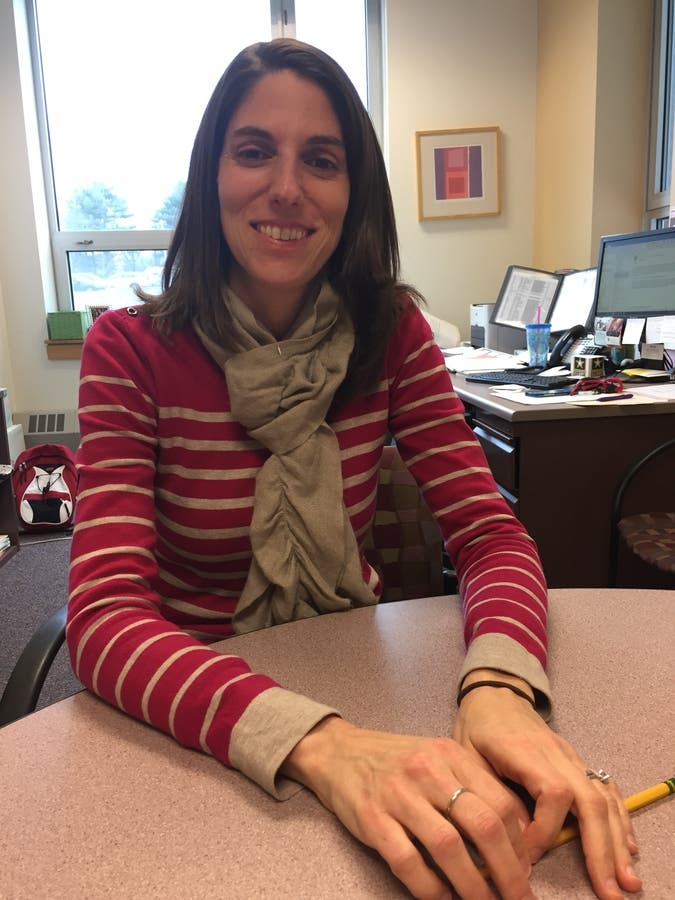
Students, residents, and especially voters, Lynna Williams has instructed us to turn to page 63 of the Superintendent's Recommended Budget. You won't need a No. 2 pencil and the test doesn't come until April 3. But ask Williams, Reading Memorial High School's Guidance Director, what concerns her most about the upcoming override vote, and her answer is buried behind pages and pages of FTEs, FY19s, and BCBAs. There are no dollar figures in her explanation.
And behind it all is Florida.
See if you can do it. Try reading a story about the social and emotional well being of Reading children without thinking about Marjory Stoneman Douglas High School. School budget presentations, middle school foreign language, class sizes, it all has led to a $4.15 million override question on April 3. But the day after the horrific shootings, talking about cuts to the regular day cost center seemed silly.
Find out what's happening in Readingfor free with the latest updates from Patch.
"That kid had something going on. We don't know the specifics. But he's not alone," said Williams, who started at RMHS in 2013. "There are so many kids who are struggling, who we know about, but there are so many more kids we might not know about because they're just quiet kids and they're keeping it to themselves. I think yesterday it just hit home once again how much people in general struggle. It's not just kids. People in general are struggling, are stressed, are overwhelmed, are pulled in a million directions. If adults are feeling that way, it trickles down to our kids and it's brought into the schools."
It wasn't her idea to bring up the events in Parkland, Fla., just 24 hours earlier. Blame the reporter for trying to connect a Florida tragedy with an override vote almost 1,500 miles north. The RMHS Director of Guidance and mother of two Birch Meadow students never played that card, until she was asked. Afterall, why would she? This is just an override story.
Find out what's happening in Readingfor free with the latest updates from Patch.
Williams was born in Pittsfield, spent time in Richmond, Va., before moving to Bedford when she was 13. After graduating from Bedford High School she attended UMass-Amherst where she graduated in 1996 with a degree in Family and Community Services. After a year working in Arlington she went back to school and earned her masters degree in school counseling at Boston University. She spent three years working at the Caldwell Alternative School in Fitchburg, followed by 12 years at Arlington High School. Williams moved to Reading in 2004 where she's lived ever since with her husband Rick and two boys, ages 7 and 9, who attend Birch Meadow.
Thanks to her two boys, Williams has a better feel for what's going on beyond the walls of RMHS. Her answers are a combination of mom and school employee.
"You are talking to a concerned mom who works for the schools and can see both sides of things," said Williams, who in addition to her duties as the head of the Guidance Department also works with roughly 120 students, kids with a last name that begins with "A" as well as a number of "Bs."
Why a happy child matters
Williams has little interest in debating lines in a budget, but tremendous interest in explaining what happens if the money isn't there. When your argument focuses on the social and emotional needs of students, sometimes it's hard to explain things like an override. Reading's $4.15 million override question includes $2,654,969 for schools.
"For me as a parent and a guidance director, I care so much about the social emotional because if we don't have happy kids ... to me that's the most important thing in life. That they are happy and they are healthy and that they are learning and that they enjoy school and they're involved and all of that stuff. For me as a parent I care more about that than I do if my child is going to the moon some day. I care more about my child being happy."
For many residents, social and emotional concerns may not be enough to say yes to more taxes.
"Ok, then let's talk numbers. Let's talk about how many people who have graduated from high school and not had the right skills to go on and be successful. How many Reading alumni in their 20s to 30s have died because of drugs. Let's take that. That's a number that's worth looking into. We need to be providing as much support for kids when they're younger so they can be successful when they're older. You can't argue with those numbers. Now can I say that all of those people who have died, which is a decent amount in the last few years ... I know many of them struggled academically. I don't necessarily know all the ins and outs of their stories. But I know they are people who were struggling, and continue to struggle. I just don't want to see that for my boys. I don't want to see that for any kids here. I want there to be enough supports in place for kids to get the help that they need."
If there's any one thing that concerns Williams the most it's class size. Should the override fail, three elementary teachers will be eliminated in grades 3-5 and the result will be class sizes of up to 27 students. The same holds true for the middle school where the elimination of seven teachers not only means no foreign language but also less teachers to support the same number of students.
"When they're talking about the potential of next year third, fourth, and fifth graders being in class sizes of 27, that's absurd. Let's just look at the big picture of that. If these kids are in large classes when they're learning some of the basic skills to help them be successful later on, there's a lot of classroom management that has to happen when you have a class that large. If all the kids are not getting what they need, they're just scooting by. When they get to middle school it's going to be more difficult. When they get to high school it's going to be more difficult.
"We have kids who are coming in who are significantly behind in their reading levels or different academic subjects. Those kids are going to be in classes with other kids, and teachers have to balance all these different levels. It just makes it more difficult. Was that around 10 years ago? Yes, but I feel there's a greater need of the social, emotional well being of the kids that is being placed more and more on the classroom teachers. You combine all that, kids who are struggling academically, with kids who are struggling socially and emotionally, you put all those kids in a class of 27, it's a lot for a teacher to handle to make sure all the kids get what they need."
Williams isn't saying the world comes to an end if class sizes grow to 27. Nobody can say for sure what the effect would be.
"Because you don't know. It going to be something different for every kid. There are going to be kids who can handle 27 in a class and be fine. But there's a very good chance that there are kids who will not be able to handle that."
Connections count
The larger class size also makes it harder to forge a connection between adults and kids, connections that help schools spot trouble before it escalates.
"The larger the class size the less opportunity for a kid to make a connection with an adult," said Williams. "Teachers wear so many hats, from being their teacher to their parent to their cheerleader, to their coach, to their friend. When you have large class sizes it's really hard to do that. That's my goal, to make sure that everybody has some type of connection with a trusting adult, at all levels. If you don't have that in elementary school, and you're a kid in elementary school and you don't feel like you have that go-to person or that strong connection with your teacher, that carries with you."
And then there's the world we live in.
"I've been a guidance councilor for 20 years and the work that I do now, as well as what I am faced with as a parent, I do think it has changed over the years. I think kids are exposed to so much more in society. You have to remember that the kids who are in school now, they know nothing before 9-11. They live in a world where we have ALICE drills, we are talking about intruders, we are talking about terrorists. They are aware of things that are going on and I believe that these things are effecting kids. A lot of their struggles personally get trickled right into the schools. They can't do well academically if they have all these other things that are going on for them.
"I'm not saying that terrorists in the world are effecting us specifically in Reading but I do think they are exposed to so much of the not-so-great things that are happening. It effects who they are as individuals and it gets carried into schools. We're in a town where we have a lot of caring, wonderful parents. But we're all stressed, whether it's because we have to work two jobs, or illnesses going on in our families, there's just so much that's going on and I think all that trickles into the schools. I'm coming from this aspect of the social and emotional needs of the kids."
Last summer the Board of Selectmen's survey contained many resident frustrations, often directed at the schools. The schools need to control their expenses and not expect an endless checkbook from the taxpayers ... schools are always crying poverty ... It is the school side that is wasteful.
Williams isn't an accountant but thinks the schools do the best with what they have. And what they have these days has Reading ranked 295th out of 326 Massachusetts communities in per pupil spending.
"I do think they are missing the big picture," said Williams of the survey comments. "It's easy for people outside of here to just look at the kids who are doing great. They're going off to great colleges and they seem happy and it's fine. But I think for the high school, we're a school of 1,300 kids, there are so many different needs. When we keep pulling away supports or increasing class sizes, or not providing enough of the academic support that they need it effects the kids, it effects the staff."
Williams's front lawn will soon sport the familiar blue and orange "Yes For Reading" sign, no surprise since she spoke at their October rally.
"I'm pretty sure all my neighbors know how I feel about the override."
She also hopes supporters, including many of her friends, have learned their lesson from the October 2016 override that failed.
"I really think that people were naïve the last time. At least in my crowd of friends there was this assumption that it was just going to happen. So some of them didn't even go out to vote and then they were shocked when it didn't happen. Now they understand."
After 90 minutes of concern expressed for Reading's children, Williams apologizes. She fears she hasn't done a good enough job explaining the override's importance.
"I focus so much on the social emotional because that's my role in the schools. I wish I had a better answer for you."
Pages 63-66 of the Superintendent's Recommended Budget contains the district goals, including "to improve social emotional learning for all students." It has little to do with the override amount. But to Williams, it has everything to do with the override's effect.
And before you go, were you able to do it? In reading this, did your thoughts ever drift to Marjory Stoneman Douglas High School? Then again, why would they. This was just an override story.
Photo by Bob Holmes
Get more local news delivered straight to your inbox. Sign up for free Patch newsletters and alerts.