Schools
School Building Committee OKs New School Plan
The committee listened to the analysis compiled by architect Brad Dore learning more about the size and features of the building.

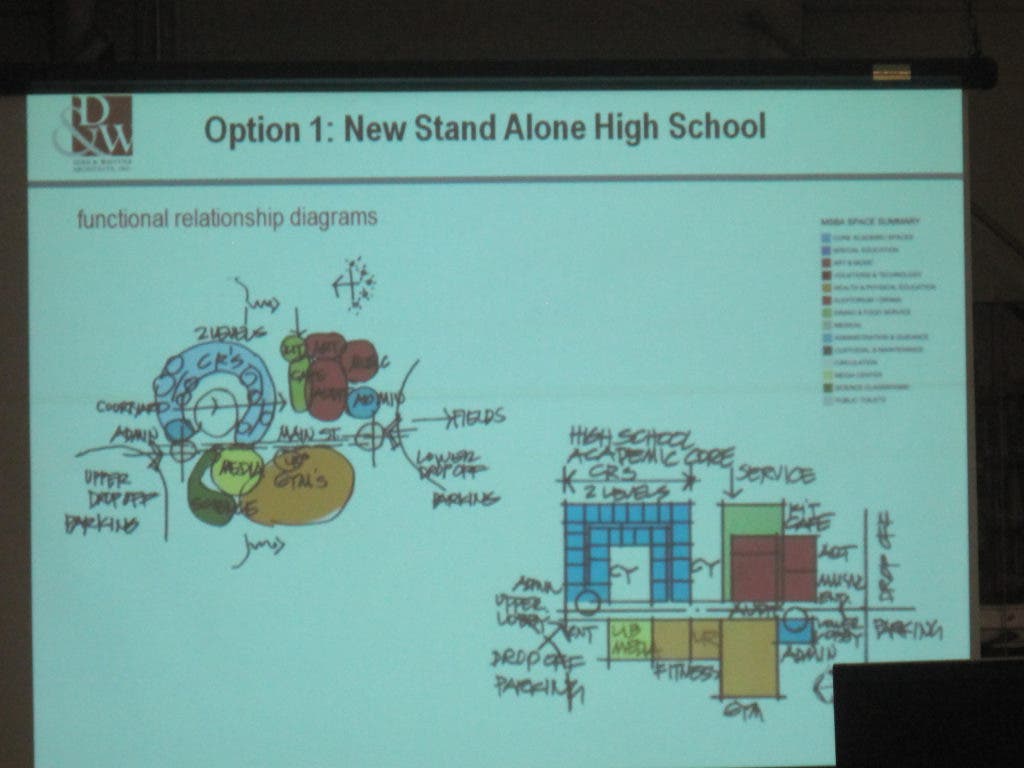

The North Reading Secondary School Building Committee took another step forward in presenting their plan for a new / combined building to the Massachusetts School Building Authority (MSBA) on Tuesday night.
The local meeting served as preface to the formal meeting held in Boston with the state agency on Sept. 14 and required a vote by the local committee on the number of square feet the proposed building would contain.
"Once we bring this to MSBA tomorrow, it's locked in," said Brad Dore, the consultant from the architectural firm Dore and Whittier. "What you vote on tonight will be the figure the MSBA uses to judge the soundness of the plan. There's no changing it."
Find out what's happening in Readingfor free with the latest updates from Patch.
Building features
After Dore discussed the functional diagrams his company prepared and clarified MSBA formats and building codes, the committee engaged in several rounds of questions.
Find out what's happening in Readingfor free with the latest updates from Patch.
There were some discrepancies between the MSBA regulations and the initial space Dore allotted to various departments. One area that had to be scaled back was the custodial space, which exceeded guidelines by 2,000 square feet.
Smaller accommodations were also made to the science classrooms and the six labs designed for the middle school due to recent standards set by the MSBA.
The regulations now call for 1,440 square feet of space at the high school, but does not allow an overall increase in the number of square feet per student. This necessitates taking some space from the middle school science classrooms.
Cathy O'Connell, the middle school principal, said she discussed the change with Dore.
"I'm comfortable with the changes," stated O'Connell. "The new plan gives us more space than we have now and is better designed."
"Informal discussions with science teachers indicate that the curriculum won't be compromised," added Cliff Bowers, a representative from the School Committee.
Educational philosophy
Dore explained the process of determining the amount of space needed to meet curriculum requirements and Superintendent Kathleen Willis shared an educational philosophy.
"Our goal is to provide a learning space that meets the standards of a 21st century education. We will increase our capacity for science and math adding robotics and technological engineering to our curriculum," said Willis.
"We will have more opportunities for Advanced Placement classes. We will provide flexible space for collaboration among teachers and students. Updated learning spaces and cluster groupings of students will reflect the job situations students will encounter. In a new facility, we can offer an environment of hands-on projects that develop students' critical thinking skills better preparing them for life in the 21st century," she said.
With Willis' philosophy in mind the middle and high school principals and staff met with Dore in a previous phase to detail what program space they need for their classes.
The MSBA has policies governing the amount of space per pupil and the architects also worked with the footprint of the existing buildings.
Clarifying plans, contrasts with existing facilities
Dore's presentation explained the differences between existing space and the new state codes as well as the additional capacity of each of the areas in the proposed combined building. He cited the poor operating capacity of the aged infrastructure, health issues associated with failing systems and the number of systems that should be replaced.
Dore presented three building option:
- A stand alone middle school
- A stand alone high school
- An integrated secondary complex -- the preferred option
In the preferred option Dore identified the core area comprised of the media/library center, multiple gymnasium spaces, locker rooms, work-out areas, health center and other common use spaces. The plan takes into consideration all teaching/learning situations, distinct classroom space, science laboratories, administrative offices, sports fields, parking lots, drop off areas and building infrastructure.
"According to the architectural analysis, the combined building serves more students in a more efficient use of space, providing more educational opportunities. The result will be a better education for students, a fiscally responsible solution to current problems and a sustainable facility the community can be confident in for years to come," Dore said in concluding his remarks.
The vote
Based on all the information provided, the NRSBC voted to approve the combined school plan with the capacity of 267,939 square feet with one member opposed.
Finding the changes to the middle school science labs unacceptable, Helen Maynard voted "no." She said she wanted to indicate her displeasure, but did not expect the vote to sway the MSBA from the merits of the proposal.