Politics & Government
Town Meeting Approves $427K in Quinn Bill Funding
Unanimous vote came minutes after convening; meeting start time was delayed 45 minutes so a quorum could be reached.

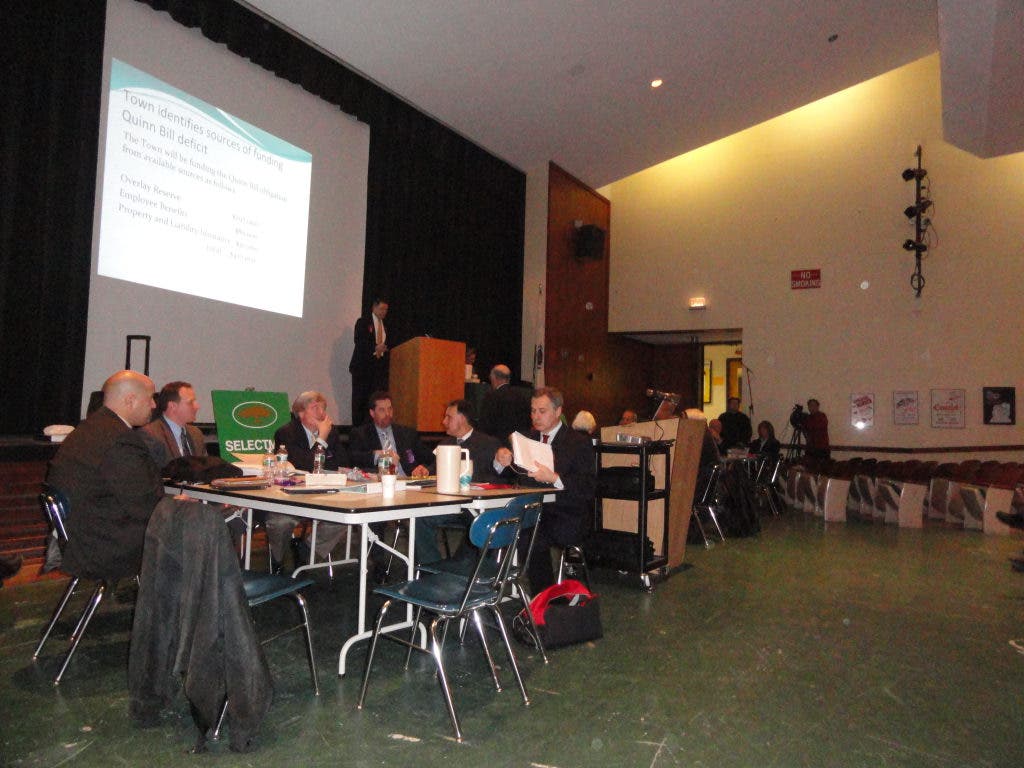
The waiting was the hardest part Monday night, but once a quorum was reached, the special Town Meeting quickly and unanimously approved an article to transfer $427,000 to retroactively fund Quinn Bill educational incentive payments to eligible police officers.
The meeting was scheduled to begin at 7 p.m. at the Daniel Shay Auditorium at, but with a quorum of 150 registered voters required, there were fewer than 100 in attendance. Town Moderator John Murphy finally convened the meeting at 7:45 p.m., after 154 voters checked in.
Once the meeting convened, voters unanimously approved to transfer $50,000 from general insurance and $80,000 from pension and benefits out of the June 2010 Town Meeting budget, as well as $297,000 from the overlay reserve fund. The funds will cover incentive payments to officers dating July 1, 2009.
Find out what's happening in Readingfor free with the latest updates from Patch.
The $80,000 in pension and benefits money represents a surplus in the budget for health insurance funding, said Board of Selectmen Chairman Robert Mauceri. The general insurance money was available due to credits the town received, including a 2 percent credit in property and liability for shoveling snow from the roofs of town buildings this winter, he said.
Mauceri said the town estimated the Quinn Bill payments to eligible police officers were $206,979 for fiscal year 2010, $115,360 through the beginning of January, and an estimated $104,661 for Jan. 14 through June 30. The latter number is subject to change depending on overtime worked through the end of this fiscal year, Mauceri said.
Find out what's happening in Readingfor free with the latest updates from Patch.
If the funding levels need to be adjusted, additional funding will be made at the June Town Meeting, Mauceri said. The Quinn Bill payments are based on a percentage of an officer's base salary plus various stipends, Mauceri said.
Both the Board of Selectmen and the Finance Committee unanimously recommended the transfers. There was no discussion from any voter in attendance on the motion to approve the article, and the meeting adjourned at 8:05 p.m., after the vote was tallied.
Although the funding for retroactive payments for officers has been approved, the town still has to settle a three-year contract with the police union, a year of which is already in arrears, Mauceri said after the meeting. Quinn Bill funding will need to be addressed in that contract, he said.
Members of the Board of Selectmen and Town Administrator Greg Balukonis met with union representatives Monday morning, a session Mauceri thought helped open communication between the parties, he said. A private negotiation session is scheduled for later this month, Mauceri said.
The union had been working under a one-year contract that was signed in March 2009. Union members agreed to no cost of living increase, no step increase, and a change in health insurance copayments.
That contract also later included an agreement that the town would pay half of the total Quinn Bill incentive, plus whatever the state contributed in reimbursement. The state's reimbursement fell from $144,756 in fiscal year 2009 to $27,119 in 2010 and $13,431 in fiscal year 2011.
A Middlesex Superior Court judge ruled last December that state law superseded the agreement, and the town had to fully fund the incentive retroactive to July 1, 2009. Judge Kathe Tuttman wrote in her decision that the state could not be held liable for what the Legislature appropriated for reimbursement.
Town Meeting needed to vote on appropriation to fund the town's retroactive obligation. But for a while, it appeared as if the meeting would not happen at all Monday night.
At 7:30 p.m., Murphy, the town moderator, announced that only 120 people were in attendance, and he would open the meeting at 7:45, at which time he would entertain a motion to adjourn if a quorum was not reached. Residents began making phone calls to get neighbors and friends to come to the high school.
The final few voters needed could be seen walking across the high school parking lot with a minute left before the deadline.
"The only hitch was getting people here," Mauceri said after the meeting. "A couple groups in town put some effort into it."
Get more local news delivered straight to your inbox. Sign up for free Patch newsletters and alerts.