If the 21st century has taught us anything about global affairs, it's that international relationships are getting more complicated and less predictable.
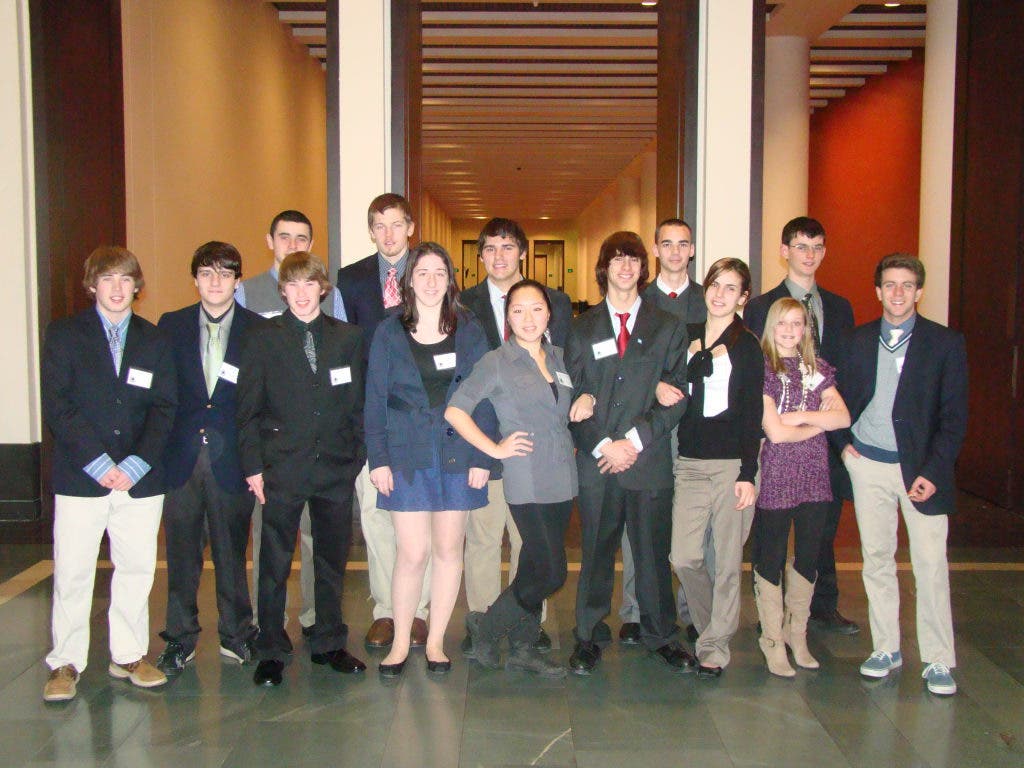
After training for a year under the tutelage of their social studies teacher and adviser, Sotirios Pintzopoulos, 14 students from North Reading High School's United Nations Club took up the challenge of worldwide negotiations by participating recently in the three-day conference of the 58th annual Harvard Model United Nations (HMUN).
The students, representing the west African nation of Gambia in the U.N. General Assembly, participated in debates with other student representatives identifying issues of importance and drafting resolutions. Passing these resolutions became their greatest challenge, as every student delegation struggled to be heard and to protect their country's interests.
Find out what's happening in Readingfor free with the latest updates from Patch.
There were hundreds of fellow delegates with different viewpoints. Students soon learned that the unmoderated caucuses allowed them to speak in informal groups and create voting blocs with greater power, Pintzopoulos said.
One of the mock delegations also in attendence at the conference were the members of the International Olympic Committee. Similar to the main body of students who took on the roles of a nation's officials, the student members of the IOC took on the roles of Olympic officials.
Find out what's happening in Readingfor free with the latest updates from Patch.
Student Maria Kim said the workings of the International Olympic Committee provided insight into the complexity of shared decision-making that all of the delegates faced. In her capacity as a member of the IOC, Kim took on the identity of Irena Szewinska, a medal-winning Polish track star who competed in the Olympic Games from 1964 to 1976.
Kim explained that throughout most of the conference her committee spent their time discussing views on the gender disparity in Olympic sports. Undertaking action to change negative attitudes about women's competitive sports was hard to address, particularly among nations who resisted the notion of women atheletes.
After much discussion, the IOC formally resolved to engage national and international women's groups in fostering the increased participation of women athletes. Kim said that the remainder of the committee's time was spent in passionate debate about which city would host the 2018 Winter Olympics. Though she preferred to see the South Korean city of Pyeongchang win its bid, the majority voted for Munich.
Back in school, each of the students reflected on their experiences. Kim, who co-founded the club last year with Nick Capezzuto, noted that the high-profile officials weren't the ones who actually made things happen. Patrick Clerkin agreed, adding, "Real progress was not made by those making speeches . . . idealism did not bring about a resolution. It was team members mingling with other groups that led to a sharing of ideas and meaningful negotiation."
North Reading students said that they learned a lot from their interactions with their international counterparts.
"The conference was a great way to gain experience in large contentious discussion and take a very active role in writing and debating ideas, working papers and final resolutions," noted Adam Sperry.
Matt Costa echoed the thoughts of many of his fellow delegates, saying that "at the opening ceremony, delegates were informed that the true spirit of HMUN is the interaction between individulas. Observing and participating . . . with so many different people, all with an opinion and a unique personality had a memorable effect on me."