This post is Part II in a four-part series about Reading’s Budget.
Click here to read Part I: Reading’s Split Tax Rate.
Note: text in green is hyperlinked, throughout.
******
Find out what's happening in Readingfor free with the latest updates from Patch.
This series was born out of discussions on new growth and economic development to decrease our present heavy reliance on residential taxes funding our operating budget.
These conversations are always important, but are especially timely today as certain mandated costs associated with running the town and schools have outpaced revenue for multiple years. As one solution, Reading voters are currently considering an override ballot question to permanently raise taxes beyond the 2.5% maximum annual increase, to fill the gap in our operating budget.
Find out what's happening in Readingfor free with the latest updates from Patch.
Resorting to tax overrides is sometimes necessary, but it cannot be the singular strategy. Responsible leaders must offer more. They have to understand where the problems originate, and then come up with creative alternatives like cutting or avoiding costs and finding or creating new sources of revenue. They must also think longer-term, considering operational changes to help address the revenue shortage.
How Properties Impact the Budget
On a most basic level, different types of properties (residential or commercial) affect Reading’s budget differently.
 Each new residential and commercial property adds dollars into the budget via property taxes, which in turn fund our town and school budget.
 Each new residential and commercial property also adds to spending by the town, to support them. The town spends money on public safety, public works, public services, and public schools to support our residents and businesses.
The difference between a property’s revenues and expenses determines whether it adds to (or burdens) our Town budget.

The nature and type of town spending for residential and commercial property varies:
- New commercial parcels (and businesses located on them) do not add to school populations; residential units generally do (unless age-restricted, e.g. over-55 housing). For reference, in 2016 Reading spent $12,437 per student educated in-district, and $59,649 per student educated out-of-district.
- New businesses pay privately for their snow & trash removal, whereas residential units typically receive these benefits at town expense* (excepting circumstances where a separate property management company is responsible)
New businesses in the town are generally a net positive to our town budget—their new tax revenues will generally exceed the anticipated town spending.
We’re Built This Way
As I’ve said before, “it’s how we’re built.” Reading’s property tax base is about 92% residential and 8% commercial, making us heavily dependent on residential homeowner taxes to fund our budget.
Reading is built very differently than our peers. Reading’s lack of commercial property tax base is obvious. In 2016, the last tax year for which data was tabulated, Reading’s budget contained $12 million less commercial (called "CIP" for Commercial-Industrial-Personal property) tax revenue than the average of 25 peer towns.
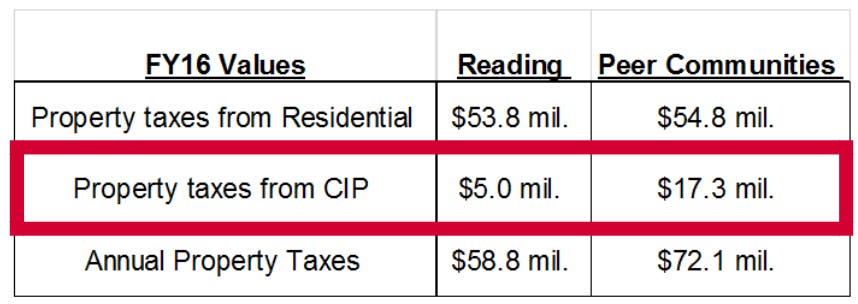
Source: Economic Development Factors, Town of Reading, 2017 (p3).
And that gap is getting worse. From 2003-2016, in all but 2006, Reading fell far behind our peers in attracting new CIP class growth (think commercial sector). We fell further behind with each year.
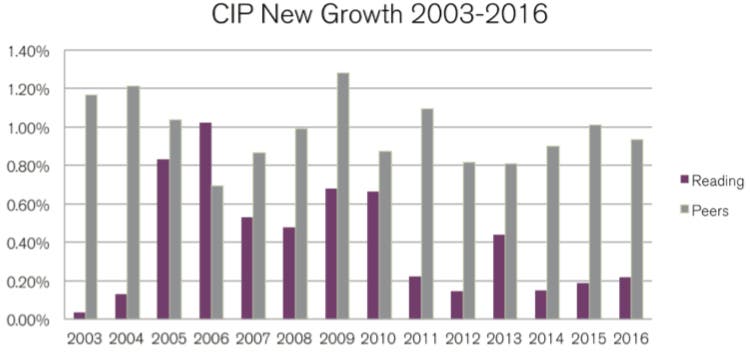
Source: Economic Development Factors, Town of Reading, 2017 (p10).
And when comparing Reading to peer towns by 3 key variables (employment level, 5-year change in employment level, and ratio of employment available to employment-aged residents), it's quite clear that Reading is a bedroom community (a place where people sleep, not work). We have low employment, low employment growth, and more than half of our working-age residents leave each day to work—and spend money—somewhere else.
On these three key measures, Reading is almost at the bottom of its peer class. We can't, nor should we try to become a Woburn or a Danvers or a Burlington. Our current position is not a good place to be for certain, but it is one where even a modest improvement would provide a disproportionate advantage. The graph below plots these three measures (bubble size reflects how many workers a town imports/exports). That’s Reading shown in the small orange dot to the left.
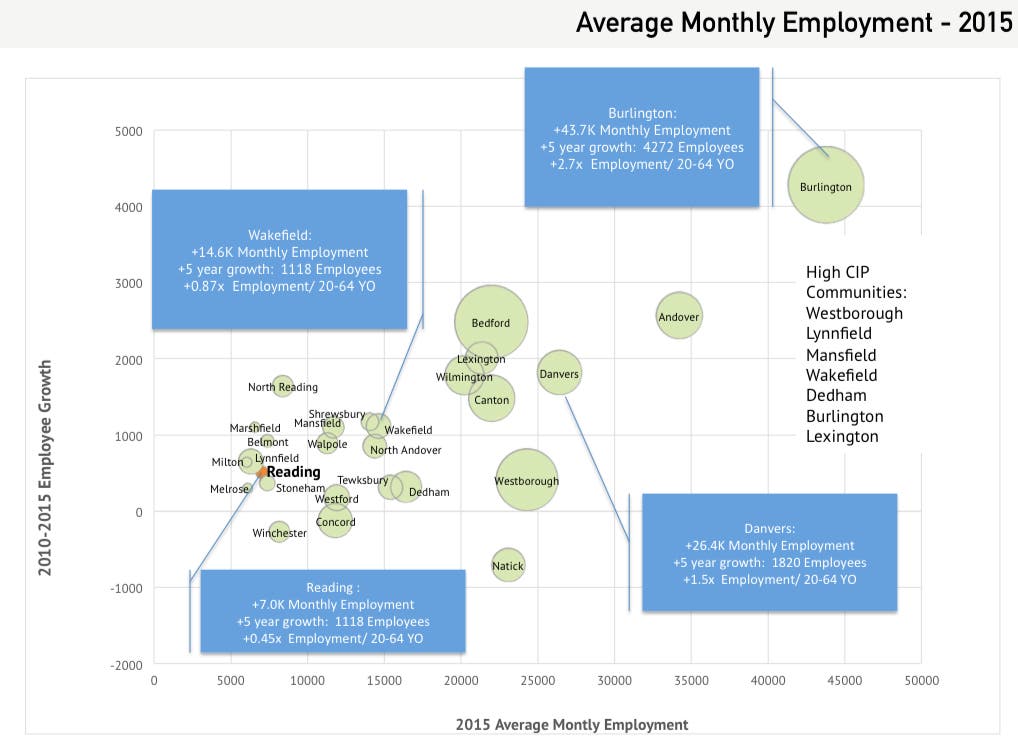
Source: Economic Development Factors, Town of Reading, 2017 (p47).
Surprise Spending
In discussions of town spending, residents often recall multi-million dollar increases and unforeseen expenditures related to the 2015 Library renovation and the 2016 RMHS construction settlement. (To be clear, the Library project was a capital project and thus unrelated to Reading's annual operating budget. As described in the link above, the high school settlement was funded from various sources: remaining building funds, free cash, and in part from the capital spending portion of the annual operating budget (by pushing other planned expenditures out further into the future). It was not without impact, however, given that scheduled and budgeted-for replacements were consequentially delayed).
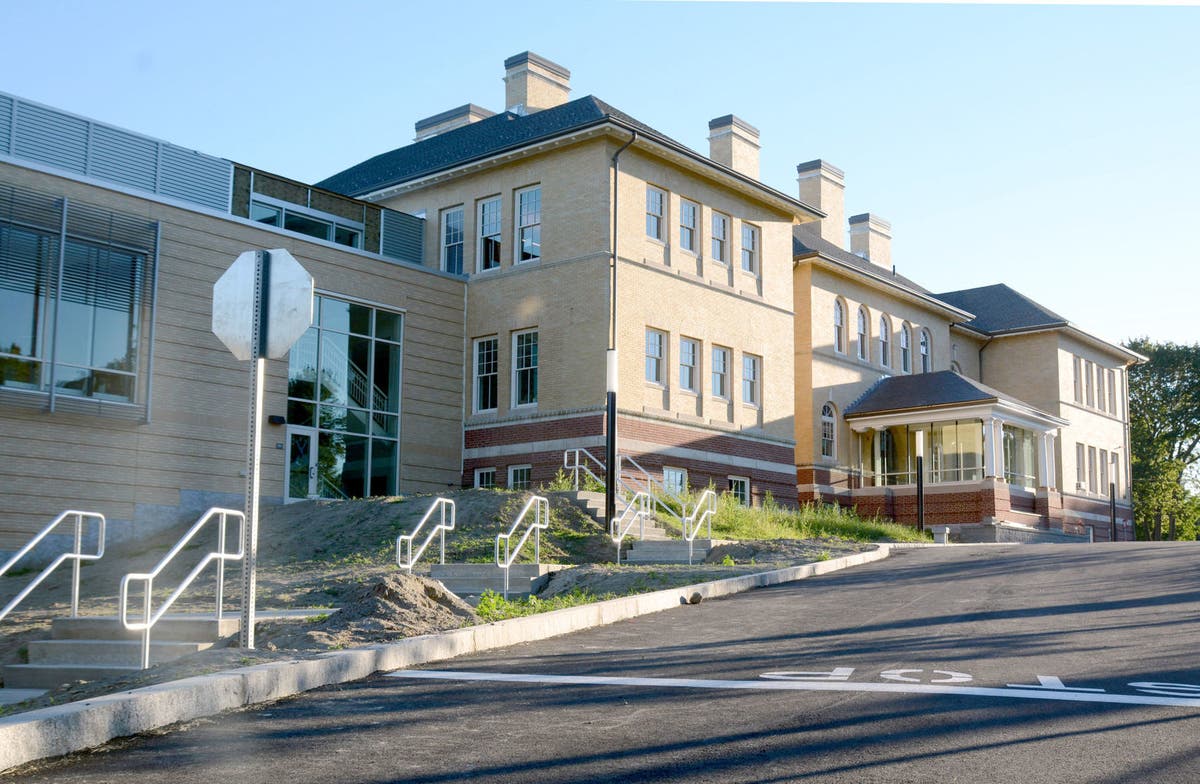
From these experiences, the town learned that elected boards are not equipped with the time or staff to manage their own complex building projects. To address this shortfall, the Board of Selectmen created a Permanent Building Committee (PBC) in 2015. The PBC is made up of subject matter experts (engineers, architects, contractors, those skilled in the trades, etc.) to provide feasibility analyses, planning alternatives, and guidance on major Reading building projects going forward.
Now What?
To address the impacts of our smaller commercial tax base, Reading's focus is on economic development aimed at encouraging professionals, manufacturers, and retailers to pick Reading as a destination.
Successful economic development does not just ‘happen’; it requires thorough economic planning, effective zoning, consistent outreach and promotion to new businesses, and of course—efficient government support of new projects.

Here's the GOOD news: work to remedy this situation is already well underway and huge strides have been made! Now that “how we got here” is better understood, look for Part III covering “How Can We Get Out?” coming later this week!
*****
This post, and others like it, can also be found on John's website at www.JohnArenaforSelectman.com/blog