Arts & Entertainment
Then & Now: Home Schooling
This apartment house started out as a one-room schoolhouse during Salem's Maritime Era.
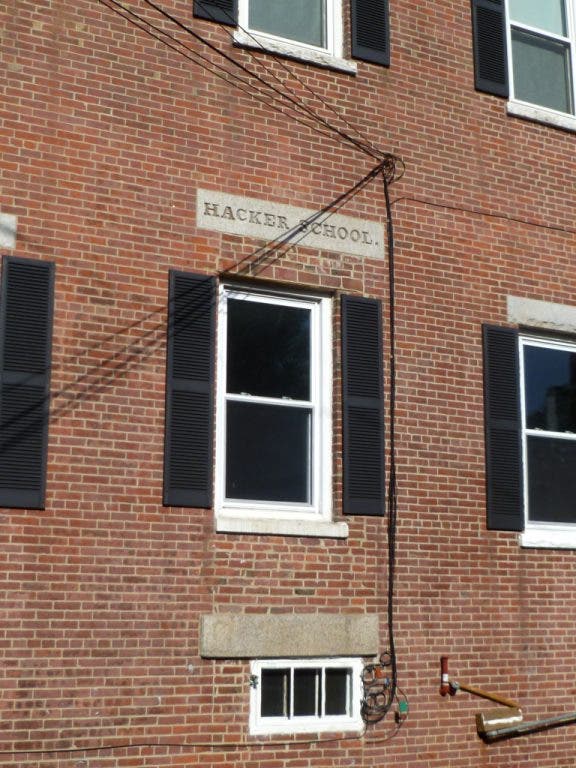


Perhaps you’ve driven down Flint Street from Federal and noticed this brick building on the right at 52-56, with the name Hacker School carved into the stone lintel above a side window and wondered about it.
It is a relic of Salem’s rich educational history.
Salem was one of the earliest towns in America to offer free education in America. In fact, many argue that it is the oldest to continuously offer free education.
Find out what's happening in Salemfor free with the latest updates from Patch.
In 1644, as local government was formed, one of their first actions was regarding education. Early town records reveal there was a requirement that all parents with children should submit their names and how much they would
pay for their education for a whole year. If they were unable to pay, then the town would do so.
In 1647, the General Court for the Colony made education important by ordering, “Every town consisting of 50 householders to have a school for reading and writing, and of 100 families to have a grammar school, so as to fit scholars for college.” These schools were exclusively for the male population at this time. It wouldn’t be until 1793 that girls were enrolled in Salem public schools.
Find out what's happening in Salemfor free with the latest updates from Patch.
As Salem’s population grew, more schools were added. From one writing or grammar school located in the old watch house on what is now Washington Street in 1712, two additional grammar schools were added in 1785. The Center School building housed both the Latin School on the second floor and the English school on the first floor, replacing the Watch House School. The West School on Dean Street, (now Flint Street) and the East School on East Street, (now Forrester Street) both opened in 1785.
The West School, also called the Dean Street School for Boys, was a small wooden building built on land known as Dean’s Field. The town purchased this sloping land just above the North River from Joseph Sprague. Once the building was completed, Salem hired Isaac Hacker as the headmaster for the school. Mr. Hacker had previously taught for a number of years in Salem. He remained headmaster for some 30 years and was well respected throughout the town. Dr. Bentley in his diaries, recounts visiting the school with a group appointed to examine all the schools in Salem.
He spoke highly of Isaac Hacker and the degree of expertise the students at the West school exhibited. Apparently it was a given that the best writing was done here and much credit was due to Isaac Hacker. In 1818, Isaac Hacker died suddenly at the age of 68 and was mourned by the town. His obituary in the Salem Gazette spoke glowingly of his life as headmaster, citizen and Christian.
In 1820, the wooden building was replaced with a larger brick building we see today. This building was further modified in 1839 by adding an additional story that allowed for the evolution of schoolhouses from the common one-room school to one with separate rooms for recitation and learning that was in keeping with educational advances. It also was able to increase the school’s student population from the original 120 boys. Within 2 years there were 146 male students. The changes made to the West school in 1839, then again with more renovations in 1849, served as a model for what Salem schools would look like in the future.
In 1845, the City of Salem started naming schools after noteworthy citizens. The West school was named after its long time master, Isaac Hacker, which was a testament to the fond memories many had of him some 20 years after his death. The name, Hacker School, was duly inscribed in the granite stone over the main door of the school.
With population growth from the 1200 residents in 1712 to the 26,000 in the 1870s, along with advances in educational philosophy, school building changes were necessary. As the school population expanded after finally adding females to the system, Salem started building larger schools and consolidating the outdated smaller ones. In 1870, the Hacker School along with the Higginson, Eapes and Bowditch Schools was consolidated into the newly built school a short distance from the Hacker school on Dean Street.
With no further use for the Hacker School, the city sold the property to H. K. Oliver, who owned property nearby on Federal Street. After purchasing it from the city for almost $3000 in 1870, he converted the property into rental units for six families. In a nod to the man, Isaac Hacker, as well as Salem history, the name has endured. The Hacker School name has remained on the building even though the center entrance has been removed. The name can now be seen over a window that replaced the main entrance. As you can see in the current photos, the main entrance has been moved around the corner facing what is now Flint Street.
Flint Street originally ran from Broad Street to Essex Street while Dean Street ran from Federal to the North River. Later, Dean Street ran across the river to Beach Street which continued to Mason Street. By 1890, all these streets were under the one name of Flint Street which runs from Broad to Mason Street.
In the ensuing years, the Hacker School Building has been home to many families. The name Hacker remains, reminding us of the long history of this
building.