Community Corner
The Common Like You've Never Seen It Before
Jerome Curley chronicles the Common from its earliest days as a militia training ground.
Do you ever wonder why Salem landmarks are the way they are?
Take, for instance, the Common. When you're walking through it, do you ever wonder why it's so large (nine acres) and laid out the way it is? Did you know the Common and Salem's militia have been linked throughout Salem's history? The militia is the reason the Common looks as it does.
From the earliest days of the Mass Bay Colony, Salem had a militia where all men between the ages of 16 and 60 had to train weekly for the common defense.
Find out what's happening in Salemfor free with the latest updates from Patch.
The requirement for the militia was written into the Mass Bay Colony Charter, (1629) which will be on display at the Peabody Essex Museum from Oct. 13 to Jan. 30, 2011.
On Aug. 19, Salem was officially designated as the birthplace of the U.S. National Guard, which evolved from the local militia that started in Salem.
Find out what's happening in Salemfor free with the latest updates from Patch.
The militia gathered on the "commons," which was a large area used by all the residents to graze their livestock during the day. The people of Salem referred to this common area as the commons, the pen or the swamp because the area was marshy, consisting of a number of ponds and hilly scrub-land.
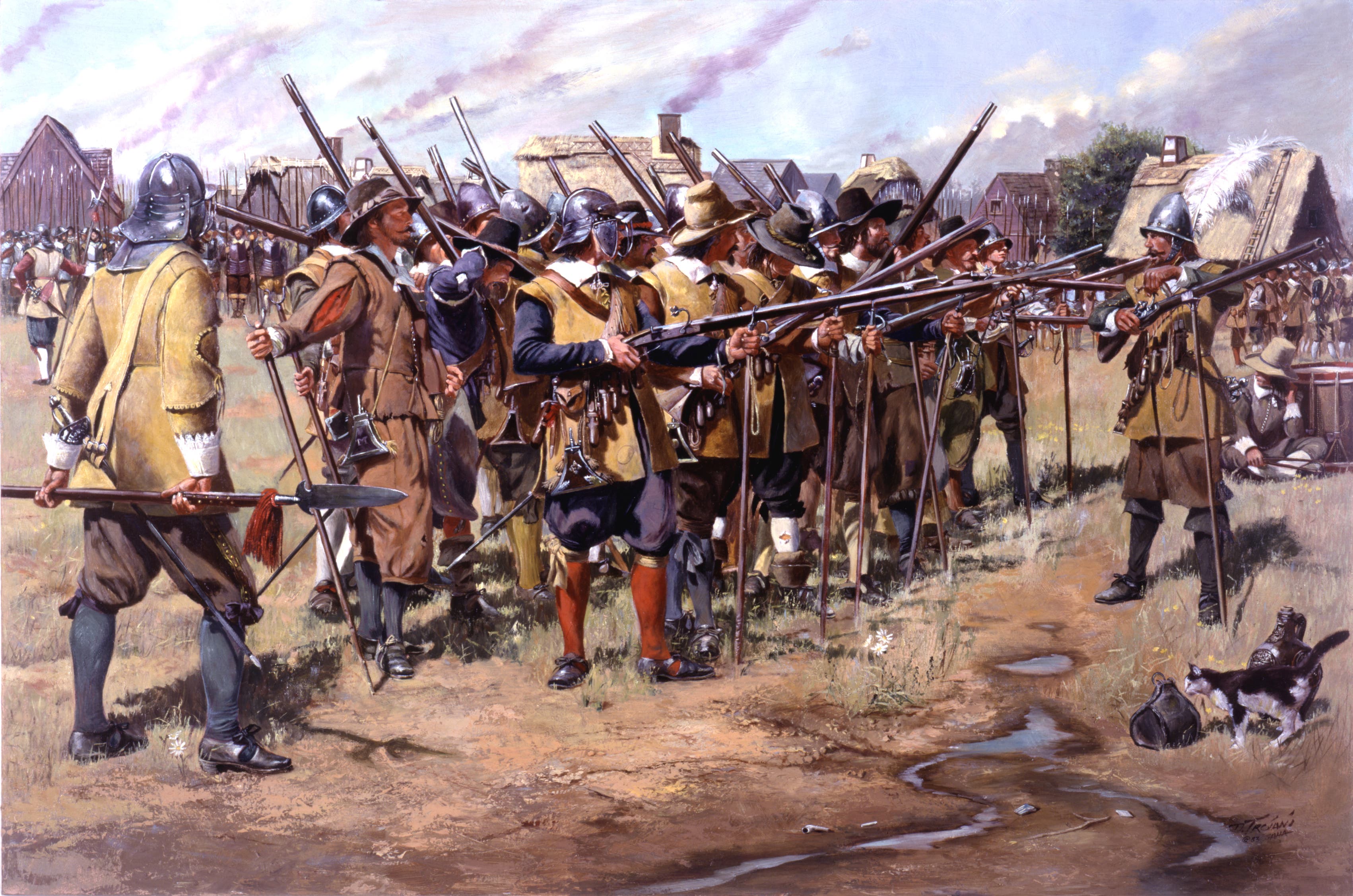
The militia trained on whatever dry ground they could find on a weekly basis from 1630 forward under the tutelage of former English soldiers. This arrangement continued as the town and population of Salem grew and more men joined the militia. The painting by Don Troiani of The First Muster in Salem (1637) illustrates well what the commons may have looked like at the time.
These men were not playing warriors. They were already a battle-hardened militia that had fought in numerous campaigns against hostile Native Americans, The Dutch in battles in Arcadia and the French during the French and Indian War when the government required a contingent from Salem to take up arms.
With the advent of the Revolutionary War, Salem's militia was an important resource for the war effort. A Salem regiment under Col. Pickering marched to Lexington on April 19, 1775, but arrived too late to fight. Members of the Salem Regiment fought at Bunker Hill where Lt. Benjamin West of Salem died. The Salem Militia fought in a number of Revolutionary battles.
Throughout these years, the Salem militia continued to train on the commons and no doubt complained about the area being ill-suited for military exercises. In 1714, the commoners who oversaw the use of the commons voted that "the area in front of Nathaniel Higginson's house shall be forever a training field for the use of Salem."
Portions of the Common were often rented to individuals for their use. In 1770, the town voted to build an almshouse for the poor in the northeast corner of the commons. The building opened for use in 1772 and continued until a new almshouse was built in the early 1800s. Also on the Common was a gun house and school building. The Common, while used by the militia regularly, was never a satisfactory place for military drills.
In 1801, all this changed. Elias Hasket Derby II was chosen to be colonel of the militia. He set out to change the Common and raised a subscription of $2,500 to level the ground, fill in the ponds and put in pathways. The design is much the same today. Rows of poplars were planted and a wooden fence with four ornate gates was installed.
Salem's famous builder and woodcarver, Samuel McIntire, built the western gate with a carved wooden medallion of George Washington that stood for many years until decay set in and necessitated its removal.
In 1976, as part of the bicentennial celebration, a smaller replica of the Washington Gate was placed in the southwestern corner. It was later moved to the north.
In 1802, the names of the streets surrounding the common were changed to Washington Square: North, South and East.
The newly laid out Common made the area around it very attractive to wealthy Salemites and it was soon surrounded by stately homes and mansions. In 1850, the wooden fence and gates were replaced with a cast iron fence, parts of which still stand. In 1926, the bandstand was built in honor of Salem's Tercentenary celebration.
The annual muster continues to take place on the Common. On April 10, 2010, the Common hosted its 373rd annual muster.
In looking back at the history of the militia in Salem, we see the work Derby and his subscribers did to improve our nation's first guard troops and give us the lasting living memorial of Salem Common that continues to serve both the people of Salem and the country.