Community Corner
Then & Now: A History of Health
This oceanfront property has a healthy history with the city.


On Saturday morning, May 7, 1910, hundreds of girls and women spread out across the city to sell a special edition of the Salem News.
The News had agreed to this fundraising venture provided that all aspects of the newspaper, with the exception of the printing, be done by women.
For some three weeks, a committee of women wrote and edited
articles, drew cartoons and compiled stories for this double-sized paper. This special edition was titled the "Tuberculosis Camp" edition and many of the stories focused on the "white death" — tuberculosis. Having editorial control, the women chose a mix of articles on fighting TB, Salem people, and history, as well as current news. They were even able to add a few “suffragette" articles almost 10 years before passage of the 19th amendment that gave women the right to vote.
Find out what's happening in Salemfor free with the latest updates from Patch.
In 1910, the estimated death toll from Tuberculosis or Consumption was 150,000 in the United States. Salem saw hundreds of cases of TB each year. During those years, Salem was fortunate to have a special Contagious Disease hospital next to the Alms House and City Farm on the Neck overlooking . The area is now Settler’s Way Condos.
The Contagious Disease Hospital treated TB cases as well as other dangerous diseases such as Scarlet Fever and Diphtheria.
Find out what's happening in Salemfor free with the latest updates from Patch.
As Public Health initiatives grew across the country, there was an increased focus on both the early treatment and prevention of TB. This highly contagious disease was the impetus for many laws about spitting in public and the requirement to have spittoons in buildings. It was felt that fresh air, sunshine, cleanliness and rest were the best ways to treat and prevent its spread.
In Salem, the Committee on the Prevention of Tuberculosis took on the challenge to raise funds for a camp for tuberculosis patients. They were especially interested in focusing on children in infected homes. If they had a camp that provided fresh air and good conditions, they could monitor and hopefully prevent TB from spreading. This committee, made up of Salem women, worked closely with the Board of Health and the Contagious Disease Hospital to address that need.
After a successful fundraising effort of selling carnations in 1909, they approached the newspaper to not only raise funds but also awareness of the disease and how it could be treated. The Salem News at the time sold for 1 cent, for this edition the target price was 10 cents. The sales were a great success — $3,502.04 was raised.
In today’s dollars, that would be equivalent to raising $80,906.36. This was more than enough to identify and equip the camp that would later be called Camp Naumkeag, located on a bluff overlooking Collins Cove and Horseshoe Beach.
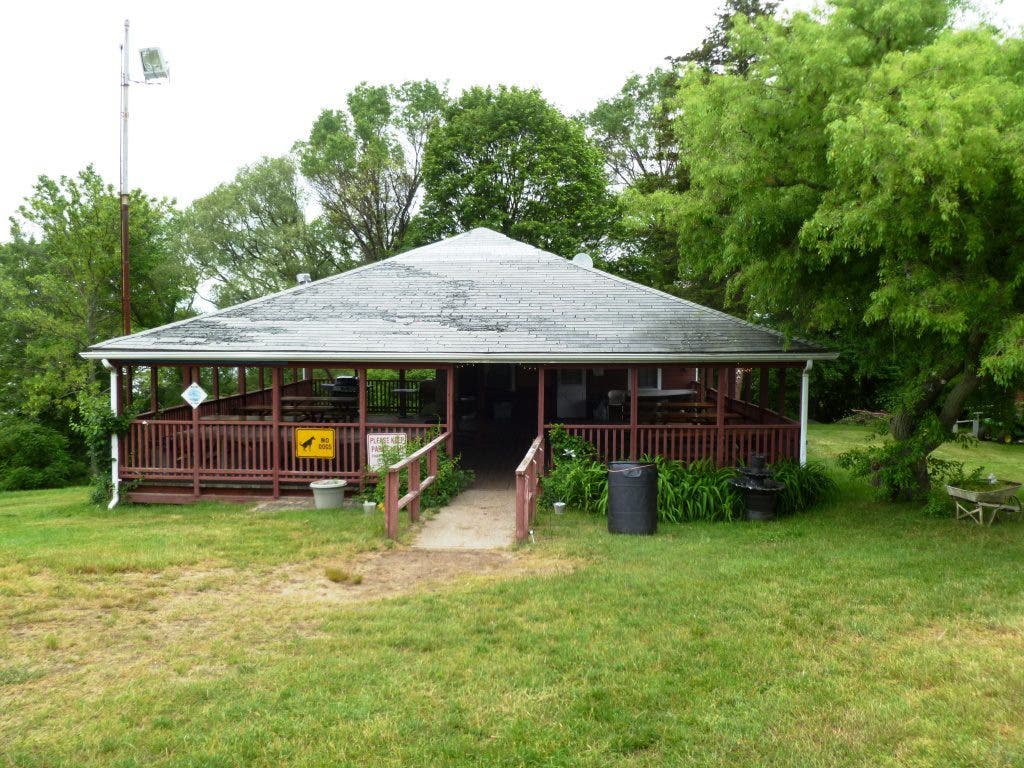
Originally, tents were used to house the patients. Then a pavilion was built to keep patients dry during summer rains. The veranda style pavilion was 20 feet wide and 60 feet long as seen in the vintage photo above. The committee ran the camp from June to October with the Board of Heath’s Contagious Disease Hospital providing thousands of meals to the patients. The city also ran water lines onto the property.
This camp ran for a number of years as public health authorities continued to battle TB with greater success. In the early 1930s, a fire caused by lightning destroyed the buildings. The current buildings —the lodge, and men's and women's cabins were built around 1932. At that time, the camp was known as the Salem Health Camp.
By the 1940s, a vaccine was widely used on TB making the world health authorities hopeful that this disease could be eliminated.
Unfortunately, that never occurred since new vaccine resistant strains have developed and there has been an upswing in cases worldwide in recent decades.
With the need no longer there for a TB camp, the Carpenter Street Home for Children used the camp from 1944 to 1946. In 1946, the Salem Rotary Club purchased the buildings while the land was retained by the City of Salem. The Rotary purchase was for the Salem Girl Scouts who named it Camp Naumkeag.
In 1964, the Girls Scouts felt the camp no longer suited their needs and turned it back to the City. The City then leased the camp to a local nonprofit group known as the Naumkeag Associates, who maintained it through fundraising for use by the youth of Salem. For almost 40 years, the Naumkeag Associates took care of the property and oversaw its use by various Salem groups.
Some notable uses over the years include a candlelight vigil for missing in action servicemen, camping by a Conn. Fife & Drum unit in Salem for the Heritage Days Parade and use by Polish and Belgian sailors when the Tall Ships came to Boston in 1976. I’m sure many readers have memories of either family or public events there.
In 2002, the City once again took possession of the camp and has been maintaining it since. The City rents it out to various groups with
special pricing for Salem residents.
In May 2011, the City Council voted to lease the camp to the Salem for three years from June to September for weekday use as a summer camp site. In addition to rental fees, the YMCA also agreed to improve the buildings that have deteriorated somewhat over the years.
As the photos show, this is a rare piece of real estate that is unique in Salem. Being essentially undeveloped, it provides us with a glimpse
of what Salem Neck looked like from Salem’s earliest days. It also offers us a great recreation place.
Let’s hope that it always remains public land.