Arts & Entertainment
Then & Now: A Maritime Shopping Center
This building is the oldest commercial structure west of Washington Street with a long history.


When you drive or even walk down this street, it’s very easy to miss this distinctive building.
With the planting of trees over recent years, this building’s historic details are obscured by greenery.
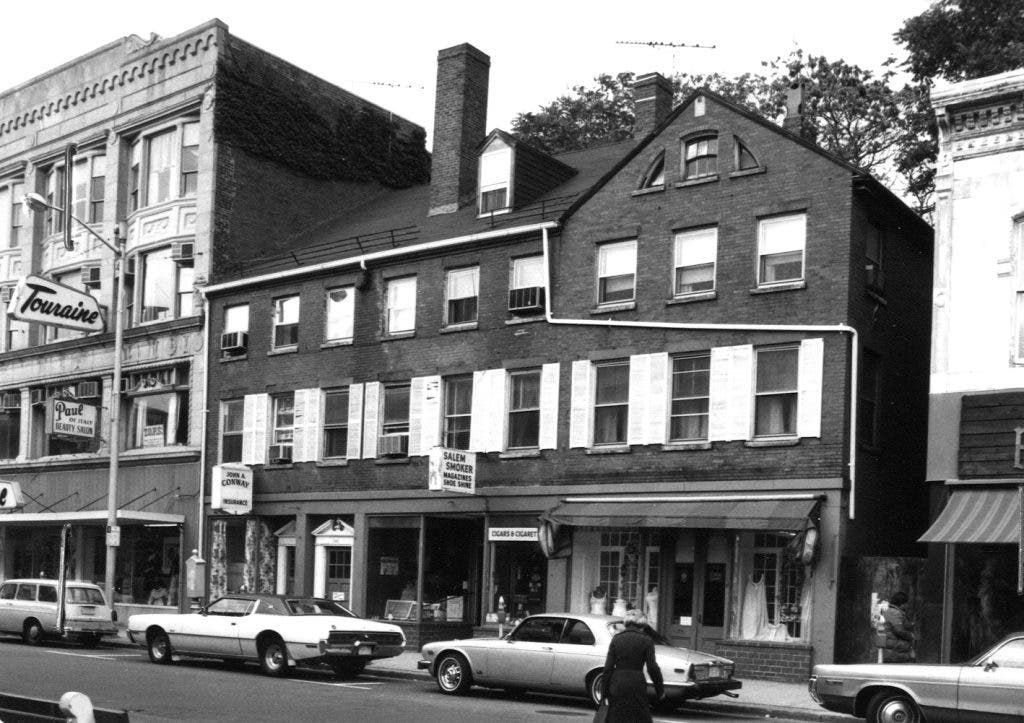
Looking closely, however, one can see the building as it looked when built in 1834 for Thorndike Proctor as a mixed use residential, commercial building.
Find out what's happening in Salemfor free with the latest updates from Patch.
This building at 244-248 Essex St. is the oldest commercial building west of Washington Street and as such gives us a glimpse of what the downtown mercantile district looked like in the first half of the 19th century.
At the time of its building, Salem was still deeply involved in maritime
trade. Bark and clipper ships were still making their way up the South River to tie up at the wharves not far from Front Street. Salem ships still plied their trade around the world. The pepper trade, while slowing, was still a vibrant source of wealth for the town.
Find out what's happening in Salemfor free with the latest updates from Patch.
Salem was a town on the brink of major change. While a known seaport, Salem was also becoming a center for leather manufacturing. In 1834 we were two years from being a city. The railroad to Boston wouldn’t be opened for four more years. Stage coaches and horses were the main mode of travel. The city was still more colonial than modern as it moved toward the new reality of a fading maritime trade and the industrialization of the city.
While expanding, Salem was still a small town where people did most of their non food shopping in Town House Square area surrounding the town pump. This area was the place to gather and learn town and country news as well as what ships were in, delayed or missing. Here,
shops sold goods and household necessities. Foodstuffs were mainly brought from the market on Front Street or at local grocers. Most commercial buildings of the time were mixed use with owners or tenants sharing space with shops.
The Proctor building, just a few steps from Town House Square and its pedestrian traffic, was prime real estate. Its stores would never lack for potential customers. The Proctor family brought this land from the Daniel Mansfield, a shopkeeper, in July 1790. Thorndike Proctor was listed as a goldsmith on the deed. It appears from an examination of various historical documents that the Proctors were also mariners involved in the pepper trade with Sumatra.
This Greek Revival Building was built around 1834, probably replacing an earlier shop in this busy area of what had been called Paved Street since it was the first paved way in town. At the time of this building. Essex Street was a combination of houses, shops and mansions. Along the street shops were gradually being added to existing buildings. The conversion to a mercantile district had begun.
Throughout the history of this building. it appears that it has always attracted tenants. The focus of the shops on clothing and shoe sales was consistent throughout the 1800s. Henry Merritt’s gold and silver watch shop and Francis Scott’s stocking factory and hosiery store in the early 1840s gave way in the 1850s to Hannah Harris’ Fancy Goods, Merrill & Walker Milliners and Sarah Potter’s Fashions and Hair Work.
From the 1850s to the turn of the 20th century there was a succession of stores offering fancy goods, tailoring, shoes, boots and hairdressing. Almost all were focused on women customers.
In the 1900s that focus continued with an occasional candy shop and jewelry store. In 1920s, while women’s wear dominated the three stores, H.M. Perkins Men’s Fashion Store opened at #246 Essex.
After a number of years in business, Perkins gave way to Follett’s Men Shop that was in business from 1930 through the 1950s, when it was known as the Colonial Men’s Shop that many of us may recall from the early 1960s.
Another long term tenant that some may recall was King’s Corset shop at 244 Essex St., which anchored this block from the mid 1930s until the late 1980s. Many probably recall the window displays of nightgowns and slips.
The third store at #248 had a more varied history with a number of different businesses here. After several Fancy Goods stores there were optometrist shops here from the 1940s through the 1960s.
As the photograph from 1979 shows, during the 1970s John Conway Real Estate was here along with the Salem Smoker. The smoke shop gave way to Essex Shoe Repair & Shine in the 1980s, which lasted into the 21st century. In the late 1980s, Shop moved here and has continued in business to the present.
In addition to Simard’s Barber and Hair Stylist Shop, the current tenants are, , a maternity fashion consignment shop and Hex, Old World Witchery, a witchcraft supply and psychic reading shop.
After having tenants for a number of years, the upstairs residences have been converted to condominiums. There are currently six condos that overlook this historic area. Their views are no longer of Salem’s far seeking fleet and the busy maritime port activity. Today from the upper windows they see and the Bewitched Statue as well as glimpses of the Square with its ongoing activity and restaurants that draw people just as the Town House Square has done for almost 400 years.