Arts & Entertainment
Then & Now: Maritime Grocers, Apothecary and Education
This building was the home to maritime grocers and a well known apothecary before being home to a scholarship fund that has its roots in Salem's history.
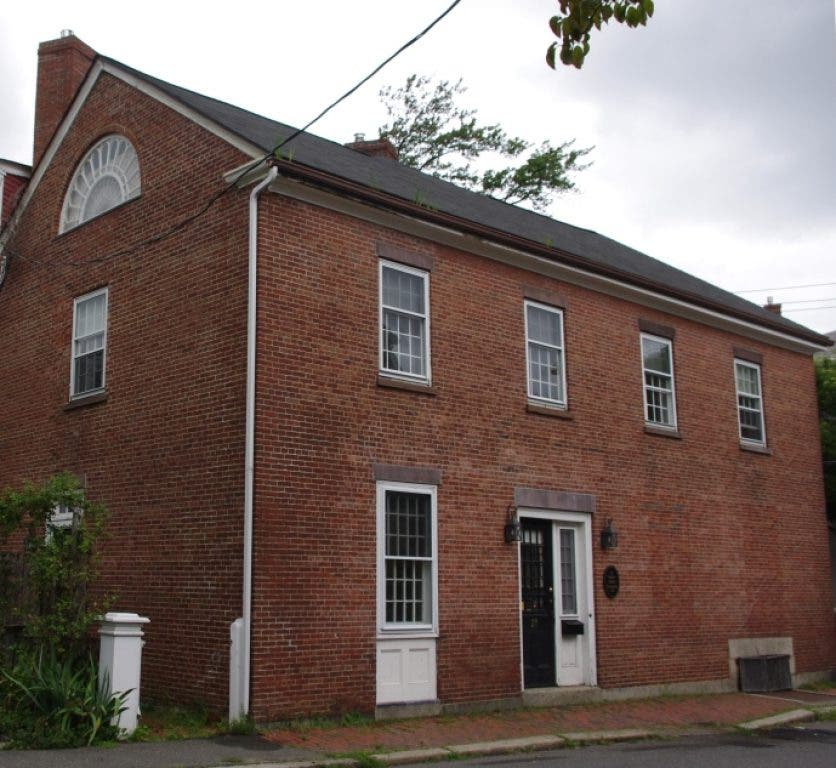


This distinctive brick building was built in 1826 as a mixed use store and dwelling.
It was built for Stephen Fogg to replace an earlier store and dwelling on the corner of Essex and Flint streets. Fogg, as did his predecessors, ran a grocery store that carried West Indian and foreign goods. This ‘high end’ grocery appears to be in keeping with the neighborhood of Essex and Chestnut streets that were populated with wealthy merchants and ship captains with a taste for the more exotic products arriving in Salem. It is not hard to imagine that the grocery would have carried a range of spices and teas as well as selections of Madera wine and port for its clientele.
In 1840, the brick house at 391 ½ Essex St. was built onto the store. Francis Fogg, then owner, had his step daughter, Lucinda, and her husband, Brackley Peabody, live here in 1842. Francis Fogg continued to live at 25 Flint St.
Find out what's happening in Salemfor free with the latest updates from Patch.
Brackley Peabody was a master mariner involved in the Sumatra Pepper Trade in the early 1800s, when fortunes were made from the
pepper trade.
With the California Gold Rush of 1849, once again, savvy merchants and mariners would generate fortunes by being first to provide supplies for the prospectors. Captain Peabody was one of those mariners who braved the dangerous voyage to San Francisco where one voyage would pay for the ship and the crew. He retired in 1856 and became involved in a number of civic activities. When Fogg passed away in 1859, the Peabody family brought the property and lived at 25 Flint St.
Find out what's happening in Salemfor free with the latest updates from Patch.
The store, owned by the Peabodys, continued to operate here under a number of different grocers. In the 1860s, Francis Sheridan ran Sheridan’s Grocery. In the 1870s, Charles Hobbs Grocery was here. In 1881, Ham & Friend Grocery opened and remained here until 1907 when Blood & Bailey Grocers took over.
The attached house was rented to a variety of tenants over the years. The store and house remained in the Peabody family and estate until it was sold to Louis and Ellen Blood in 1916. They continued to operate Louis Blood Grocery until 1943, when the grocery closed.
In 1943, Eaton’s Apothecary took over the store and remained here until 1981. With its distinctive mortar and pestle signage, this is the store that many of us remember best. While it wasn’t as big as Eaton’s other stores scattered throughout the North Shore, it was the most distinctive and most historical looking apothecary. The photo from 1968 shows the store as it looked when Eaton’s was here. Unfortunately, this photo is of the Flint Street side and doesn’t show the distinctive gold mortar and pestle that was attached to the corner of the building.
When Eaton’s was acquired by a chain pharmacy corporation, this store closed and the building was empty until Becket’s Antique shop opened here. Becket’s was here for several years during the 1990s.
In 2005, The Stephen Phillips Scholarship Fund acquired the store unit condo as the headquarters for their scholarship fund. This fund is a
product of the philanthropy of the prominent Phillips family. The Phillips Family has a long history in Salem as maritime merchants, railroad owners and politicians. The tenant units have also been converted to condominiums.
Stephen Philips and his wife Betty were strong advocates of education and throughout their lives focused their resources on helping to fund local students so that they could successfully complete college. When Stephen died in 1971, his wife set up a memorial scholarship fund in Stephen’s name that has helped thousands of students complete their college education.
She also respected Stephen’s wish that his family home at 34 Chestnut St. become a museum where five generations of Phillips Family memorabilia would be accessible to the public. , now part of Historic New England properties, is the only house on Chestnut Street open to the public. It provides the unique experience of seeing the world through the eyes of the Phillips family during the early days of the twentieth century.
It is well worth a visit.