Kids & Family
Sharon High Grad's Bicycle Ride is Homework on School Lunches
Leah Kramer Heyman and her partner, Adam Williams, will ride across the nation looking for partnerships between schools and local farms.


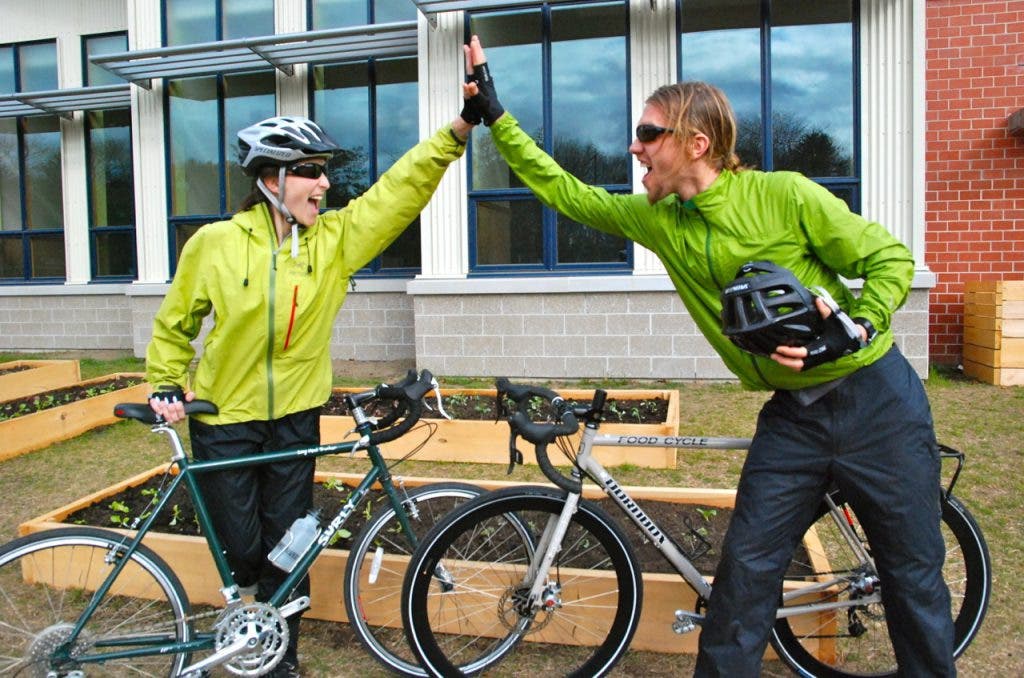
Saturday, 2003 Sharon High School alumnus Leah Kramer Heyman and her partner Adam Williams begin a cross-country bicycle tour with a local flavor.
The duo will search for the best projects where local schools' meals include local farms' food.
The more than 4,500-mile ride from Brunswick, Maine to California is through FoodCycle, a nonprofit that Williams launched two years ago. The organization is "dedicated to the creation of enduring collaborations between small-scale organic farms and Public Schools," according to its website.
Find out what's happening in Sharonfor free with the latest updates from Patch.
Heyman and Williams will visit schools and farms, taking notes along the way. They expect to finish in August, Heyman says. And they've raised $5,000 of their $10,000 goal, to buy about 15,000 pounds of food from Brunswick-area farms for an elementary school in that community.
"The bike trip has always been part of the plan," Heyman says.
Find out what's happening in Sharonfor free with the latest updates from Patch.
"FoodCycle started to germinate as Adam drove cross country through large scale agriculture fields during his years of college. He was traveling from Sonoma State in California to home in Maine, with lots of time to think about what foods the fields of corn would turn into. He was reading about what was happening to our food, and more importantly to our newest generation's food choices.
"Adam wanted to know how to make a farm to school program work, he wanted to see what schools were doing to make it work in different states. But he was done using fossil fuels, he wanted to walk his talk in regards to sustainability and healthy living. So the cross-country bike idea was fused with food to make the foundations name: FoodCycle."
This interview was conducted by e-mail.
SHARON PATCH
How does your vision tie into the FDA's attempts to make school lunches healthier?
LEAH KRAMER HEYMAN
While the FDA is attempting to make food healthier and we look at any these improvements as a step forward, we do not see large scale agriculture and subsidize food systems as the way to fix our health issues or the economy.
We hope by making a strong connection between schools and local farms that we will encourage growth in local economy as well as a deeper connection for the students to what is on their plate, or tray.
SHARON PATCH
The economic crisis has made school districts' budgets very tight. To what extent is sourcing school meals locally financially possible?
LEAH KRAMER HEYMAN
We do not expect the towns and communities to incur these local food costs for schools at first.
Our model is working to completely fund the first year of sustainably grown foods for our pilot school in Brunswick, Maine at no cost to taxpayers.
As we establish the appropriate methods for growing, distributing and serving these foods, and can track evidence of success and student engagement we will move toward a locally subsidized model. This is to say that the school will budget a percentage of its' per student food costs towards locally grown foods while FoodCycle will match their commitment 1 for 1. In this scenario, a school could invest only half of per student resources ($) into the program and receive a full share in return.
SHARON PATCH
If a school district wants to start sourcing their meals locally, what's a good way to start?
LEAH KRAMER HEYMAN
For those school systems that are looking for a good way to implement a regional food model in the cafeteria, they have many resources, including starting with themselves.
Start a garden! There is less red tape around a school growing its' own food rather then having someone grow it for them and its an amazing way to connect growing food to learning.
There are also national farm-to-school databases that can direct teachers, students, administrators and parents that think this would be a good idea.
A first step, though, should be more interaction with the people and families that are growing foods in your community. This is obviously specific to region, yet when children have access to interaction with those behind growing their foods-as they with the police officer who taught DARE or the firefighter who teaches about fire safety, they see these people as role models and friendly faces.,
SHARON PATCH
What happens after the bike ride? Your website mentions you'll be documenting the efforts you see during the trip. How will you be sharing the results?
LEAH KRAMER HEYMAN
We have purchased A/V equipment for the journey and will be recording our visits with schools, farms, towns, and community along our journey.
We have home-based editors who will produce web episodes for us and post them as we continue our journey. This will continue after the bike ride, as well as a review of what we believe to be an appropriate overview of "what makes a farm-to-school work."
Get more local news delivered straight to your inbox. Sign up for free Patch newsletters and alerts.