Business & Tech
SoWa Spotlight On: Shara Porter
After years of nurturing a hobby, Porter realized it could also be her career...
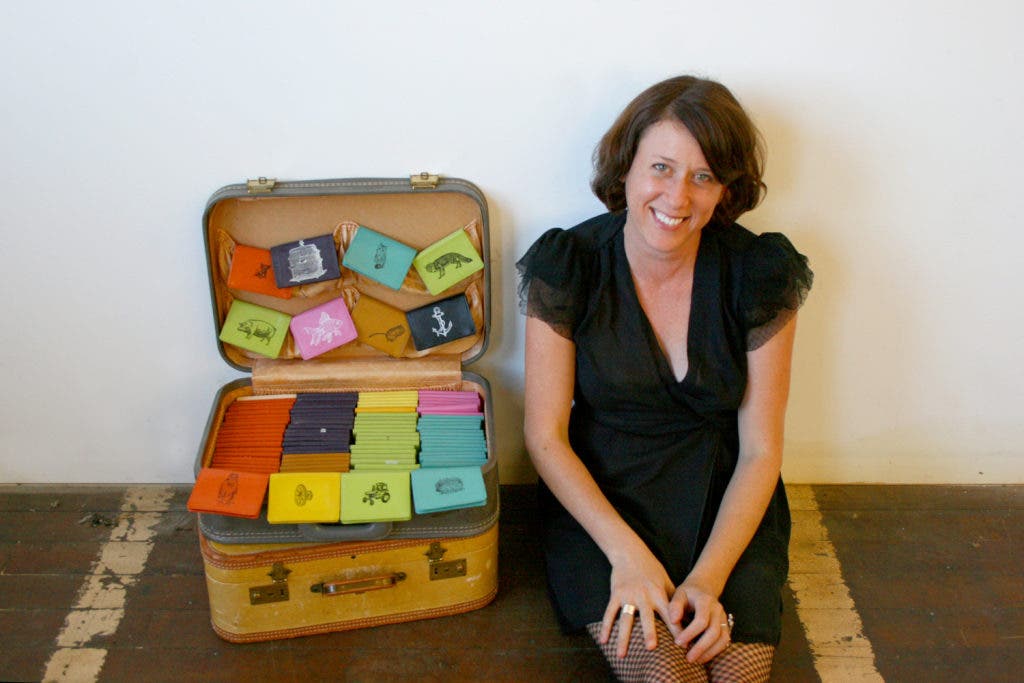


As a kid, Shara Porter was obsessed with dryer lint.
“I would always ask to clean out the lint tray to see what the clothes had made,” she told me. “It amazed me to see all of the residue combining to form new fabric--well, at the time it just amazed me, but looking back on it, that’s how I feel.”
That same wonderment and knack for transformative thinking led to other telling childhood adventures: at the ripe age of 4, the Princeton, New Jersey native repurposed a pair of her mother’s blue jeans into a shoulder bag, following along with the kids on PBS’s “Zoom”. Mama Porter wasn’t thrilled.
Find out what's happening in South Endfor free with the latest updates from Patch.
By the time she was a teen she was digging through rummage sales for items she could remake into things that were more to her liking, offering to help set up the sales in exchange for free goodies. But Porter hadn’t fully realized a career of reimagining thrifty finds was an option, and she eventually landed a degree in Public Policy from Northwestern University. Later, she would receive an MFA in Textiles from UMass Dartmouth.
“It took a 10 year circuitous journey after I graduated from college for me to discover my world,” she explained. “While working a series of terrible waitressing jobs to pay the rent—involving wearing a beeper, maneuvering around belly dancers with hot soup, and sporting a fish tie—I took textile classes at FIT, Parsons, and most influentially for me, Penland School of Crafts.”
Find out what's happening in South Endfor free with the latest updates from Patch.
She tried her hand at building furniture, designing costumes, and ended up starting a business dyeing slip dresses.
Porter now has a burgeoning business selling a line of screen-design-stamped accessories that she creates from discarded materials and second-hand finds, making her yet another fine example of an artist working toward a sustainable ideal. She regularly participates in the SoWa Open Market.
Patch: When you were in school, what did you envision you'd be doing with your career?
Shara Porter: In graduate school my work was conceptual. I was creating sculpture and installations using many materials, but focusing on texture. I just really enjoyed the freedom to make whatever I wanted. I cherished that time. I didn’t really plan too much for life after school- I knew I could waitress to pay the rent as I continued making my artwork.
When I graduated, I decided to stay in New Bedford, MA because of the affordable studio spaces. I continued to thrift shop, and started finding lots of leather clutches and bags. I had done a lot of screen printing in school, but had never seen screen printed leather. I wasn’t sure it could be done, so I began to experiment—printing images on these leather accessories—and my line was born. I decided that I would start this business and try to build it up so it would support me, while still making the conceptual work. I’ve been very lucky that it has grown and allowed me to do what I love, but I definitely spend most of my time on the business aspect rather than on the art.
Patch: Can you share a little about your process?
Shara: My process is pretty standard as far as screen printing goes; the hardest part was finding an ink that adheres to the leather and will not just flake off or rub away in time. I’ve also moved from just printing on vintage items to printing on new items as well. I take lots of trips to find the vintage leather, and often stumble upon lots of “new old stock” which I buy in bulk. I also buy some pieces that are made from scraps of leather which would normally be discarded—leftovers from making leather jackets and other larger leather items. I’m hoping to design my own line of leather goods made from scrap leather in the future.
Patch: With the influence of the web and the increase in indie artist businesses, do you think it's harder to survive? Easier?
Shara: I think on the whole that the web has made it easier to do business and for wholesalers to find independent designers. And the increase in independent designers has led to more independent art shows. It has a ripple effect: craft makes its way into the mainstream through sites like Etsy and people use outlets like that to appreciating things that are handmade. On the other hand, it’s essential to find a niche since there’s such an abundance of people making things. The bar is raised, shows become more competitive to get into, and craftsmanship and display become more important.
Patch: Do you feel that the 'digital age' been good for working artists, or do you think it's fouled things up for those that prefer hand craft?
Shara: I still like to make things by hand, and often choose the more labor intensive route because it is more familiar to me. For example, I put together a packet for stores that shows all of the images they can choose from, and instead of scanning in the images and creating a document through Photoshop, I cut and pasted the images, and typed the text with a typewriter. There is something more satisfying to me about being able to move the items with my hands and placing things exactly where I want them to be. And I like the homemade look, the typed text, the imperfection. I could probably achieve something similar with the computer, but I enjoy the process.
On the other hand, the computer savvy, graphic-design-minded artists who like to blog are probably doing a better job of promoting their business than I am. I could use some help on that front!
Patch: What are some of the things you strive to convey with the juxtaposition of screen-printed images you use?
Shara: I love the idea of taking an ultra-feminine purse and putting something unexpected on it, such as a tire or a ladder. I like making people laugh, and look at something twice. When I was a kid I used to turn the elevator button at my dad’s office building for main floor (M) upside down to a W. People always turned it back around to M, but I liked that they noticed. I like things that don’t make sense, that are absurd. Life can be serious and dull—I like taking things that are ordinary and giving them a boost, making them special and giving them a new life.