Health & Fitness
Good Things Come to Those Who Wait
Health care can change lives, governments can too.


I embarked on a long journey last June when I arrived in Afghanistan; no, not the journey of the deployment. This journey was just a part and would be more difficult — navigating two massive bureaucracies in an attempt to improve the lives of Afghans through mysterious government systems of abject neglect and corruption.
Afghanistan has a very primitive health care system. There is no health insurance, few real hospitals and only a few reliable, quality clinics. These facilities service only about 15 to 20 percent of the entire population. The rest are left to whatever care is available in their villages or, if they able able, to trek hours or days to a facility that can help treat them. The mortality rate of children in particular is high because there is simply no way to get mothers and their children to facilities often enough for even routine care.
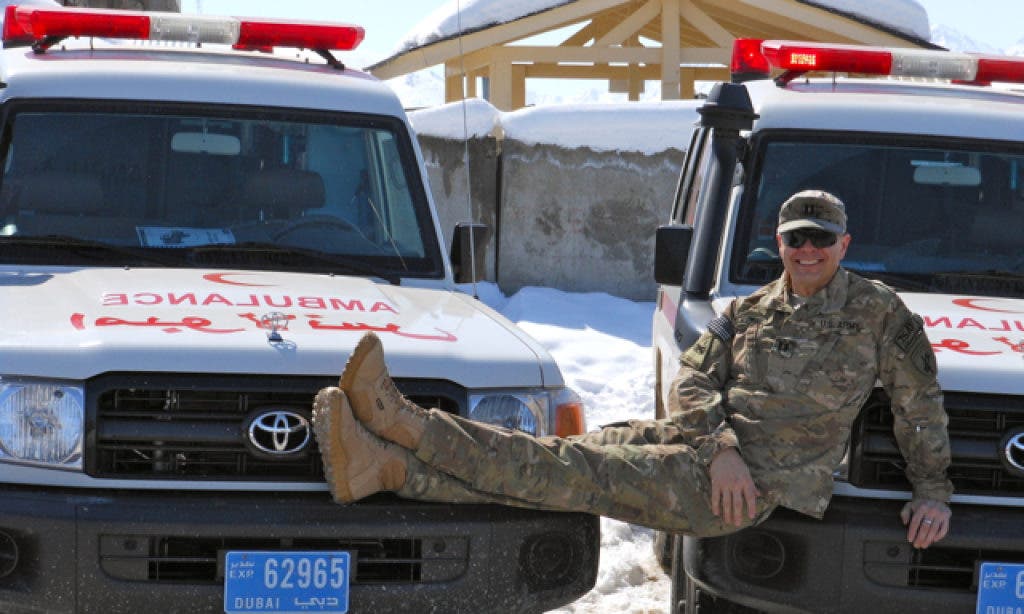
I endeavored last June to create a mobile hospital system in our area that would change the dynamic, allow health care to reach the rural Afghans and provide a noticeable, if small, improvement in their health care. Afghans traveling long distances is too much for many of them, our project would be to purchase ambulances that would have four wheel drive, have room for emergency patients and carry enough supplies to be a mobile clinic.
Find out what's happening in Sudburyfor free with the latest updates from Patch.
The Turkish Provincial Reconstruction Team works with us often on different projects and they had recently constructed a few clinics in the very remote districts of Merkaz-e Behsud and Hesa-e Awal-e Behsud. We sought to equip those clinics with the ambulances so that the local medical staff would be able to extend the reach of their clinic and their supplies. One of the benefits of these two districts is that they are mostly Hazaran, an ethnic population that is very supportive of coalition forces and is a safe area for us.
This simple task turned out to be a bureaucratic nightmare on both sides, the Afghans and the Americans. We first submitted the reams of documentation and paperwork to purchase the ambulances and were met with the first frustration. We were asked, "Why in the Behsuds? There's no value for us to offset the fighting there." It seems part of our "hearts and minds" campaign is to wage war by spending money in the places where people want to kill us. Give them money and projects, and they'll stop shooting at us. I'm not sure who's brilliant idea that was, but let me just say, it doesn't work. More on that in a later post after I leave Afghanistan.
Find out what's happening in Sudburyfor free with the latest updates from Patch.
In the end, we successfully convinced people that spending money in areas where we could actually have a positive effect on the lives of ordinary Afghans was a good thing. We completed all the remaining documents and paperwork and eventually were able to push through to a contract. We executed the contract and waited anxiously for the ambulances to arrive.
Then the real fun began.
When the ambulances arrived at the embarkation point in Afghanistan, the customs officials refused to allow the ambulances into the country without paying the requisite import tax, roughly $140,000 USD. The ambulance contractor was surprised, as were we. This was a donation by the US Government to the people of Afghanistan, why would we pay more money to the government for the privilege of donating to the government? The thought was this was more a ploy to shakedown the contractor, but the customs office wouldn't budge.
It seemed our best bet was to work with our US partners to identify a document, memo, phone call that could be made and straighten this out in short order. The response I received was even more shocking. Everyone I spoke to thought the contractor was shaking us down! I tried to explain that the contractor was only looking for a way to get permission to bring the ambulances into the country, but you can only hit your head on the brick wall for so long.
Trying to work through the Afghan government was just as bad. Nearly everyone we spoke to wanted a little something to help us out, and I know you all know what I mean. Now it became a matter of principle. These were ambulances, not LCD TVs. These ambulances were going to save lives.
Three months we worked the problem through multiple levels of governments on both sides. Eventually, there was a very positive resolution. The Ministry of Finance at the highest level of Afghan government finally stepped in and instructed the customs office to release the ambulances without prejudice. Two days later the ambulances arrived at FOB Airborne.
It is nice to know the Afghans finally worked out the resolution with the Afghan government. In the end that was the best solution. But the frustration of working through such obstinate and corrupt government processes left me as frustrated with my own government that refused to offer its support for a project that it itself was funding.
We enjoyed a wonderful, sunny day with a ceremony presenting the ambulances to the Director of Public Health and our friends at the Turkish PRT. It was a great end to a long process that will bring a better quality of life to many Afghans.