Neighbor News
Your Eversource Bill is the New Tax Bill (funding bridges and trains... and Eversource earnings)
We pay for the Sudbury to Hudson Transmission Line. It's not all about Reliability, it's about Eversource's earnings and 'piggybacking'.


Your monthly Eversource electric bill is the new tax bill: industry lobbyists and cash-strapped state agencies want a piece of it. Yet for all the scrutiny of where our taxes go, our rising Massachusetts electric bills fly under the radar. In this respect, Eversource, and Beacon Hill, would prefer to keep us in the dark.
Eversource (NYSE:ES) wants to lock in more revenue, and has told investors electric transmission (the high voltage wires on tall towers) is key to its earnings growth. To deliver earnings per share and corporate bonuses, the utility giant is counting on state approval for a backlog of grandfathered projects. Years behind and in the face of market changes, Eversource is dangling our ratepayer dollars in front of the MBTA, DCR, and New England towns in an effort to win support. State Siting Boards, responsible for approving or rejecting such projects based on reliability need, cost, and the environment (and no other criteria), are feeling the pressure to ignore their full mandate and take the bait.

Who will pay the price? The electric ratepayer, and New England’s landscape and natural resources. The turn of the century gave us the Big Dig - plagued by waste and overruns. Now, a slew of big energy infrastructure projects threaten our landscape and pocketbooks. In New Hampshire, Eversource’s 192 mile, $1.6B Northern Pass transmission project threatens the White Mountains. In Massachusetts, Eversource’s $100M Sudbury to Hudson Transmission project threatens to fragment 900 acres of connected conservation land, clearcut up to 60 acres, and contaminate drinking water.
Find out what's happening in Sudburyfor free with the latest updates from Patch.
What they don’t want you to know: due to declining electricity demand, such projects may be unnecessary, and less damaging solutions are available to maintain a reliable grid.
Many assume our ever-increasing electric bills are due to powering more devices and opting for cleaner energy. In fact, thanks largely to energy efficiency and solar, electricity demand in New England is going down. 2016 had the lowest observed annual electricity sales of any year since 1999. Efficiency is working: LED bulbs, efficient appliances, insulation, smart thermostats, solid state (flash) storage, and server virtualization in public and private clouds have been game-changers.
Find out what's happening in Sudburyfor free with the latest updates from Patch.
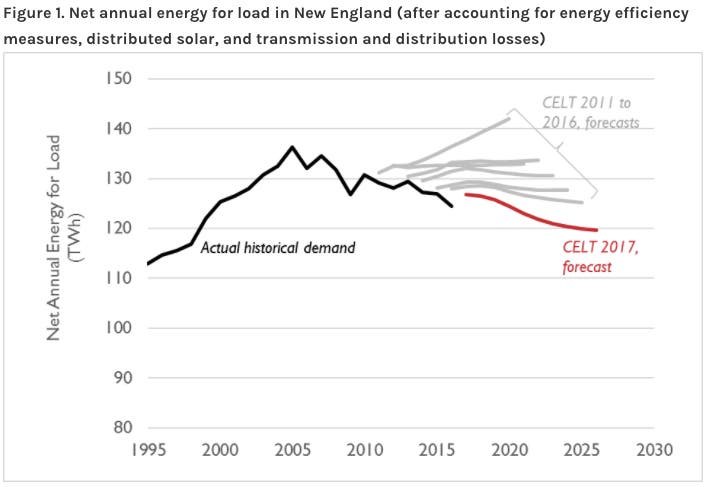
When demand for oil goes down, we enjoy lower prices at the pump. Why, as electric demand declines, are rates going up?
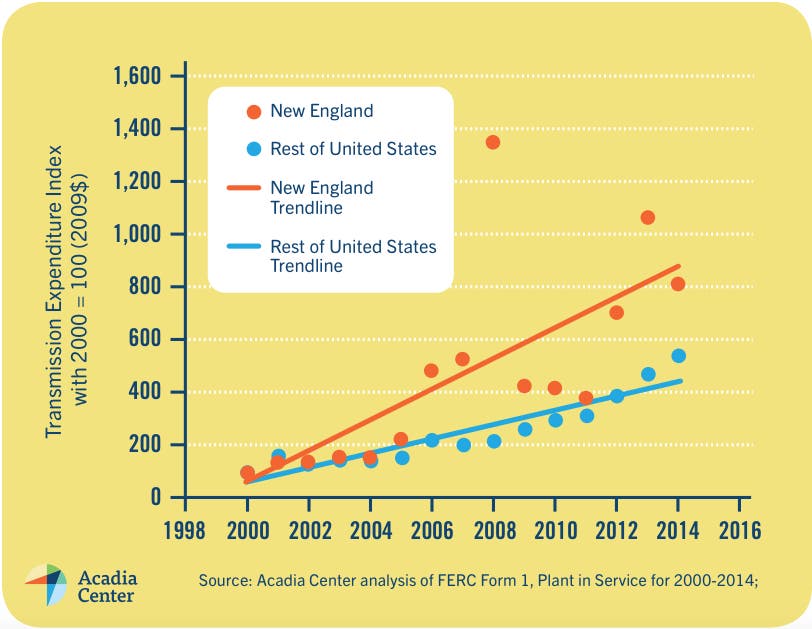
A big driver is the cost of transmission, more expensive in New England than the rest of the US. (See Acadia Center figure). Utilities are guaranteed disproportionately large annual revenue for transmission (higher than distribution). Transmission development costs, and overruns, are fully absorbed by ratepayers, plus a 10-12% return on equity built into annual ‘carrying charges’ for utilities. New ‘greenfield’ transmission reliability projects, eligible for waivers on regulations and local bylaws, represent targets of opportunity for Eversource, as it seeks to grow its number of transmission miles.`
With declining demand, we entrust our siting boards to revisit each transmission project, and consider whether the reliability need it is meant to address is real and proportional to its cost and environmental damage. Needs were imagined based on old forecasts of future peak loads exceeding some threshold, perhaps one summer day 10 years down the road. If the need didn’t materialize in the past decade when demand was higher, how likely are overloads to knock out power for an extended time going forward as demand declines? (Hint: much less likely than downed distribution wires on poorly maintained local utility poles leaving you without power for hours or days each winter. Recall statewide outages from the ‘Halloween Nor’easter’ of 2011 that left us in the cold for days? The major cause was unmaintained distribution lines, for which the Patrick Administration penalized Eversource.)
Unlike other regions in the country, Eversource and the regional operator, ISO New England (ISO-NE) have treated the probability and duration of a theoretical overload as irrelevant. If a contingency scenario could happen, ISO-NE ratifies the need, however unlikely, and awards projects to the incumbent utilities based on rough (-25/+50%) construction cost estimates provided by the utilities. With respect to cost and alternative solutions, ISO-NE has trailed all the other regions in adopting competitive rules of the FERC-1000 Order. The ISO-NE planning process does not consider the cost to the environment in awarding projects. Irresponsible, underbid plans are born, take on a life of their own, and refuse to die.
On September 14, ISO-NE hosted a public meeting in Boston to review its 2017 regional system plan (RSP). Keynote speaker, former EPA Administrator Gina McCarthy focused on climate change and clean energy. During Q&A she welcomed debate on whether to create new transmission corridors inflicting permanent damage on the environment versus using existing utility corridors. ISO-NE faced questions about when it will consider the environment as part of its planning. The response was troubling. That leaves State siting boards and permitting authorities as the only remaining speed bumps to Eversource carving up the New England landscape.
In New Hampshire, Eversource faces setbacks on Northern Pass, as the NH Site Evaluation Committee recently voted to delay its decision by 6 months. Meanwhile in Massachusetts, Eversource has petitioned the Energy Facilities Siting Board (EFSB) for approval of the Sudbury to Hudson Transmission Reliability Project. In the face of the evaporating reliability need, Eversource has adapted their EFSB petition around supposed benefits to MassDOT and DCR . Negotiated payments from Eversource’s electric ratepayers to lease an inactive rail corridor have been characterized by MBTA Realty Chief Janelle Chan as “much needed operating revenue to sustain the MBTA’s train and bus system”. The gravel utility road Eversource would leave alongside high voltage lines has been marketed as DCR’s Mass Central Rail Trail (MCRT) bike path.
Eversource is not solely to blame. State agencies have actively sought to ‘piggyback’ onto utility projects, and Eversource has been all too happy to oblige. The Metropolitan Area Planning Council (MAPC) has actively promoted piggybacking on public work projects , and MAPC’s senior transportation planner, David Loutzenheiser, gave Eversource a featured presentation slot at a recent MCRT update meeting to pitch its story. In 2013, DCR, headed by then-Commissioner Richard Sullivan, identified Eversource (then NSTAR) as a potential funding source in its MCRT Environmental Notification Form (ENF). DCR had contracted the firm VHB Engineering to produce the ENF. Months later, Richard Sullivan became Secretary of EEA, waiving the requirement for his old department to complete an extensive Environmental Impact Report.
Fast forwarding to the present, Eversource’s prime contractor for the Sudbury to Hudson transmission project is also VHB Engineering, and the petition before the EFSB features those same Mass Central Rail Trail plans VHB prepared for DCR. Former VHB employee Leo Roy, now the DCR Commissioner, was quick to submit to the Siting Board a letter of support for the Eversource plan (cc:ing the MBTA), requiring that the costly transmission project facilitate the development of a rail trail.
Where does this leave the residents of Sudbury and Hudson? Unfairly painted as ‘anti-rail trail’ for opposing Eversource’s damaging plan. Despite the fact that Sudbury has repeatedly voted to fund rail trail development (the north-south Bruce Freeman Rail Trail is underway), and was poised to vote on funding Mass Central Rail Trail development at Town Meeting in 2015, before Eversource ‘entered stage left’. Now the Towns of Sudbury and Hudson, and grassroots organization Protect Sudbury (inspired by Don Henley’s Walden Woods Project), are fighting an expensive legal battle as intervenors before the EFSB, questioning first and foremost the reliability need for a new transmission line. Absent the reliability need, ratepayers must be spared the unnecessary expense. Should the EFSB find the need proportional to the cost, intervenors seek to protect conservation lands and water supply, and redirect the project to another alternative, including under Sudbury streets, which Eversource’s VHB consultant acknowledged would not have the permanent negative environmental impacts of the MBTA route. “I would say that the Eversource project has halted most and likely all support for the MCRT in Sudbury,” Sudbury Town Manager Melissa Murphy-Rodrigues said. “The Eversource project will run through the heart of Sudbury, decimating wetlands, endangering our drinking water source and cutting down trees for 30 to 50 feet across the entire town. That area is home to endangered species, families, a national wildlife refuge and acres of conservation land.”
Where does this leave dispassionate citizens and electric ratepayers throughout New England? Paying their Eversource bills and trusting that professionals such as Stephen August, Presiding Officer at the Energy Facilities Siting Board, reject petitions to have ratepayers foot the bill for unjustified, non-reliability projects which permanently destroy the environment. Ultimately Governor Baker’s appointed Siting Board members, chaired by EEA Secretary Matthew Beaton, make the decision.
A recent Boston Globe opinion piece by Richard North Patterson touted public-private partnerships, stating “The only formula for kick-starting a given project should be: whatever works”. Ridiculous. Electric ratepayers shouldn’t pay $100M for a $13M rail trail, a $425K/yr MBTA bailout, an unnecessary, environmentally destructive new transmission corridor, and a risk-free annual profit stream to Eversource.