Health & Fitness
Human Trafficking in Boston -
Slavery was supposedly abolished back in 1865, but did you know it still happens all across America and even right here in Boston?
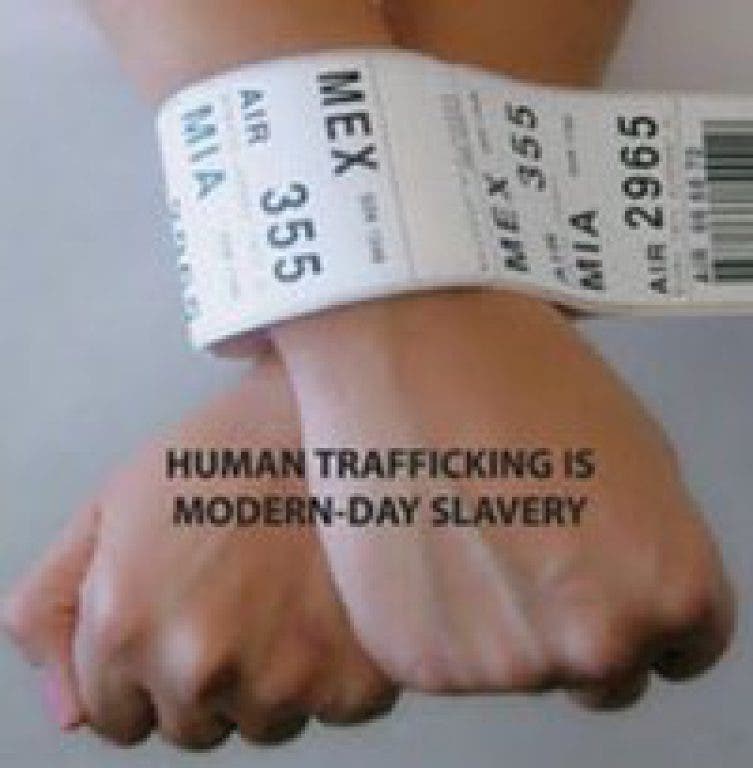
Imagine being forced to work without pay while suffering brutal mental and physical abuse, and you don’t have the freedom to walk away. Slavery was abolished with the 13th amendment in 1865, but it’s still happening every day in America, “The Land of the Free”. In fact, there are an estimated 27 million slaves worldwide; that's more slaves today than at any other time in human history (www.freetheslaves.net). Modern-day slavery is often called “human trafficking,” which is loosely defined by the U.S. State Department as “commercial acts or services induced by force, fraud or coercion.” Two of the most common forms of trafficking are labor trafficking and sex trafficking. Labor trafficking victims in the U.S. are enslaved to work in farm fields, restaurants, hair/nail salons, hotels, or as domestic servants; sex trafficking victims are enslaved as prostitutes, often sold online, and forced to sell their bodies in massage parlors, strip clubs, neighborhood brothels, truck stops, and local hotels.
Those exploited by trafficking in this country may be foreign-born or U.S. citizens. Often domestic sex trafficking victims are young girls, at-risk youth, runaways; they are the most vulnerable of society – our nation’s children. The facts are all at once staggering, mind numbing, and enraging. Human trafficking has become the fastest growing crime in the world and generates $32 billion per year, ranking second only to drug trafficking in annual profit (United Nations Office on Drugs and Crime). Organized crime rings, cartels, gangs, and pimps know that a drug or weapon can only be sold once, but a person can be sold over and over again.
A Local Problem
Find out what's happening in Swampscottfor free with the latest updates from Patch.
The CIA has estimated there are approximately 1 million people enslaved in the United States. No area of the country seems to be immune as human trafficking cases have been reported in all 50 states (www.polarisproject.org). It happens in big cities, small towns, and right here in the Greater Boston area - possibly in your own neighborhood. Just last year, three Cambridge neighborhood brothels were raided in which the women enslaved as prostitutes had been trafficked from Vietnam, Korea, and Malaysia. See details here: Feds take down prostitution ring. More recently, this February a month-long investigation by local and federal law enforcement uncovered a “sophisticated” sex trafficking “business” using 12-14 females, who were living in “deplorable” conditions and forced to sell their bodies up to 15 times a day in East Boston and Chelsea (4 alleged leaders nabbed in sex trafficking ring). If convicted, the alleged traffickers will face much harsher penalties thanks to the state’s newly enacted human trafficking law.
Reason to hope
Find out what's happening in Swampscottfor free with the latest updates from Patch.
It’s horrifying and overwhelming to learn about this, but there is hope. Local law enforcement officials are becoming increasingly aware of this crime and realize that prostitutes are usually not criminals to be arrested but sex trafficking victims in need of help. Another great reason for hope is Amirah, Inc., a local nonprofit dedicated to establishing the Greater Boston area’s very first long-term residential care facility for female trafficking survivors in the local and greater New England areas. Currently, Greater Boston has no long-term residential care facilities for trafficking survivors to receive the extensive services necessary for their healing and restoration. With the opening of the Amirah Safe Home this year, local police and other service providers will now have a place to refer women emerging from trafficking situations instead of releasing them back onto the streets, where they may likely be exploited again. Amirah’s mission is to bring healing, restoration and empowerment to women exploited by human trafficking so they can attain their rightful place as productive members of society. The Amirah Safe Home will address survivors’ mental, physical, emotional, and spiritual needs through trauma therapy/counseling, alternative healing therapies (art, yoga, meditation, self-defense classes), medical care, immigration services, legal services, job-skill and life-skill training.
What can you do?
Would you like to bring hope to women trafficking survivors in the Boston area? Consider how you can get involved with Amirah. For more information, go to www.amirahboston.org. For additional ways you can immediately take a stand against modern-day slavery, check out these very practical, easy steps here:7 things you can do right now to fight modern slavery
Let’s all do our part to finally make slavery history in our communities and the world at large. I'll leave you with these words from two women who certainly made their mark on the world. Be inspired to act...
“Never worry about numbers. Help one person at a time and always start with the person nearest you.” ― Mother Teresa
“Every great dream begins with a dreamer. Always remember, you have within you the strength, the patience, and the passion to reach for the stars to change the world.” – Harriet Tubman